Downloads
 Login
Login
 Register


Tags
Bhutan farmers race against time as water shortages delay paddy transplantation
The delayed monsoon and declining irrigation sources have disrupted the paddy calendar in several parts of the country, leaving farmers uncertain about whether they can complete transplantation on time.
YK Poudel Kuensel
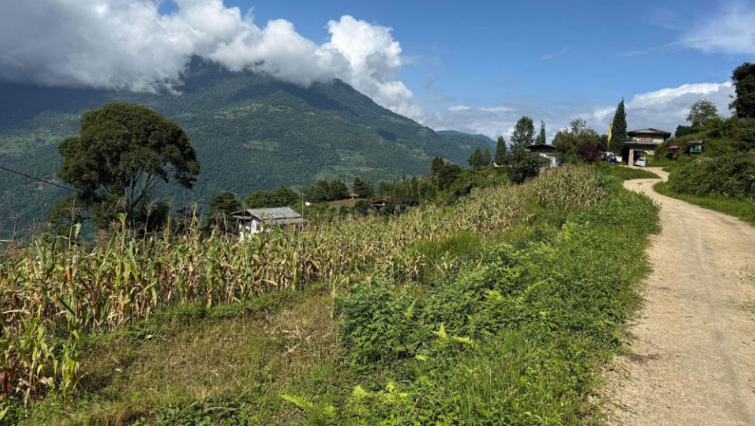
THIMPHU – By mid-July, farmers in Khagochen village under Kana Gewog, Dagana, would normally have completed paddy transplantation.
This year, however, prolonged dry conditions have left many terraces uncultivated, with some fields still planted with maize as farmers wait for rainfall to restore water supplies.
The delayed monsoon and declining irrigation sources have disrupted the paddy calendar in several parts of the country, leaving farmers uncertain about whether they can complete transplantation on time.
The situation has also raised concerns over possible production losses, particularly as Bhutan prepares for the potential impacts of a Super El Niño.
A farmer from Dagana, Tashi, said that weather patterns this summer have been unlike those of previous years, making agricultural planning increasingly difficult.
“Daily weather conditions this summer have not been consistent like in the past. By this time, farmers at the lowest elevations dependent on the water supply would have completed paddy transplantation,” said Tashi.
Even if transplantation is completed, he said, the lack of a continuous water supply could cause seedlings to dry up due to increased temperatures this year.
For many farmers, the problem is not only delayed rainfall but also unreliable irrigation systems that have become insufficient during dry periods.
Another farmer, Tika Ram Dahal, is waiting for a reliable source of water before beginning transplantation.
“Paddy requires sufficient water during transplantation and the early growth stages. Delayed transplantation can shorten the growing period and increase the risk of lower productivity if crops face further weather stress later in the season,” he said.
Similarly, across the country, agricultural production continues to depend heavily on timely rainfall and traditional irrigation systems.
However, changing weather patterns are making farming increasingly uncertain, with delayed rainfall and prolonged dry spells affecting planting schedules and putting crop production at risk.
Tshering Pem from the Department of Agriculture (DoA), Ministry of Agriculture and Livestock (MoAL), said that the department is monitoring the situation and supporting farmers through weather-based agricultural advisories and technical guidance.
“The FAO and WMO identify agrometeorological advisories as one of the most effective adaptation measures against climate-related agricultural risks,” she said.
However, the effectiveness of these advisories remains a concern. Studies, including findings published in the Bhutanese Journal of Agriculture, have shown that while many farmers are aware of weather information, they do not always use it to guide farming decisions.
The DoA said advisories are intended not only to provide weather updates but also to help farmers make timely decisions based on changing conditions.
“Agrometeorological advisories are designed to go beyond information-sharing by helping farmers translate weather signals into timely and practical decisions in the field,” Tshering Pem said.
Agriculture field officers are advising farmers on adjusting sowing and harvesting dates, adopting efficient irrigation practices, pumping water from rivers and streams, conserving soil moisture through mulching, selecting crop varieties that require less water, and managing pest and disease risks.
The MoAL, with technical support from the National Center for Hydrology and Meteorology (NCHM), is working to ensure that climate forecasts are translated into crop-specific recommendations.
The MoAL’s Super El Niño Food Security Impact Assessment and Contingency Plan was developed using NCHM’s seasonal climate forecasts, particularly the National Climate Outlook Forum (NCOF-12) outlook, along with agricultural production and vulnerability data.
The assessment has identified dzongkhags according to different levels of climate risk and prepared targeted interventions. However, ensuring that climate information reaches farmers, especially those in remote communities, remains a major challenge.
The ministry has shared written advisories with dzongkhags and local governments for further dissemination to gewogs and villages. Dzongkhag agriculture officers and extension personnel are also visiting farming communities to provide recommendations based on forecasts and actual field conditions.
However, climate services cannot be measured only by the number of advisories issued. Their effectiveness depends on whether farmers experience fewer crop losses, improved productivity, and stronger resilience against climate shocks.
The DoA said a comprehensive impact evaluation of climate advisories is still ongoing, although monitoring systems have already been established.
Meanwhile, the department is preparing immediate measures to respond to possible agricultural impacts.
The DoA maintains adequate stocks of plant protection chemicals and fertilisers for emergency requirements and is mobilising portable water pumps to support irrigation wherever feasible.
The ministry is also encouraging farmers to shift to alternative crops where water shortages make paddy cultivation difficult.
“Where farmers are willing, the department is arranging seeds for alternative, less water-intensive crops to help sustain production under drier conditions,” Tshering Pem said.
For long-term adaptation, the MoAL is replacing traditional open irrigation channels with climate-proofed piped irrigation systems, expanding solar-powered water pumps, and promoting micro-irrigation technologies such as drip and sprinkler systems. The National Crop and Livestock Insurance Scheme is also being promoted among farmers.
To coordinate national preparedness, a high-level committee on Super El Niño has been established involving the Prime Minister, Minister of Home Affairs, Cabinet Secretary, and secretaries from relevant ministries.
The Department of Local Governance and Disaster Management serves as the secretariat.
A technical task force within the MoAL has also been established, chaired by the Secretary of MoAL and comprising officials from agriculture, livestock, marketing, trade, and food agencies.
The MoAL has instructed dzongkhags to provide regular updates on rainfall, irrigation water availability, crop conditions, and pest and disease situations.
All paddy-growing dzongkhags have also been directed to immediately report critical situations, including prolonged dry spells, flash floods, and severe pest outbreaks.
https://asianews.network/bhutan-farmers-race-against-time-as-water-shortages-delay-paddy-transplantation/Published Date: July 20, 2026



 READ
READ