Downloads
 Login
Login
 Register


Tags
How smarter water management can reduce arsenic in rice
ASU researcher helps identify a practical strategy that could make one of the world’s most important staple foods safer while conserving water.
By Gabriela Harrod
Rice is a staple food for more than half of the world’s population. But unlike other major grains, it naturally absorbs arsenic — a known carcinogen — because of the unique way it is grown.
For years, scientists have searched for ways to reduce arsenic in rice without sacrificing crop yields or creating new food safety concerns. Now, new research co-authored by an Arizona State University professor shows that a relatively simple change in how rice fields are managed could help accomplish both.
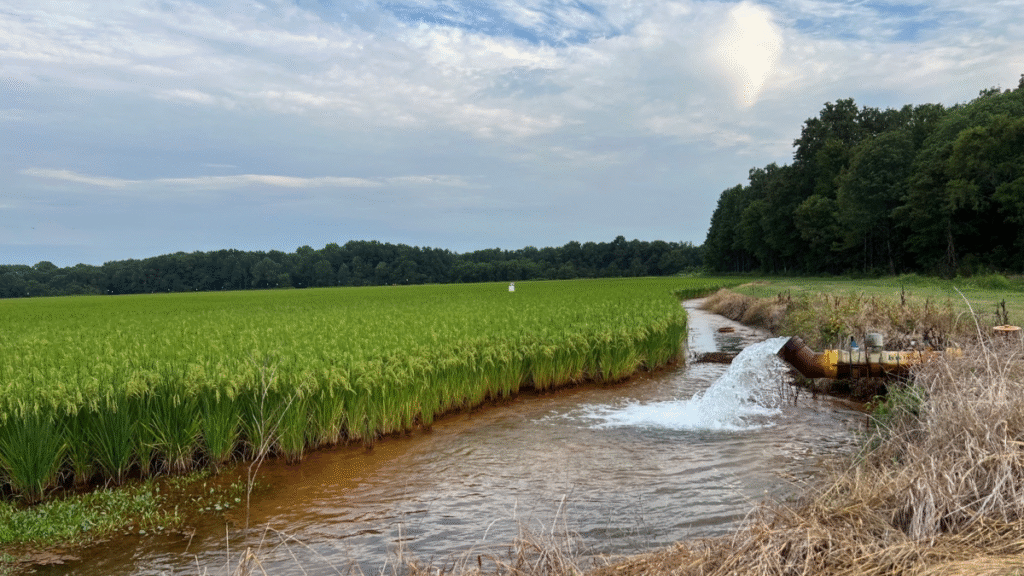
The study found that periodically draining and re-flooding rice fields during the growing season lowered arsenic concentrations in rice grown under commercial farming conditions in Arkansas.
The practice also avoided problematic increases in cadmium, another naturally occurring metal that can become more available as soils dry.
The findings illustrate how understanding the chemistry beneath the soil surface can lead to practical solutions that improve food safety while also conserving water and reducing agriculture’s environmental footprint.
A hidden problem beneath the surface

When people hear about arsenic in rice, many assume it’s the result of industrial contamination. But Angelia Seyfferth, a senior Global Futures scientist and professor in the School of Life Sciences, says that’s one of the biggest misconceptions.
Instead, arsenic occurs naturally in many soils. What makes rice different is how it’s grown.
Unlike crops such as wheat or corn, rice is cultivated in flooded fields. Those waterlogged conditions remove oxygen from the soil, changing the microbial community living underground. As different microorganisms take over, they dissolve iron oxides like rust, which normally bind arsenic to soil particles. Once released, the arsenic becomes much easier for rice plants to absorb.
Flooding alone is enough to make arsenic more available to rice plants, regardless of how much arsenic is naturally present in the soil, Seyfferth said.
Allowing fields to dry periodically reverses that process. As oxygen returns to the soil, iron oxides reform, trapping arsenic once again and making less of it available to the rice plant.
“It’s really the soil chemistry that’s changing,” she said.
That understanding is central to Seyfferth’s research. Her laboratory studies how metals move through soils and into crops, with the goal of identifying farming practices that improve food safety without sacrificing agricultural productivity. By understanding the microscopic interactions among soil, microbes and water, researchers can help shape healthier food systems before food ever reaches consumers.
Testing a practical solution
While previous research suggested that alternate wetting and drying could reduce arsenic in rice, many studies were conducted under controlled research conditions. Seyfferth and her collaborators wanted to know whether the same approach would work on commercial farms, where soil types, weather and farming practices vary from field to field.
Working with support from the Institute for the Advancement of Food and Nutrition Sciences, researchers from ASU, the University of Delaware, the University of Arkansas and the U.S. Department of Agriculture analyzed hundreds of rice samples collected from commercial farms across Arkansas over multiple growing seasons to determine how different irrigation strategies influenced arsenic and cadmium concentrations.
The researchers found that multiple drying periods during the growing season consistently reduced arsenic in harvested rice.
Equally important, the strategy did not create a different food safety problem.
Scientists have long known that arsenic and cadmium often behave in opposite ways. Conditions that reduce arsenic can increase cadmium, another toxic metal that can remain in the body for decades and has been linked to kidney disease and certain cancers.
“One of my biggest concerns is making sure that we’re not solving one problem by creating another problem,” Seyfferth said.
Although cadmium levels increased slightly under the new irrigation strategy, they remained well below international food safety limits, giving researchers confidence that growers can reduce arsenic without introducing another significant risk.
Benefits beyond food safety
For many rice growers, the strategy may be easier to adopt than people realize.
Farmers already drain rice fields before harvest so heavy equipment can enter the fields. Incorporating one or two additional drainage periods during the growing season often requires only modest adjustments to existing management practices, particularly in regions with reliable water supplies.
The practice offers benefits beyond food safety. Periodically drying fields can reduce irrigation demands while also lowering methane emissions from flooded rice production, making the approach attractive from both agricultural and environmental perspectives.
Rather than asking consumers to change what they eat, Seyfferth hopes research like this can improve the way food is produced. Better understanding how soil chemistry influences what crops absorb gives farmers another tool for producing healthier food before it reaches grocery store shelves.
The research demonstrates how understanding fundamental soil chemistry can lead to practical solutions with far-reaching benefits. By adjusting when rice fields are flooded and drained, growers may be able to reduce arsenic in one of the world’s most important food crops while conserving water and lowering greenhouse gas emissions.
“If farmers are doing these practices, it should be safer for people from a metals perspective, but it’s also saving water. It also can decrease the amount of methane emissions that are coming from rice,” Seyfferth said. “It’s kind of like everybody wins.”
https://news.asu.edu/20260713-science-and-technology-how-smarter-water-management-can-reduce-arsenic-ricePublished Date: July 14, 2026


 READ
READ