Downloads
 Login
Login
 Register


Tags
Prices surge in country despite peak Boro season
Rice prices hit 18-month global high.
Yasir Wardad
Global rice prices surged to an 18-month high in June, with prices also rising in Bangladesh’s domestic market despite the ongoing peak Boro harvesting season, raising fresh food inflation concerns.
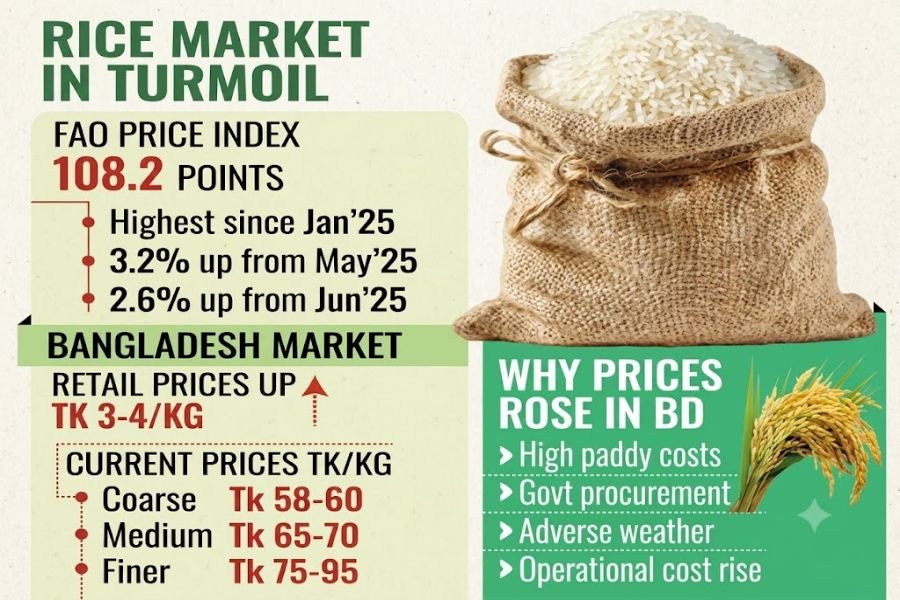
According to the latest Food and Agriculture Organisation (FAO) Rice Price Update, the FAO All Rice Price Index (FARPI) rose 3.2 per cent month-on-month to 108.2 points in June, its highest level since January 2025.
The figure was 2.6 per cent higher than a year earlier.
The increase was driven mainly by Indica rice, the world’s most traded variety whose price index jumped 4.6 per cent from May as export quotations strengthened across all major Asian suppliers.
Among major exporters, Thailand’s 100 per cent parboiled rice was quoted at $506.7 per tonne, Pakistan’s 5 per cent broken rice at $393.5, Vietnam’s 5 per cent broken rice at $412.3, and India’s 5 per cent parboiled rice at $338.6.
FAO attributed the rally to stronger import demand, particularly from the Philippines, tighter supplies in Vietnam, robust exports from Thailand and Pakistan, and concerns over the 2026-27 crop outlook.
Exporters in Pakistan also accelerated shipments before tax and levy concessions expired on June 30.
Contrary to the seasonal trend, rice prices have continued to rise in Bangladesh during the Boro harvest, when supplies usually increase and prices ease.
Retail prices of most rice varieties increased by Tk 3.0-4.0 per kg over the past week, equivalent to a 6.0-9.0 per cent hike, according to market sources.
Coarse Swarna rice was selling at Tk 58-60 per kg, while medium varieties, including BRRI dhan-28 and Paijam, were priced at Tk 65-70 per kg.
Finer rice varieties were selling between Tk 75 and Tk 95 per kg.
The upward trend is also evident in Dinajpur, Naogaon, Nilphamari, and other largest rice-milling districts, where prices have increased despite abundant new supplies.
At the Hili wholesale market in Dinajpur, the price of a 50kg sack of Miniket rice rose from Tk 3,100 to Tk 3,300 within a month.
The price of BRRI dhan-28 increased from Tk 2,700 to Tk 2,850 per sack, while that of Swarna climbed from Tk 2,250 to Tk 2,500.
Chinigura rice prices rose from Tk 7,000 to Tk 8,000 per sack.
“We usually witness lower rice prices during this period. This year, however, prices have increased by Tk 150-300 per sack mainly because paddy prices and production costs have gone up,” says trader Alamgir Hossain.
Rice mill owner Golam Rasul says paddy prices have remained high since harvesting began and increased further after the government announced its procurement programme.
He says imports have virtually stopped during the Boro procurement season, reducing market supply.
Heavy rainfall in several districts, particularly Rangpur and Rajshahi, has also disrupted rice drying and milling operations, he adds.
Vice-President of the Bangladesh Auto, Major and Husking Mill Owners’ Association Shahidur Rahman Patwari Mohan says frequent power outages have increased milling costs by nearly 15 per cent.
“Electricity tariffs were also raised recently, which would further increase production costs,” he says, adding that transport expenses have gone up, leaving millers with little option but to increase rice prices.
He, however, notes that higher prices have reduced sales.
Nilphamari-based rice trader Anwar Hossain Babul says his daily sales have fallen sharply to 30-40 sacks from 90-100 previously.
Agricultural economist Professor Rashidul Hasan says higher paddy, fuel, and electricity prices have pushed up milling costs, while rising global prices may exert additional pressure on the domestic market in the coming months.
Consumers Association of Bangladesh (CAB) Secretary Humayun Kabir Bhuiyan says ordinary consumers are bearing the brunt of the latest price hike.
“Income has not increased, but the prices of rice and other essentials continue to rise. If rice becomes unaffordable, it will create serious hardship for low-income families,” he says.
He warns that the market could become even more volatile if paddy supplies tighten further and production costs remain elevated, urging the government to ease imports if necessary and strengthen market monitoring.
According to the Department of Agricultural Extension (DAE), Bangladesh has targeted around 43 million tonnes of rice production from the Aus, Aman, and Boro seasons in FY26.
The Directorate General of Food currently holds around 1.9 million tonnes of rice in public stocks and has already procured 1.1 million tonnes from domestic sources during the ongoing Boro procurement season (April-August).
https://thefinancialexpress.com.bd/trade/no-plans-to-privatise-teletalkPublished Date: July 8, 2026


 READ
READ