Downloads
 Login
Login
 Register

Tags
Sino-Pakistan project yields satisfactory results
By LIU KUN in Wuhan and GUO YANQI
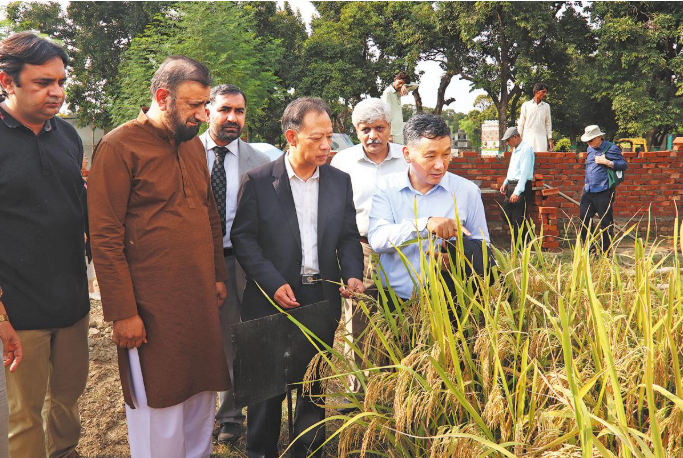
A hybrid rice variety, jointly developed by China’s Wuhan University and the University of the Punjab in Pakistan, is moving toward wider commercial use in Pakistan.
According to the University of Punjab, the variety registered under the name PU-786 is the first Honglian-Type hybrid rice developed in Pakistan. It has been tested across four provinces in the country before a commercialization agreement was signed in March, moving the project from the laboratory toward the market. Muhammad Ashfaq, a professor at the Punjab University and one of the project’s key researchers, said that before PU-786, Pakistan’s rice sector faced low yields, vulnerability to pests and climate stress, and limited export competitiveness. Farmers also faced unstable harvests and high input costs, limiting the sector’s broader potential.
“PU-786 is remarkable because it triples yield potential — up to 5.6 metric tons per acre (13.83 tons per hectare) — while maintaining grain quality suitable for both domestic consumption and export,” Ashfaq said. “The difference is not just in numbers. You can see healthier, fuller panicles and more consistent grain quality.”
The development partnership dates back to 2018, when the University of the Punjab began working with the Wuhan University team led by Zhu Renshan, a professor at the College of Life Sciences. In 2021, the Luotian base of their joint research center was set up in Huanggang, Hubei, giving the cooperation a more formal institutional footing. Since then, the project has moved through breeding, regional trials, registration and commercialization.
The rice at the center of the cooperation comes from a longer Chinese research tradition. Zhu said the Honglian-Type hybrid, developed over decades at Wuhan University, is known for its broad adaptability, strong resistance, stable seed production and efficient use of nitrogen fertilizer, as well as its ability to combine high yields with good grain quality. It has been widely planted in China’s Yangtze River Basin and has also flourished in Southeast Asia, South Asia and Africa, he added.
http://global.chinadaily.com.cn/a/202604/16/WS69e03aaaa310d6866eb43b86_1.htmlPublished Date: April 16, 2026


 READ
READ