Downloads
 Login
Login
 Register


Tags
Rice-wheat monoculture impacting Punjab’s soil health, says study
Union Minister of State for Agriculture and Farmers’ Welfare Bhagirath Choudhary tells the Lok Sabha that it has affected soil physical health without appropriate management practices.
By BL Mangaluru Bureau
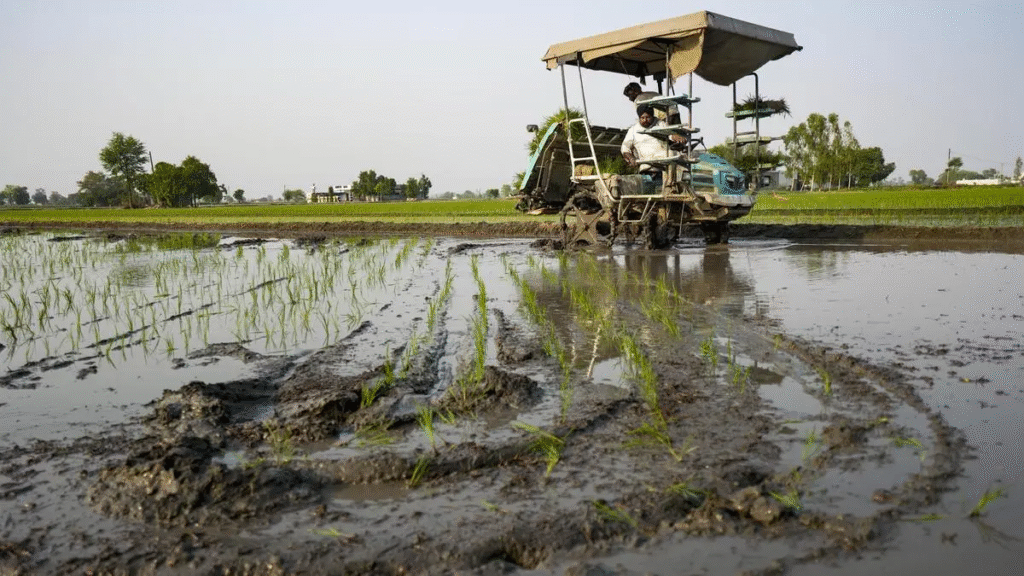
A study conducted by Punjab Agricultural University has revealed that continuous rice-wheat monoculture has often been associated with concerns regarding soil degradation in Punjab.
In a written reply in the Lok Sabha on Tuesday, Bhagirath Choudhary, Union Minister of State for Agriculture and Farmers’ Welfare, attributed soil degradation to repeated puddling, intensive tillage, the lack of legumes or green manuring, and mono-cropping.
Puddling during rice transplanting disrupt soil aggregation, reduce porosity, and increase sub-surface compaction, which adversely affect soil physical health without appropriate management practices. However, these effects are largely reversible through scientifically recommended package of practices such as inclusion of legumes, crop rotation, balanced fertilizer application, integrated nutrient management, addition of organic manure and residue incorporation, he said.
Rice area in Punjab has shown an increase from 29.69 lakh hectares in 2021-22 to 32.68 lakh hectares in 2025-26. Area under wheat has remained largely stable from 35.25 lakh hectares to 34.58 lakh hectares during the period.
Over the same period, the area under other field crops such as maize, pulses and oilseeds relative to the rice-wheat system declined from 8.6 per cent to 6.2 per cent, whereas the share of horticultural crops (fruits and vegetables) increased gradually from 6.3 per cent to 7.2 per cent, indicating a marginal shift towards horticultural diversification while the rice-wheat system continues to predominate, he said.
Water-intensive crops
To a separate question on cultivation of water-intensive crops in areas facing recurring water scarcity and declining aquifer levels, Choudhary said rice, sugarcane, cotton and jute are among the major water-intensive crops grown in India and together occupy about 62.7 million hectares, representing nearly one-third of the country’s gross cropped area.
Recognising the need to align cropping patterns with local water availability, ICAR assessed the cultivation of major water-intensive crops in relation to rainfall and water availability. The assessment identified that about 2.89 million hectares of rice are cultivated in 68 districts receiving less than 650 mm annual rainfall, accounting for about 5.67 per cent of the total rice area (51 million hectares).
About 0.721 million hectares of sugarcane are cultivated in 91 districts receiving less than 700 mm annual rainfall, representing about 10.76 per cent of the total sugarcane cultivated area (6.7 million hectares).
These assessments provide the scientific basis for promoting location-specific crop diversification, particularly in water-scarce regions experiencing recurring water stress and declining groundwater levels, while balancing water security, farmer livelihoods and agricultural productivity, he said.
FPOs scheme
In a written reply in Lok Sabha on Tuesday, Ramnath Thakur, Union Minister of State for Agriculture and Farmers’ Welfare, said the Government is implementing the Central sector scheme for the formation and promotion of 10,000 FPOs.
Stating that 10,000 FPOs have been formed under the scheme since 2020-21, he said FPOs undertake a wide range of business activities, including agri-input supply, aggregation and trading of agricultural produce, value addition and processing, seed production, digital commerce through e-market places, custom hiring services and export promotion.
“From the audited financial statements 2024-25 of the scheme, 6964 FPOs had a turnover of up to ₹50 lakh, 862 FPOs had a turnover of ₹50 lakh to ₹1 crore, and 1135 FPOs had a turnover of over ₹1 crore,” he said.
More than 65 lakh shareholders (predominantly small and marginal farmers) have been collectivised under the scheme to leverage economies of scale. As on date, 6928 FPOs have seed licenses, 4987 have pesticide licenses, and 6650 have fertilizer licenses. He said 5765 FPOs have their own processing units and 3083 FPOs have availed credit guarantee.
GI-tagged coffee
To a query on the initiatives taken by the Government and the Coffee Board to promote GI-tagged coffee and support growers cultivating such varieties, Jitin Prasada, Union Minister of State for Commerce and Industry, said Coffee Board has undertaken several initiatives to promote GI-tagged coffees and support coffee growers for cultivating GI-registered coffees.
During 2025-26, the average export unit values of GI-registered Arabica and Robusta coffees increased by 34.36 per cent and 29.73 per cent, respectively, compared to 2024-25, he said.
https://www.thehindubusinessline.com/economy/agri-business/rice-wheat-monoculture-impacting-punjabs-soil-health-says-study/article71305264.ecePublished Date: August 5, 2026


 READ
READ