Downloads
 Login
Login
 Register

Tags
How to grow more rice without draining the land
SB Naseem
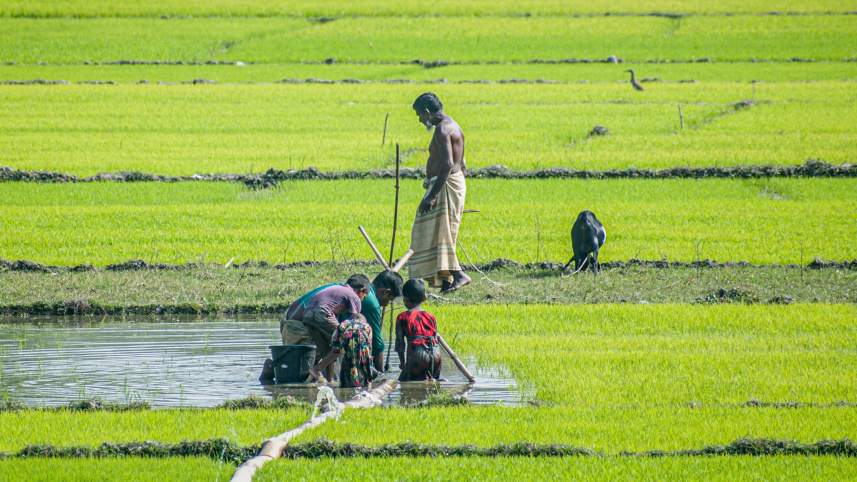
Over the past 25 years, Bangladesh has added nearly five crore people to its population, intensifying pressure on the country’s staple: rice. While production has grown, its pace has lagged behind population growth, raising fresh questions about long-term food security and sustainability.
Bangladesh’s population rose from about 12.9 crore in the year 2000 to roughly 17.6 crore in 2025, an increase of more than one-third. Over the same period, national rice output increased from around 3.6 crore tonnes to 3.7-3.9 crore tonnes, indicating only modest net growth. Experts say yield growth has slowed in the last decade as land constraints, climate stress, and resource limitations intensified. Total rice demand continues to rise due to population growth, meaning even small production fluctuations can influence prices and imports.
This long-term pressure is now amplified by the ongoing energy crisis. With the critical Boro paddy season disrupted by acute diesel shortages, increased fuel costs, and power outages, traditional, resource-heavy farming is proving dangerously vulnerable. Thousands of irrigation pumps have lain idle and state-run fertiliser factories have faced forced shutdowns. This immediate crisis underscores that shifting to sustainable agriculture is no longer just a future environmental goal, but an urgent necessity. As the country looks for ways to produce more rice with fewer resources, adopting modern, resilient practices can offer a vital lifeline.
The central challenge facing Bangladesh is compounded by the fact that the relationship between rice production and the environment is a dangerous two-way street. The drive for higher yields through traditional methods is actively harming the ecosystem in several ways.
Methane emissions: Traditional rice cultivation requires fields to remain flooded for long periods. Under these waterlogged conditions, soil microorganisms decompose organic matter without oxygen, producing methane (CH₄)—a greenhouse gas far more potent than carbon dioxide in trapping heat. Globally, rice cultivation contributes roughly 10-12 percent of agricultural greenhouse gas emissions, and Bangladesh is a significant contributor.
Groundwater depletion: Dry-season Boro rice, which accounts for more than half of Bangladesh’s total output, depends heavily on groundwater. Millions of tube wells pump water from underground aquifers, causing water levels to decline precipitously in regions like northwestern Bangladesh. Pumping this water requires immense energy, contributing to carbon dioxide emissions and leaving farmers vulnerable to fuel shortages.
Fertiliser pollution and nitrous oxide: Inefficient use of chemical fertilisers, particularly urea, releases nitrous oxide (N₂O) into the atmosphere, another powerful greenhouse gas. Over-application also leads to nutrient runoff into rivers and wetlands, destroying water quality and aquatic ecosystems.
Ecosystem loss: Expanding agricultural footprints can lead to the loss of biodiversity and the reduction of vital wetlands, which play a crucial role in natural carbon storage, flood control, and supporting rural fisheries.
Simultaneously, climate change is increasingly threatening the very rice farming that contributes to it. Rising temperatures, erratic rainfall, frequent floods, droughts, and salinity intrusion in coastal regions are already affecting crop yields. Studies suggest that temperature increases during the growing season can significantly reduce yields, particularly for Boro rice, while sea-level rise threatens soil fertility through seawater intrusion.
How can Bangladesh produce more rice to feed a growing population without damaging the environment on which agriculture depends? The answer lies in adopting a strategy of sustainable intensification—increasing productivity from existing farmland while actively reducing environmental stress. Agricultural specialists point to several key strategies.
Climate-tolerant varieties: Deploying rice strains resistant to floods, salinity, and drought is one of the most effective tools. These varieties help stabilise yields in vulnerable regions such as coastal belts and flood-prone haor areas, reducing the risk of crop loss.
Smarter irrigation: Techniques like alternate wetting and drying (AWD), where fields are not kept continuously submerged, can cut water use significantly while drastically lowering methane emissions. Pairing this with solar-powered pumps and better field levelling helps farmers reduce energy costs and bypass grid failures.
Precision nutrient management: Modern techniques such as site-specific nutrient management, leaf colour charts for nitrogen application, and integrated soil fertility management can significantly improve fertiliser efficiency. Applying nutrients precisely when and where crops need them reduces chemical waste and nitrous oxide emissions.
Integrated Pest Management (IPM): Using biological controls and monitoring pests before spraying helps farmers reduce toxic pesticide use without sacrificing productivity, protecting biodiversity and human health.
Reducing post-harvest losses: A massive portion of rice is lost during harvesting, drying, storage, and milling due to outdated practices. Upgrading to modern milling facilities and hermetic storage technologies could save millions of tonnes annually, effectively increasing food availability without growing a single additional crop.
Mechanisation: The use of rice transplanters, combine harvesters, and other modern equipment can increase efficiency, offset rural labour shortages, and support resource-saving practices like direct-seeded rice.
Opportunistic expansion: While the primary focus must remain on intensifying yields on existing farmland, Bangladesh can also strategically explore new agricultural frontiers. Newly emerging river char lands and parts of the coastal region offer opportunities for expanding cultivation, provided climate-resilient varieties and community-based irrigation are used.
Bangladesh’s success in increasing rice production over the past few decades has been vital for national food security, serving as a global example of agricultural progress. However, the environmental and energy costs of intensive, traditional cultivation can no longer be ignored.
The path forward for our rice sector is not about producing at any cost, but about producing smarter. By combining scientific innovation, efficient resource management, and strong agricultural policies, Bangladesh can achieve sustainable growth—increasing yields even under a constrained environment while safeguarding the natural resources its people depend on.
Dr SB Naseem is former head of Rice Farming Systems Division under Bangladesh Rice Research Institute in Gazipur. He can be reached at sbnaseem@hotmail.com.
Views expressed in this article are the author’s own.
https://www.thedailystar.net/opinion/views/news/how-grow-more-rice-without-draining-the-land-4158226Published Date: April 23, 2026


 READ
READ