Downloads
 Login
Login
 Register


Tags
Forecast-based rice farming can transform agriculture
Niaz Md Farhat Rahman
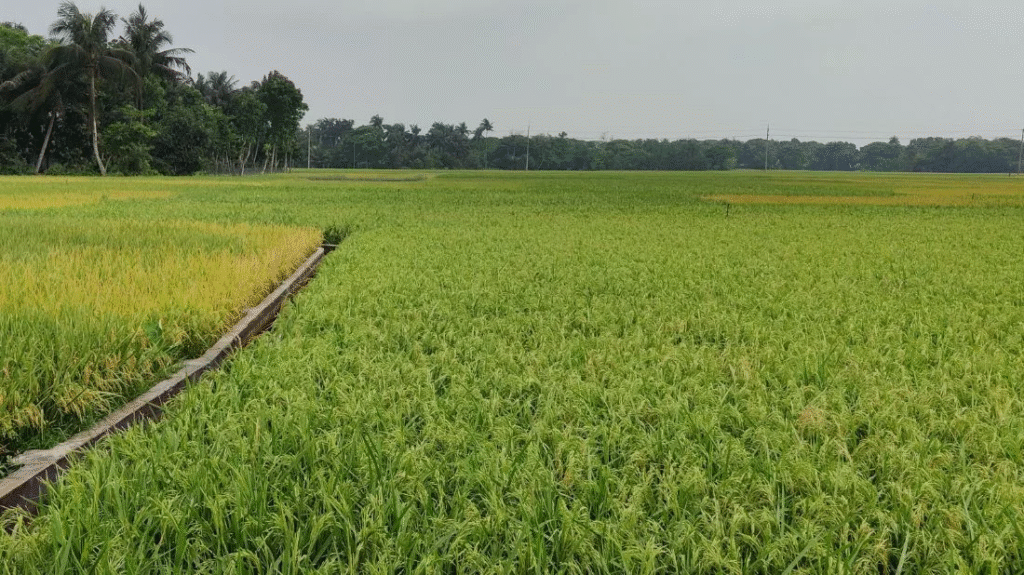
Every season, Bangladesh’s farmers live at the mercy of the weather. A sudden flash flood often triggered by upstream rainfall can submerge nearly mature Boro rice within a matter of hours, while an untimely drought can dry entire fields.
Year after year, they cultivate in uncertainty — planting their hopes on nature’s whims. Yet imagine if a farmer knew in advance that heavy rain or flash flood was coming next week, the monsoon would be delayed, or a storm would strike within 48 hours. They could take precautions, save their crops, protect their livestock, and secure the fish in their ponds.
It is time to use the power of modern science to safeguard farmers from climate-induced losses. Reliable weather forecasts, delivered at the right time, can transform uncertainty into opportunity and make Bangladesh’s agriculture more productive, resilient, and profitable.
Agriculture remains the backbone of Bangladesh’s economy, contributing about 13.47% to GDP, while the crop subsector adds another 6.77%. Together, they account for more than one-fifth of national economic output.
Rice dominates this landscape, supplying nearly 80% of the food consumed in the country. Yet despite its overwhelming importance, most farmers still depend on traditional methods and experience-based cultivation. In an era of increasingly irregular climate behaviour, these traditional instincts are no longer enough.
Globally, 2024 was the warmest year on record with temperatures about 1.47°C above pre-industrial levels. Scientists warn that the world could cross the critical 1.5°C limit by 2030, pushing the planet into a dangerous state.
For Bangladesh, the situation is even more alarming. In 2024, the country experienced a record 35-day heatwave, the longest in both duration and spatial coverage in history. Over the past two decades, Bangladesh has faced 185 extreme climate events, clearly indicating a rapid increase in climate risks.
This growing trend is evident from real-world impacts on agriculture.
In 2007, Cyclone Sidr severely damaged Aman crops in coastal districts and caused saline water intrusion, reducing soil fertility.
In 2017, a sudden flash flood in the haor areas submerged about 1.2 lakh hectares of nearly mature Boro rice just before harvest, leading to devastating losses.
Similarly, in the drought-prone Rajshahi region, the 2020 drought delayed sowing of Aus rice and maize and reduced yields by around 30%.
These examples highlight how climate extremes like floods, cyclones, droughts, and cold waves pose serious threats to agricultural production. The Food and Agriculture Organization (FAO) estimates that 25-30% of global agricultural production is lost each year due to weather-related disasters.
In South Asia, this translates into rising farmer indebtedness, higher food prices, and deepening rural poverty. In this reality, the urgent need for timely weather forecasts and early warning systems to protect farmers’ livelihoods.
Weather-based agricultural advisory services can become a critical support system for farmers. Countries like India have already demonstrated success, millions of farmers there now receive advisories through SMS, voice calls, radio, and television, and studies show that those who follow these advisories earn 10-25% higher income.
In Bangladesh, the Agrometeorology, Crop Modeling and Climate Change Research Laboratory (Agromet Lab) of the Bangladesh Rice Research Institute (BRRI) has been conducting intensive research on such forecast-based advisory technologies since 2016-17.
The findings were published in 2023 in the internationally acclaimed Journal of the Science of Food and Agriculture under the title “Sustaining Agricultural Productivity through Weather-Resilient Agricultural Practices.”
The results showed that climate change is increasing production costs and losses, but weather forecast-based advisory services significantly reduce risks and strengthen farmers’ incomes.
Farmers using such services achieved around 7% higher yield and 13% lower production costs compared to traditional methods. Labour requirements decreased by 120 hours per hectare, fertilizer use fell by 16%, irrigation by 23%, herbicides by 52%, insecticides by 40%, and fungicides by 26%. This reduction in chemicals not only saved money but also reduced environmental pressure and improved soil and water health.
The economic impact is equally compelling. Farmers reported a 31% increase in net income per bigha after adopting forecast-based advisories. On average, they earned an additional $229 per hectare equivalent to nearly Tk28,000 without investing in any new infrastructure.
The benefit-cost ratio improved from 1.75 under traditional cultivation to 2.17 under the advisory-based system. Simply put, better information led to better decisions, and better decisions brought higher incomes.
This technology is already being piloted across 24 districts under six climate-sensitive hotspots identified in the Bangladesh Delta Plan 2100. When heavy rainfall, drought, or excessive precipitation is forecast, farmers receive advance warnings so they can adjust irrigation, fertilizer application, and pest control accordingly.
With proper institutional collaboration, this system can reshape agricultural decision-making nationwide. The Bangladesh Meteorological Department, Water Development Board, BRRI, BARI, agricultural universities, and the Department of Agricultural Extension all have roles to play in strengthening and expanding this service.
Yet challenges remain: The absence of hyper-local forecasts, delays in information flow, lack of user-friendly formats, trust gaps, and weak institutional coordination. These limit how much farmers can benefit.
Bangladesh now needs targeted action. Automated weather stations at the union or upazila level can generate localized data. Simple voice calls and community-based media can deliver forecasts in easy, understandable language.
Digital platforms-web, mobile apps, and social media can unify advisory services and expand reach. Extension officers require specialized training, while media involvement and university-led research must be strengthened.
To make agriculture sustainable, profitable, and climate-resilient, weather forecasting must be treated as core infrastructure, an essential part of agricultural planning rather than a supplementary service.
Reliable forecasts are no longer a luxury; they are a prerequisite for food security. Policy-makers should incorporate forecast-based advisory services into national agricultural strategies, and research institutions and private technology partners should collaborate to improve accuracy and outreach.
If every farmer, no matter how remote, can access reliable weather forecasts, then rain will come as blessings rather than threats, and dry spells will be managed rather than feared.
Niaz Md.Farhat Rahman, PhD, is Principal Scientific Officer (Weather & Climate Change Researcher), Agricultural Statistics Division, Bangladesh Rice Research Institute (BRRI), Gazipur, Bangladesh. Email: niaz.sust@gmail.com.
https://www.dhakatribune.com/opinion/op-ed/408752/forecast-based-rice-farming-can-transformPublished Date: April 27, 2026


 READ
READ