Downloads
 Login
 Register

Tags
Building sustainable competitiveness for rice – Part 1: Transformation from the fields
The project for the sustainable development of 1 million hectares of high-quality, low-emission rice cultivation linked to green growth in the Mekong Delta by 2030 (the 1 million hectare high-quality rice project) has recorded positive changes after 3 years of implementation.
However, despite exemplary models, widespread green and low-emission production still faces numerous bottlenecks related to infrastructure, supply chain linkages, capital, and markets.
However, despite exemplary models, widespread green and low-emission production still faces numerous bottlenecks related to infrastructure, supply chain linkages, capital, and markets.
Lesson 1: Transformation from the fields
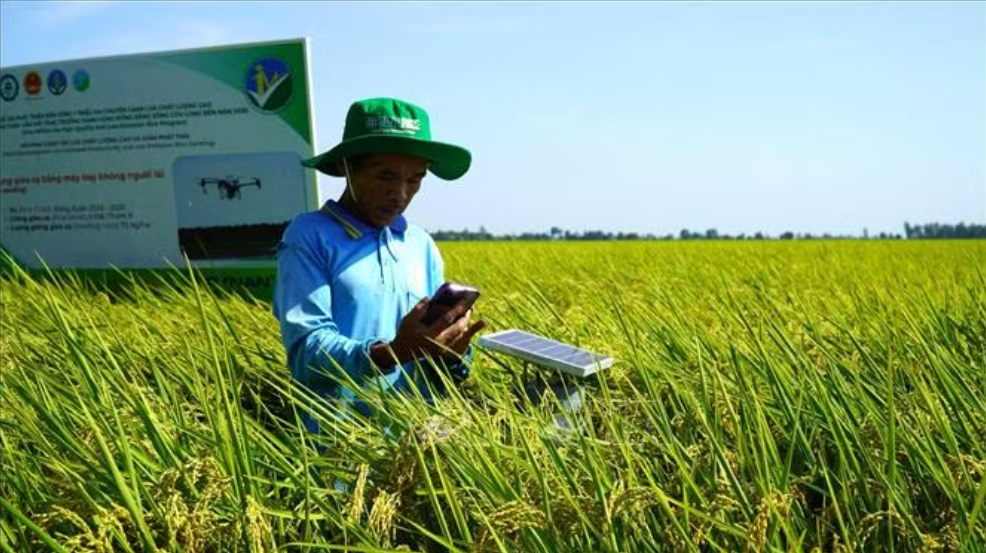
Farmers control water pumps via smartphone app. (Illustrative photo: Van Si/TTXVN)
After three years of implementing the project to sustainably develop 1 million hectares of high-quality, low-emission rice cultivation linked to green growth in the Mekong Delta, rice farming methods are gradually shifting from production based on increasing inputs to improving quality, reducing costs, and protecting the environment. However, to maintain effectiveness and expand these models, it is necessary to comprehensively address limitations in infrastructure, technology, and local production organization conditions.
Reduce inputs, increase production efficiency.
According to the Ministry of Agriculture and Environment , as of September 2026, the area applying all or part of the sustainable production process within the framework of the 1 million hectare high-quality rice project reached 420,813 hectares. Of this, the area applying all criteria of the sustainable process reached 67,648 hectares; the number of households registered to participate exceeded 175,000.
According to Ms. Nguyen Thi Thu Huong, Deputy Director of the Department of Crop Production and Plant Protection, Ministry of Agriculture and Environment, initial results show that applying high-quality, low-emission farming practices not only serves environmental goals but also contributes to reducing costs and improving economic efficiency for farmers.
Specifically, the amount of seeds sown can be reduced by 30-50%; the amount of chemical fertilizers by 20-30%; and the number of pesticide applications by 2-3 times per crop. Irrigation water usage is reduced by 20-40%, while yield increases by 5-12%. Profits increase by approximately 1.5-9.3 million VND/ha/crop. Initial emission reductions measured in the models are estimated at 3-4 tons of CO₂ equivalent/ha/crop, depending on ecological conditions, season, and the level of application of integrated technical procedures.
According to Mr. Hoang Van Hong, Deputy Director of the National Agricultural Extension Center, in the models implemented in coordination with the agricultural extension system, the amount of seeds sown has decreased from the common level of 100-150 kg/ha to about 70 kg/ha; the amount of urea fertilizer has decreased by 20-40 kg/ha. Thanks to the application of the new process, farmers’ income has increased by about 3-5 million VND/ha compared to conventional farming methods.
The above results show that reducing input materials does not necessarily mean a decrease in productivity, but may lead to improved production efficiency. However, the level of efficiency depends on whether farmers fully implement the process and the specific farming conditions in each locality.
The scale of emission-reduction farming models is also continuously expanding. In 2024, the project implemented 7 models with a total area of 302 hectares; in 2025, this increased to 39 models, covering an area of 1,950 hectares. By the 2025-2026 Winter-Spring crop season, the number of models reached over 200, covering an area of approximately 10,300 hectares. In the 2026 Summer-Autumn crop season, there will be more than 376 models with a total area of 67,648 hectares that fully meet the sustainability criteria.
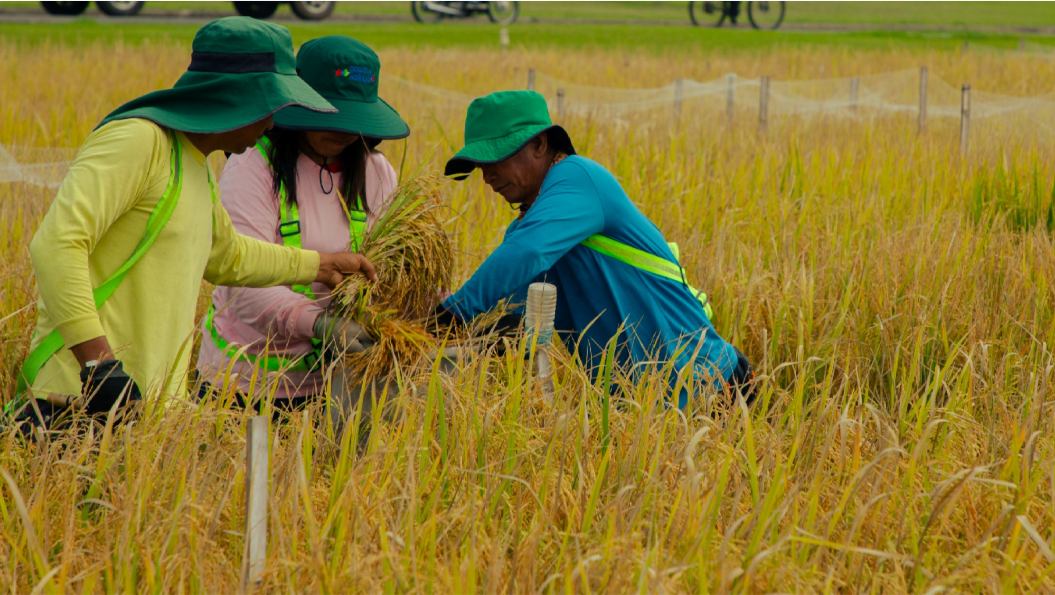
Along with changes in farming techniques, mechanization in land preparation and harvesting during the winter-spring crop season has reached nearly 100% in the reported areas. In some places, 50-70% of the straw is collected after harvest, creating conditions for utilizing by-products and gradually developing circular production activities. Having been involved in rice farming for many years in the buffer zone of Tram Chim National Park, Dong Thap province, Mr. Ho Phuoc Minh was used to burning straw after harvest, spraying pesticides regularly, and increasing fertilizer use to ensure yield. However, since being guided by agricultural extension officers on ecological farming, reducing chemical pesticides, and using biological products, he has gradually changed his production practices.
“Initially, like many other farmers, I was hesitant to change traditional farming methods, but after receiving training, we changed our perspective. From viewing straw as waste, we realized it has become a valuable byproduct when properly collected and processed. More importantly, we started thinking about the long-term benefits for our health and the surrounding environment. Not only does it increase income from our fields, but the quality of the soil and water resources is also protected, meaning we farmers are the first to benefit,” shared Mr. Ho Phuoc Minh.
The changes in these models also show that sustainable production is not just about changing a few technical steps, but is also linked to adjusting farming practices, choosing production models that suit the ecological conditions and organizational capacity of each community.
At Nam Quy Cooperative in Dong Thai commune, An Giang province, 97 members are organizing production on a total area of approximately 157 hectares using a rice-shrimp-crab model, aiming to adapt to natural conditions and improve economic efficiency. Mr. Pham Chi Thuong, Director of Nam Quy Cooperative, said that previously, people mainly cultivated two rice crops per year. However, changing weather patterns, increased input costs, and the excessive use of chemical fertilizers and pesticides have affected the soil, water resources, and the health of producers. Since 2020, members have switched to a combination of one shrimp and crab crop and one rice crop, selecting high-value varieties such as ST24, ST25, and ST purple, and gradually moving towards organic production.
The model has initially yielded positive economic results, the field environment has gradually improved, and birds have reappeared. People are also utilizing naturally occurring tilapia to make fish cakes and other fish to produce fish sauce, contributing to increased production value. According to Mr. Pham Chi Thuong, changing farming practices requires a process of practice, monitoring, and periodic evaluation of effectiveness. When people see concrete benefits from reduced costs, soil protection, and water conservation, the likelihood of maintaining the new production method will be higher.
Infrastructure and connectivity remain bottlenecks.
Despite the rapid increase in cultivated area, scaling up low-emission rice farming models still faces many difficulties. One major obstacle is the lack of synchronized infrastructure, which directly affects the ability to apply technical procedures on a large scale. According to Mr. Hoang Van Hong, the alternating wet and dry irrigation method requires rice fields to have a proactive water supply and drainage system. If the irrigation system does not meet the requirements, farmers will find it difficult to fully implement the process, even after training and technical guidance. Therefore, expanding the cultivated area cannot rely solely on the initiative of individual households or training programs. Along with a capable agricultural extension system to support farmers, it is necessary to gradually improve irrigation, internal field transportation, mechanization, and services supporting production. Areas that do not have a reliable water source need a suitable transition roadmap, avoiding the application of the same machinery and procedures to all fields.
Besides infrastructure, the production organization capacity of some cooperatives is limited; linkages with businesses are not stable. This affects the ability to maintain a synchronized production process, especially in the supply of materials, technical guidance, and harvesting organization. The utilization of straw has also not been fully realized due to difficulties in collection, processing, and consumption, and the market for straw products is unstable. Without a suitable purchasing unit and appropriate utilization plan, the collection of by-products is difficult to maintain regularly.
Mr. Pham Chi Thuong stated that rice-shrimp farming depends not only on the variety but also on the water source. However, farmers and cooperatives cannot independently control the quality of both the input and output water sources. The irrigation system only meets the basic water supply needs but lacks a wastewater treatment system for the combined farming and aquaculture process. Furthermore, cooperatives still face difficulties due to inconsistent seed quality. In particular, shrimp and crab are not sold through guaranteed buyers by businesses, mainly through traders, leading to unstable prices.
According to Mr. Pham Chi Thuong, the cooperative hopes to have businesses as long-term partners in supplying seeds, materials, technical guidance, brand building, and product consumption. Because green and clean production requires more effort and cost, if the products lack a market or the selling price is not commensurate, it will be difficult for farmers to sustain the process in the long term. These limitations show that transforming farming methods cannot rely solely on changes in farmers’ awareness and techniques. Production conditions, organizational capacity, and support capabilities at the grassroots level need to be improved so that farmers can implement the new process stably.
The reality also necessitates zoning production areas that are suitable to irrigation conditions, ecological factors, and farming practices. Once input factors are secured, proven effective models can be replicated, laying the foundation for reorganizing rice production towards high quality and low emissions. Another issue is access to credit and green financing. Farmers and cooperatives need resources to invest, reorganize production, and meet the requirements of the new process. Meanwhile, the benefits from reduced emissions are not always directly translated into income for producers.
Dr. Tran Dai Nghia, National Coordinator and Climate Finance expert at the Food and Agriculture Organization of the United Nations (FAO) in Vietnam, stated: The transition to low-emission rice production, adapting to climate change, is creating a huge investment need, while existing financial resources are insufficient. Not only is there a lack of capital, but the agricultural sector in Vietnam also faces difficulties in accessing private financing due to the dispersed nature of production, high risks, and limited ability to generate stable cash flow.
https://www.vietnam.vn/en/xay-dung-nang-luc-canh-tranh-ben-vung-cho-lua-gao-bai-1-chuyen-bien-tu-dong-ruongPublished Date: November 12, 2026


 READ