Downloads
 Login
 Register


Tags
‘Can’t afford another loss’: Pirojpur farmers plan to cut Boro acreage
Low returns and rising costs may leave large areas of farmland uncultivated in the district’s major rice-growing areas
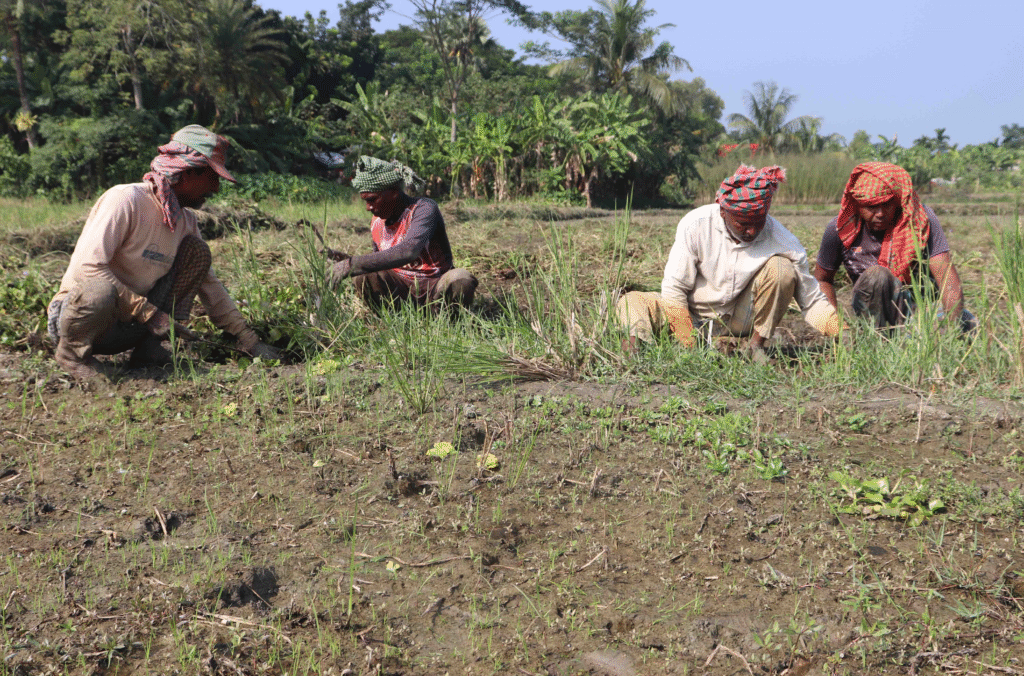
“Even after selling the paddy, I could not recover my production costs last year because of the low market price,” said Abinas Mondal, a farmer in Dakkhin Jhanjhania village of Pirojpur’s Nazirpur upazila.
Having suffered losses last year, Abinas says he cannot afford to take the same risk again as the Boro season approaches.
He spent around Tk 36,000, including harvesting costs, to cultivate one bigha of land last year and harvested around 40 maunds of paddy. But the low selling price meant he failed to recover his investment.
Abinas is not alone. Across the vast wetlands of Pirojpur, farmers are reconsidering how much land they will bring under Boro cultivation this season, as low paddy prices and rising production costs make farming increasingly unprofitable.
Pradip Mondal of the same village has decided to reduce his Boro acreage from eight bighas last year to five this season. Each locally measured bigha is equivalent to 52 decimals.
“Last year, I could not get more than Tk 800 for a maund (40kg) of paddy, which caused losses. Rising fuel and pesticide prices will increase production costs further this year,” he said, adding that he was also worried about getting fertiliser on time.
Khokan Halder, another farmer from the village, said many farmers were still unable to sell their previous harvest at expected prices, as wholesale buyers showed little interest.
Farmers said they could previously sell a maund of paddy for more than Tk 1,100. They now need Tk 1,200 to Tk 1,300 per maund to make a profit. But last year, they had to sell at a maximum of Tk 850.
They also questioned why buyers were reluctant to purchase paddy while rice prices remained high in the market.
The rising cost of harvesting has added to their woes. Farmers have to pay around Tk 1,200 to hire a labourer at the time of harvesting.
Abdus Salam, who cultivated 4.5 bighas last year, plans to reduce his Boro acreage by 1.5 bighas this season.
“I could not harvest all my paddy due to a shortage of labourers. I even left some in the field because harvesting it would cost more than the return,” he said.
The situation is particularly worrying in Nazirpur and other wetland areas, where Boro is the only annual crop and accounts for the largest share of the district’s paddy production.
Farmers have already started preparing seedbeds, while transplantation is expected to begin within the next month.
Esratunnesa Easha, agriculture officer of Nazirpur upazila, said farmers had not received the prices they expected for last year’s harvest.
“We provide technical support to farmers, but low paddy prices may affect cultivation,” she said, adding that the department was not responsible for determining market prices.
She said Boro was cultivated on 12,600 hectares in the upazila last year, while the target for this season had been set at 12,500 hectares.
According to the Department of Agricultural Extension (DAE) in Pirojpur, Boro was cultivated on 34,005 hectares across the district last year. The target for this season is 34,020 hectares.
https://www.thedailystar.net/news/news/cant-afford-another-loss-pirojpur-farmers-plan-cut-boro-acreage-4320941Published Date: November 11, 2026


 READ