Downloads
 Login
Login
 Register

Tags
Time to fix paddy marketing crisis, ensure fertilizer security
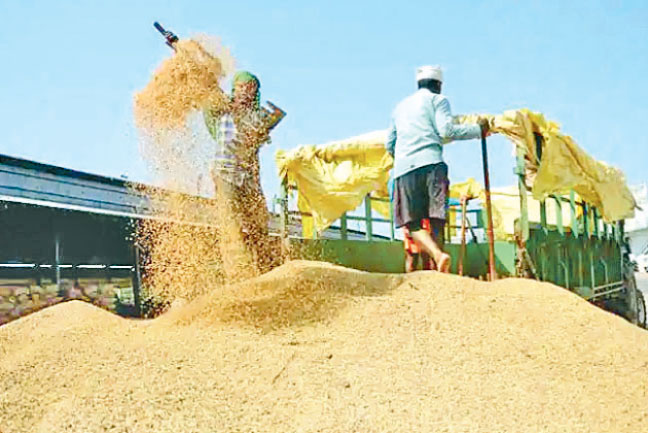
Paddy marketing crisis is an annual phenomenon. Right throughout the past decades under successive Governments, farmers’ complaints about the lack of a better farm-gate price and lack of marketing facilities have been commonly heard issues during harvesting times. It is heard once again with the current Yala season harvest being collected in the major cultivation areas such as Anuradhapura, Polonnaruwa and Ampara.
Rice farming is a sensitive matter since it is directly linked to the food security of the country. Rice is the staple food of Sri Lanka. A sizeable share of the population is also involved in paddy cultivation, and as such, prolonged unrest among them has political ramifications for sure. Past Governments were held to account by farmers. For instance, the ban on chemical farming by the Gotabaya Rajapaksa Government caused a crisis in the agriculture sector, and the farmers took to the streets. The politicians of the current Government were at the forefront, giving leadership to farmers’ struggles at that time.
Once again, the farmers have started raising their concerns. They keep saying that their produce does not fetch a reasonable price. The Government has not yet declared a guaranteed price. The problem looks inherent in Sri Lanka since successive Governments have failed to address the marketing crisis in a scientific manner. In a market economy, things move in a particular way, and the Government has to guide its behaviour through necessary policy reforms.
Deep-Rooted Problems
Today’s crisis has deep-rooted problems. Rice farmers are mostly smallholders. They do not have storage facilities and are in debt. Or else, they do not have sufficient cash in hand. The end result is that they are compelled to sell off their harvest no sooner than it has been collected. Then, they are at the mercy of mill owners who have a stake in the market when the Government’s intervention is minimal.
It is no secret that the rice milling industry is controlled by an oligopoly which is politically influential, no matter what party is at the helm of affairs. They have a say in determining the prices, and farmers are left with no choice but to sell off their produce, at least part of it, at the available price. When it is not satisfactory, they complain that it is way below the production cost. That is where the role of the Government matters. It should ensure a farm-gate price, as in most countries. But the Paddy Marketing Board (PMB), which is the state institution designed to act as a safety net by buying paddy at guaranteed prices to maintain a “buffer stock,” has largely failed to compete with the private sector. It has tied the Government’s hands in responding to the regularly erupting paddy marketing crisis.
In the meantime, the large millers have taken advantage of their massive storage capacities. They have the liquid capital to buy up the majority of the harvest at very low farm-gate prices. They even control the rice supply to the market when they seek price hikes during certain months.
Any Governmental intervention has made matters worse because of this oligopoly. If the retail price is regulated, they will hoard stocks and create an artificial shortage. The end result is a price hike. Then, backdoor networks get activated to sell rice at exorbitant prices.
Harvesting Season
In the event of any shortage, Governments used to resort to importing foreign rice. However, the timing of these imports is often heavily criticised. Importers and Governments sometimes allow foreign rice to flood the market right as the local harvesting season begins. It gluts the market. Farmers complain that this is one of the reasons for the current crisis. The Government is now making desperate bids to dispose of excess rice in the country to create demand for the fresh harvest.
This is a kind of vicious circle in which successive Sri Lankan Governments are trapped. It is time for the new Government to free the country from this cycle and manage agro-marketing policies and approaches for the good of both farmers and consumers alike. The Government cannot afford to allow rice prices to go through the roof because it has an adverse impact on the cost of living.
A prudent agro-marketing approach is needed for the benefit of growers of vegetables and other crops as well.
In this exercise, Sri Lanka can look at the experience of other countries such as India. In India, the Minimum Support Price (MSP) is declared before each sowing season by the central Government, based on the recommendations of the Commission for Agricultural Costs and Prices (CACP). Currently, MSPs are announced for 23 farm commodities, covering cereals, pulses, oilseeds and commercial crops.
The Food Corporation of India (FCI) and various state agencies get involved in the purchase of food grains such as wheat, rice and coarse grains from farmers at guaranteed prices.
Sri Lanka’s recurring paddy marketing crisis is fundamentally a breakdown of state capacity. Sri Lanka has to work out a mechanism to insulate farmers from adverse impacts. It has to be a well-studied, scientific approach rather than the reactionary measures currently being taken.
At the same time, with the closing of the Hormuz Strait, the fertiliser issue has been brought into sharp focus. Nitrogen fertilizer is the main agriculture input. Sri Lanka is set to take the brunt of this problem. Unless addressed, it will not only affect food security but also export revenue. The tea industry is already grappling with the high cost of nitrogen fertiliser. Decades of intensive chemical fertiliser use have depleted the country’s soil. The use of bio-fertiliser is not an immediate option as a result. The Government should ensure that adequate urea supplies are there for the next cultivation season. Otherwise, the agriculture sector will crash.
The West Asia crisis is a reminder for Sri Lanka that food security does not depend on local factors but on the stability of global energy supplies. The closing of Strait of Hormuz not only leaves fuel prices high but also food bills. Now it is time to secure fertilizer security as part of agro-marketing policies.
https://dailynews.lk/2026/07/01/general-opinion/1018955/time-to-fix-paddy-marketing-crisis-ensure-fertilizer-security/?__cf_chl_f_tk=kmwyuoXNVg4JIL0rHdOJs2y9ht3F7Fir0zMNq48WR0E-1782886403-1.0.1.1-8e7oa0w7LBLhbf5vyLONG4V0nBddMiXplG6V7x9smRwPublished Date: July 1, 2026


 READ
READ