Downloads
 Login
Login
 Register


Tags
Thai farm debt crisis deepens in early test for Anutin’s government
By Orathai Sriring and Panarat Thepgumpanat
Summary
- Polls show falling public confidence in Anutin’s government
- Government subsidy measures seen as insufficient for farmers
- Over half of farm borrowers at state bank trapped in debt
- Rising costs linked to Iran conflict worsen debt burden
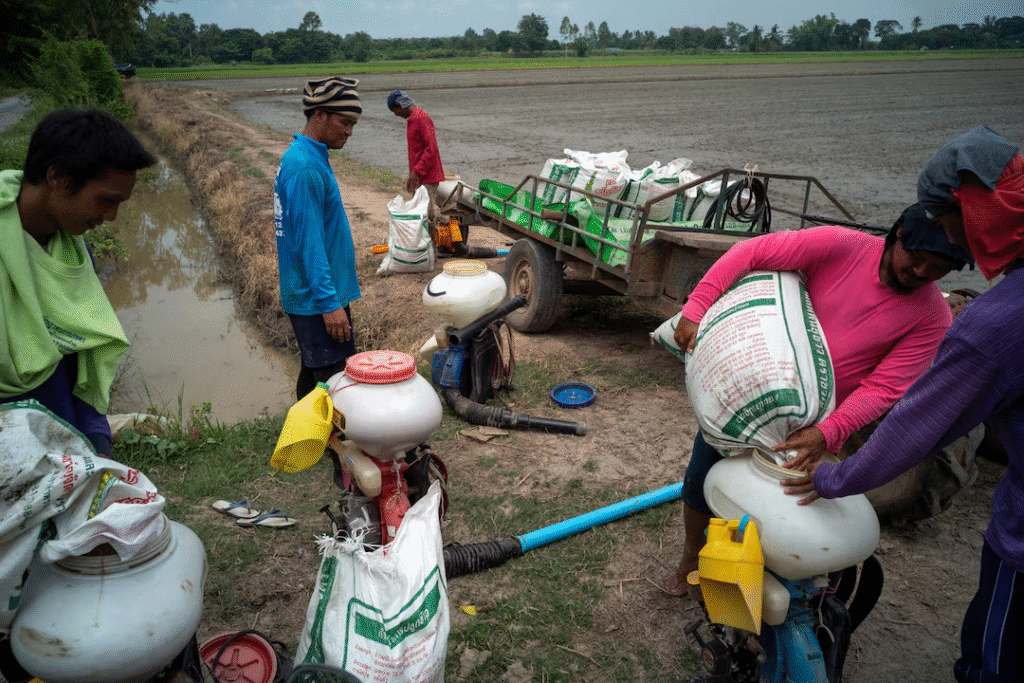
BANGKOK, June 11 (Reuters) – Ahead of Thailand’s February general election, politicians often came to court voters like 69-year-old rice farmer Chaon Taiupok in Ayutthaya, about 80 km (50 miles) north of the capital, Bangkok.
“Once they won and formed the government, they disappeared,” said Chaon, who is struggling to make ends meet as rising costs of fuel and fertiliser triggered by the Iran war combine with falling rice prices to hammer farmers.
Retail diesel prices in Thailand surged by more than 60% at their peak as a result of the conflict, while fertiliser costs have risen by more than 30%.
“The government is not tackling the problem,” Chaon said.
Chaon’s discontent reflects the growing political risk confronting Prime Minister Anutin Charnvirakul, who won a landslide election victory with the backing of rural voters but is now facing the heat as a war-driven price shock deepens Thailand’s farm debt crisis.
Only months into its four-year term, support for Anutin’s administration is already eroding.
About 57% of respondents told a poll by Suan Dusit University in May they had little or no expectation of the government’s performance, a sharp reversal from March when 68% of those polled had expressed optimism.
“The government will roll out further measures to support people and boost confidence in its work,” said deputy government spokesperson Ploythalay Laksameesaengjan, adding higher oil prices driven by the war were beyond the administration’s control.
The struggles of Thai farmers underscore the broader pressures weighing on Southeast Asia’s second-largest economy, which has struggled with low growth.
Thailand has also lagged peers since the pandemic because its economy is reliant on slow-recovering tourism while domestic demand remains weak, constrained by high household debt. Nearly 78% of respondents in the May poll called for urgent action on rising living costs.
‘CRISIS OF CONFIDENCE’
Finance Minister Ekniti Nitithanprapas has already described the situation as a “cost-of-living crisis,” acknowledging the growing strain on ordinary households.
However, after years of stimulus spending the government’s fiscal policy options are limited, while inflation is projected to breach the Bank of Thailand’s target of 1% to 3% this year, as the central bank has held its key interest rate (THCBIR=ECI), opens new tab at 1%.
Overall household debt in Thailand stands at 86.7% of gross domestic product, among the highest in Asia, reflecting weak income growth, past easy credit and economic shocks, blunting the impact of government stimulus.
To ease the hardship, Anutin’s government has introduced support measures and launched a 176-billion-baht ($5.4 billion) consumer subsidy program, as part of a wider 400-billion-baht borrowing decree, which is facing a legal challenge from opposition parties.
Even targeted government schemes, such as subsidies of about 1,000 baht ($30) per rai (0.16 hectares) for rice farmers, have done little to offset the rise in fertiliser and fuel prices, as they are insufficient to cover farmers’ expenses, said Pramote Charoensilp, president of the Thai Agriculturists Association.
“The pressure on the government is not just economic,” said Ngamprawan Ehsomnuk, dean at Suan Dusit University’s school of law and politics.
“It’s a crisis of confidence in whether the government can govern effectively.”
‘NOTHING LEFT BUT DEBT’
For many, including 64-year-old Ayutthaya rice farmer Phayong Saengthong, the current situation feels insurmountable.
After decades of farming, Phayong owes more than 1 million baht ($30,628) to lenders. The rising fertiliser and fuel costs, compounded by weak rice prices, added a further 200,000 baht ($6,125) in losses after his latest harvest.
Thai rice prices slumped last year, with export prices hitting an 18-year low, mainly due to ample global supply and intense competition from India.
“The debt is overwhelming,” Phayong said.
He is not alone. More than half of the 3.73 million farm borrowers at the state-owned Bank for Agriculture and Agricultural Cooperatives are ensnared in a “debt trap” they are unlikely to escape before retirement, the central bank’s research institute said in an April report.
With formal loans exhausted, Phayong said he relies on suppliers to extend him credit.
“If they stop giving me goods on credit, I may have to stop growing rice,” he said, echoing the frustrations of many of the around 4.6 million rice farming households across rural Thailand who thought they would get more government assistance.
“There are no clear measures to help farmers,” said Pramote, who plans to push for stronger support at a national rice policy board meeting on Thursday.
If paddy prices were closer to 10,000 baht ($306) per ton, compared to about 7,800 currently, farmers could still find a way out, said Chaon, who farms on 72 rai (11.5 hectares) of land in Ayutthaya and owes the state lender about half a million baht.
“With costs so high and rice prices so low, there’s nothing left but debt,” he said.
($1 = 32.81 baht)
Reporting by Orathai Sriring and Panarat Thepgumpanat; Editing by Devjyot Ghoshal and Kate Mayberry
https://www.reuters.com/world/asia-pacific/thai-farm-debt-crisis-deepens-early-test-anutins-government-2026-06-10/Published Date: June 11, 2026


 READ
READ