Downloads
 Login
Login
 Register


Tags
West Africa must build a competitive rice value chain to cut import dependence, says World Bank
The World Bank says West Africa can achieve rice self-sufficiency, but only if countries strengthen the entire value chain and make local rice competitive with imports.
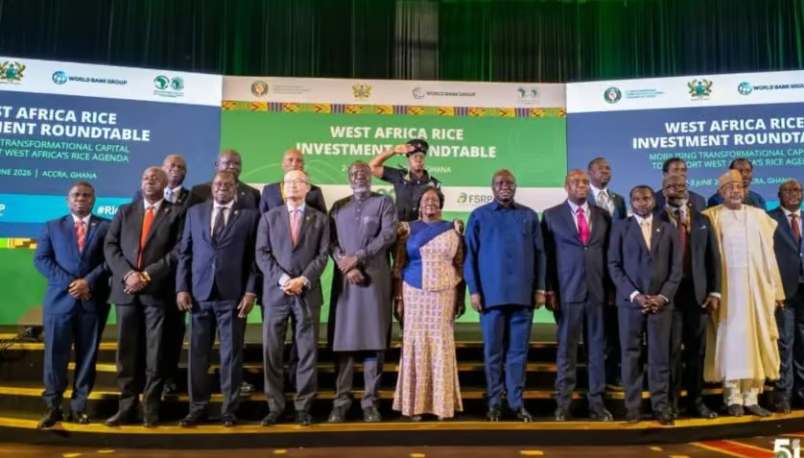
WEST AFRICA – West Africa can reduce its dependence on imported rice, but countries must strengthen production, processing, storage and marketing across the entire value chain, according to Chakib Jenane, Director of the Planet Department for West and Central Africa at the World Bank.
Speaking to Ecofin Agency during the Rice Investment Roundtable held in Accra, Ghana, from June 2 to 3, Jenane said the region has strong agricultural potential but needs larger-scale action to meet rising rice demand.
“West Africa has considerable agricultural assets. The challenge is not so much their absence as their underutilization. To progress, it is no longer enough to move forward in small steps. We must structure farms, group producers on larger and more mechanizable areas, and give them greater access to credit,” he said.
Rice demand has grown steadily across the Economic Community of West African States (ECOWAS) for more than a decade. Yet many farmers still rely on rain-fed production, which limits output and leaves the sector exposed to weather-related risks.
Jenane said the World Bank’s AgriConnect initiative seeks to strengthen the entire rice value chain across the region.
“The goal is to build a high-performing ecosystem around rice. In countries like Senegal, Mali, and Nigeria, yields per hectare are already comparable to those seen in Asia. But producing more is not enough: we also need to improve storage, processing, and marketing. Ultimately, to succeed, the entire West African rice value chain must be competitive with imports,” he said.
He also stressed the food security risks linked to global market disruptions.
“We cannot leave populations permanently exposed to the fluctuations of global markets. Successive crises, the Covid-19 pandemic, the war in Ukraine, disruptions to maritime routes, have disrupted supply chains and increased the cost of inputs, particularly fertilizers,” he said.
To support the sector, the World Bank recently approved a US$500 million programme for agricultural value chains and smallholder farmers in Nigeria. The institution also allocated US$300 million to support agricultural modernization in Togo and is preparing additional projects in Guinea, Senegal and Côte d’Ivoire.
The comments came shortly after the Rice Investment Roundtable concluded with the Accra Declaration, which sets a target of rice self-sufficiency in West Africa by 2035. Participating countries committed to doubling paddy production, raising average yields from 2.1 to 4.1 tonnes per hectare, reducing post-harvest losses to below 10%, and cutting import dependence to less than 15%.
The meeting also secured US$1.54 billion in financial commitments from investors and development partners. ECOWAS expects to finalize a regional rice investment compact by September 2026 to guide implementation and coordinate funding across the region.
https://millingmea.com/west-africa-must-build-a-competitive-rice-value-chain-to-cut-import-dependence-says-world-bank/Published Date: June 9, 2026


 READ
READ