Downloads
 Login
Login
 Register


Tags
Indus Water Treaty violations by India threaten rice production in KP
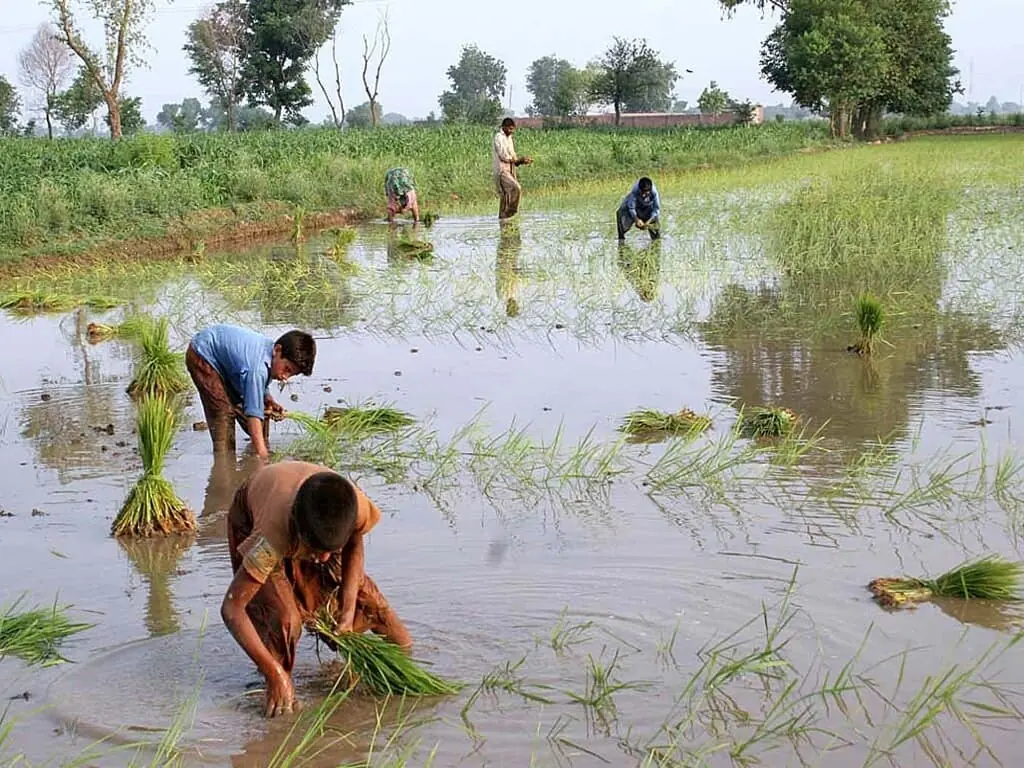
PESHAWAR: As golden wheat fields disappear from the plains of Swabi after harvest, farmers in Khyber Pakhtunkhwa are once again preparing their lands for rice cultivation, but this summer, uncertainty hangs over their hopes following repeated Indus Water Treaty (IWT) violations by India since April last year.
In Margoz village of Swabi district, progressive farmer Zubair Ali carefully levels his fields with a tractor under the scorching May sun, relying on the waters of the River Indus to irrigate his five acres of rice farmland. “Our entire village largely depends on the water of Tarbela dam built on the river Indus. If the flow decreases, small farmers will suffer the most in Swabi.”
Besides thousands of poor farmers, women in rural areas are often the first to face hardship when crops fail because household food security is directly affected.
For Zubair and thousands of other farmers across KP, water is not merely a resource but it is survival for them, their families, agriculture and livestock. Pointing towards the flowing Indus River, Zubair said rice cultivation entirely depends on a steady and uninterrupted supply of water.
“If the river flow decreases, rice production will suffer badly,” he said. “Thousands of farming families depend on this water for their livelihood. Any long suspension or continued violation of the treaty can directly affect our crops and income.”
The growing concerns emerged after India’s illegal move to place the IWT in abeyance, triggering fears among farmers, environmentalists, and legal experts in KP about the future of agriculture, livestock, apiculture and food security in Pakistan.
Signed in 1960 with the support of the World Bank, the IWT has long been regarded as one of the most durable agreements between Pakistan and India despite decades of political tensions and wars.
The treaty governs the distribution and management of waters of the Indus basin — a lifeline for agriculture, drinking water, hydropower, and industry across the region.
Dr Abdul Rauf, former Director General of Agriculture Research KP said that rice farming already faces challenges from climate change and rising input costs and the water uncertainty amid IWT violations by India has added another layer of fear especially among rice and watermelon growers.
He termed the treaty the backbone of Pakistan’s agricultural economy, warning that any prolonged disruption in the water flow could negatively impact water-dependent crops, especially rice, mangoes, melon, and watermelons in KP and Punjab provinces.
“Water is the lifeline of humans and agriculture on the globe,” Dr Rauf said. “Pakistan produces around 7.5 million tonnes of rice annually and ranks 10th among the world leading rice-producing countries.
He said any reduction in irrigation water can severely impact rice production and its exports, warning that the negative consequences would extend beyond borders.
“The Indus basin supports fruit orchards, fisheries, livestock, apiculture, wildlife and even rice exports,” he said. “Disruptions in water availability can threaten food security, increase poverty, and affect millions of people connected to farming and related industries in the region.”
Dr Rauf described the IWT violations by India as equivalent to pushing millions of people toward hunger and economic hardship that may create human rights issues. He also raised alarm over the humanitarian implications of restricting river water flows by India and declared it a serious violation of human rights and international laws.
“Water is not merely a political tool; rather, it is essential for human survival,” said Tauheedul Haq, former Conservator of Forests, while talking to APP. “Any action that threatens water availability for civilian populations risks creating a humanitarian crisis.”
In Pakistan, where agriculture contributes significantly to the national economy, economies of rural communities in Khyber Pakhtunkhwa, Punjab, and Sindh are particularly vulnerable because millions rely directly on irrigation systems linked to the Indus basin.
He feared that interruptions in coordinated water management could further damage the region’s fragile ecosystems already stressed by climate change, glacial melting, and rising temperatures.
Reduced water availability, he warned, could intensify glaciers’ melt in Himalaya, drought conditions, force mass displacement from rural areas, and deepen poverty in already vulnerable communities. Legal experts have also questioned the implications of suspending the treaty.
“Under international law, states are expected to avoid actions that deliberately deprive civilian populations of essential resources,” said Malik Ashfaq Advocate.
“India’s unilateral and illegal actions go against the World Bank’s guarantees and the rulings of the International Court of Arbitration.”
Political observers cautioned that escalating disputes over water could further destabilize relations between the two nuclear-armed neighbours and another war, especially over water, could put peace of the entire region into jeopardy.
“IWT survived three wars because both countries understood that water should remain outside political confrontation,” said Malik Ashfaq. “Weakening that principle could create dangerous consequences for regional peace and human security.”
Back in Swabi, farmers like Zubair Ali remain anxious as they prepare their nurseries for rice transplantation amid uncertainty of water.
“We are simple farmers,” Zubair said while watching water flow through a narrow irrigation channel. “We do not understand politics, but we understand one thing: without water, there is no crop, no income, and no future for our children.”
As uncertainty grows, rice farmers and experts alike are urging the World Bank and international community to play an active role in preserving the treaty and ensuring uninterrupted water access for millions of people dependent on IWT.
https://www.brecorder.com/news/40420542Published Date: May 11, 2026



 READ
READ