Downloads
 Login
Login
 Register

Tags
Why Bangladesh lags in global rice productivity despite topping South Asia
Shadique Mahbub Islam
The challenge is no longer producing enough, but producing more from the same land and water without exhausting both resources.
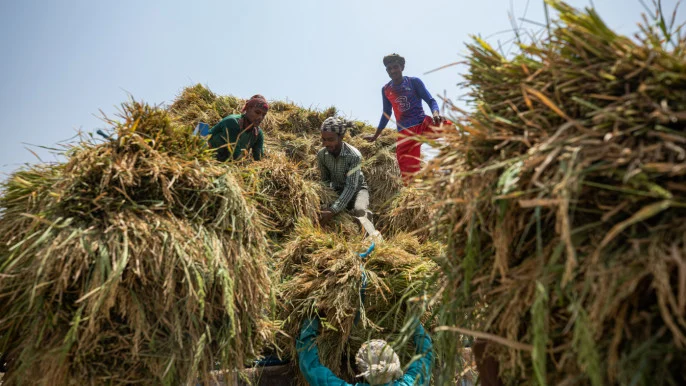
Bangladesh topped South Asia’s rice productivity charts in 2024, producing about 5.3 tonnes of paddy per hectare, compared with roughly 4.3 tonnes in India, 3.74 tonnes in Pakistan and 4.19 tonnes in Nepal, according to latest data by the Food and Agriculture Organization (FAO).
But globally, that puts Bangladesh around the middle of the pack: the world average is roughly 4.7-4.8 tonnes per hectare, while yields reach about 7.1 tonnes in China, 8.68 tonnes in the US and 11.9 tonnes in Australia. Even Egypt, the semi-desert country, yields approach 9.1 tonnes per hectare.
That productivity gap is becoming an economic vulnerability. According to the Department of Agriculture Extension, Bangladesh produced around 41.9 million tonnes of rice in FY25, yet imported 14.36 lakh tonnes, the highest volume in seven years.
In value terms, rice imports exploded from just $25.4 million in FY24 to $682.4 million in FY25, a 2,584% increase, after floods damaged more than 1 million tonnes of domestic rice.
At the same time, the groundwater-intensive boro system is putting increasing pressure on water resources, particularly in the drought-prone northwest.
The question is no longer simply whether Bangladesh can produce enough rice, but whether it can move beyond its productivity ceiling without exhausting the land and water underpinning current output.
With yield growth slowing, climate shocks exposing the limits of domestic supply and imports becoming an increasingly important buffer, Bangladesh needs to close its yield gap through better farm management, technology adoption, research-extension links, mechanisation and more efficient use of water and inputs.
The missing link between technology and farmers
Sayla Khandoker, assistant professor at Sher-e-Bangla Agricultural University’s Department of Agricultural Economics, believes that the problem is not primarily that Bangladesh lacks technologies. It is that those technologies are not reaching farmers effectively.
“Productivity depends on genetic potential, input use, including seed, fertiliser, labour and irrigation, technology adoption, soil quality, climatic risk and also socioeconomic factors such as farming experience, education and extension contact,” she said.
Bangladesh’s problem, she says, is increasingly, not the absence of technology. It is the difficulty of converting available technology into profitable and reliable adoption at scale.
“Bangladesh Rice Research Institute (BRRI) has developed around 127 high-yielding modern rice varieties, including salt-, drought-tolerant and short-duration varieties. But how many of them are actually in farmers’ fields? That is the main concern,” she explained.
According to Sayla, the binding constraint is the weak connection between research, agricultural extension and farmers.
“The main reason for the yield gap is the low adoption of those technologies. The main constraint is the lack of linkages among research, extension and farmers. Either farmers are not aware of the technology, or they may have inadequate technical knowledge.”
Research also suggests the returns from adoption can be significant. Farmers adopting hybrid rice varieties were found to be 6.24% more technically efficient and had 12.03% higher frontier-predicted yields than non-adopters.
The management gap
Jahangir Alam Khan, agri-economist and former member-director of the Bangladesh Agricultural Research Council, sees Bangladesh’s productivity ceiling as a combination of technological and management constraints.
“Compared with countries such as China, the United States and Australia, which have the highest levels of rice productivity, Bangladesh still lags behind in terms of technological standards,” he said.
The second issue Jahangir noted is management. “Our farm-management practices are not as efficient as those used in countries such as China and the United States. Farmers also do not always apply fertiliser and water at the optimum levels. In some cases, they use too much fertiliser, while in others they use too little.”
As a result, he says, soil quality is also being affected, and we do not always take the necessary steps to restore soil health.
All of these factors together, he believes, have placed a ceiling on our production potential. “We have not been able to push productivity beyond that ceiling, which is why countries such as China, the United States and Australia have moved much further ahead.”
“We need better farm management and a significant improvement in the level of technology available to our farmers.”
“The main reason for the yield gap is the low adoption of technologies. The main constraint is the lack of linkages among research, extension and farmers. Either farmers are not aware of the technology, or they may have inadequate technical knowledge.”
Sayla Khandoker, Assistant Professor of Agricultural Economics, Sher-e-Bangla Agricultural University
Bangladesh has nevertheless built a substantial research base. “We have made considerable progress in rice research,” he said. “BRRI has developed around 120 rice varieties, while other universities and institutions, including the Bangladesh Institute of Nuclear Agriculture, have collectively developed around 150 varieties.”
But research cannot be treated as a one-off achievement.
“This development needs to continue systematically, with new varieties being developed one after another to meet changing conditions and productivity requirements,” he said. “We may not be investing in and advancing this area as consistently or as rapidly as countries such as China, the United States and Australia.”
He believes collaboration is equally important. “Most farmers are still unable to adopt these technologies and practices at the level required. If we could strengthen collaboration among our research institutions and improve access to technology, our productivity could increase significantly.”
Lessons from higher-yielding countries
China has pushed the genetic frontier through decades of state-backed hybrid-rice research. It reduced its rice-growing acreage by about 14% after 1978 while increasing production by more than 44%. Its super-hybrid programme has targeted yields of around 12 tonnes per hectare, with experimental varieties exceeding 17 tonnes.
Vietnam offers a different lesson. Its response to the ecological pressure in the Mekong Delta has increasingly focused on better management, including alternate wetting and drying rather than keeping rice fields permanently submerged. Its One Million Hectares of High-Quality Rice programme aims to raise quality while reducing input and environmental costs.
The US and Australia demonstrate another route: capital-intensive precision agriculture, with mechanised land preparation, precision fertiliser application, controlled irrigation and increasingly sophisticated farm monitoring.
Closing the efficiency gap
Bangladesh’s own research indicates that there is considerable room to improve without waiting for a technological breakthrough.
BRRI’s study titled “Doubling Rice Productivity in Bangladesh” found that improved management could reduce the genetic gain required to achieve long-term productivity targets by about 41%. Farm-level research has also identified management as a larger contributor to rice-yield variation than genetics in Bangladesh.
That is significant. It suggests that a substantial part of the next productivity increase is technically possible.
That opportunity is already being engineered in the field.
Owen Calvert, Chief of Party- Team Lead in Bangladesh of the International Maize and Wheat Improvement Center (CIMMYT) frames the next phase as one of efficiency rather than expansion.
“Bangladesh has achieved significant progress, but the next phase must be about raising productivity while using land, labour and other resources such as water and fertiliser more efficiently and sustainably,” he said.
“With the generous support from the government of the United States, CIMMYT is developing technology to ensure appropriate placement and therefore more efficient use of fertiliser in rice production,” he said.
“Mechanised transplanting can play an important role by addressing labor shortages, reducing production constraints and enabling more timely crop establishment. Lasting gains will depend on combining technology with strong agronomic practices and effective services.”
But raising productivity also means confronting Bangladesh’s dependence on groundwater-intensive rice cultivation. This is where the productivity debate becomes a question of resilience.
Sayla Khandoker argues that the objective should not be self-sufficiency regardless of cost.
“Rice productivity is not merely an agricultural issue but a macroeconomic and national-resilience issue,” she said. “It greatly influences food and nutrition security, farmers’ income, social safety and foreign earnings. Higher productivity reduces dependence on volatile global rice markets.”
“Bangladesh therefore needs more rice from each unit of land at low cost and with less climate risk,” she said.
She argued that underinvestment in R&D is probably contributing to Bangladesh’s slowing productivity growth, particularly by constraining modern breeding, location-specific technology and the dissemination of technology. In addition, rice supply-chain and value-chain development are also important.
https://www.tbsnews.net/features/panorama/why-bangladesh-lags-global-rice-productivity-despite-topping-south-asia-1518951Published Date: August 19, 2026


 READ
READ