Downloads
 Login
Login
 Register

Tags
Vietnam Hosts World Bank and IRRI Learning Event to Scale Sustainable Rice Innovations
International Rice Research Institute (IRRI)
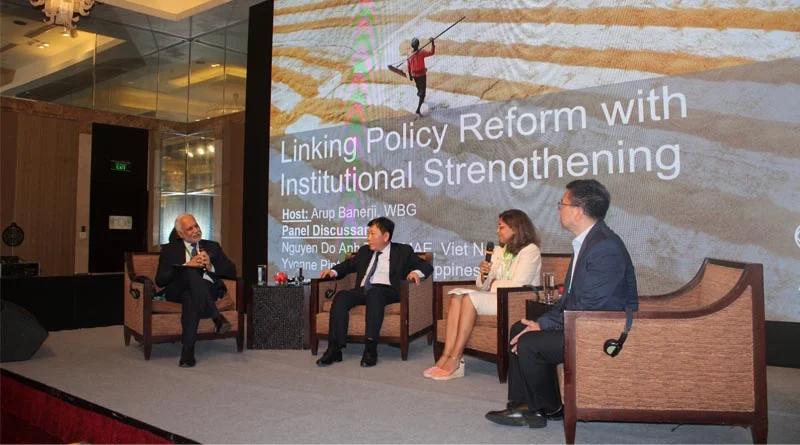
19 March 2026, Vietnam: Vietnam hosted the second learning event under the World Bank Group’s Scaling Next Generation Rice Impact Program (Scaling NextGen). This week-long “Learning Journey” brought together stakeholders and experts from seven key rice-producing nations, including Bangladesh, Cambodia, China, India, Indonesia, the Philippines, and Vietnam, to accelerate the transition toward sustainable, low-emission rice systems.
Co-organized by Vietnam’s Ministry of Agriculture and Environment (MAE) and the International Rice Research Institute (IRRI), the event emphasized critical pillars such as policy reform, value chain development, and private sector engagement. The program culminated in an immersive field visit to the Mekong Delta, where participants observed innovative farming practices being scaled through World Bank-supported operations.
During the event, IRRI showcased a comprehensive suite of technologies designed to promote high-yield, low-emission rice production. In an interactive “World Café” session, IRRI senior scientists and leadership engaged with international delegates to discuss the technical and digital innovations currently transforming the region.
Dr. Nguyen Van Hung, IRRI Senior Scientist, presented the technical guidelines for Vietnam’s ambitious “One Million Hectares of High-Quality and Low-Emission Rice” (1mHa) Program. His presentation focused on integrated cultivation techniques, harvest and post-harvest management, and efficient straw handling.
“Mechanized direct seeded rice (mDSR) is a game changer,” Dr. Hung explained. “It significantly reduces seed rates and fertilizer application, minimizes lodging and post-harvest losses, and increases disease resistance—all while boosting overall yields and farmer profits.”
Transitioning to sustainable rice cultivation requires data-driven transparency. Dr. Katherine Nelson, IRRI Scientist and Climate Change Specialist, introduced the RiceMoRe/FarMoRe platforms. These near-real-time digital tools monitor and report agricultural activities, directly linking to automatic greenhouse gas (GHG) emission calculations.
Supporting these efforts is IRRI’s Monitoring, Reporting, and Verification (MRV) toolbox, which includes specialized tools such as SECTOR, CF-Rice, DISPLAY, MapAWD, and COMPARE. This suite assists project managers in the rigorous monitoring and verification required for GHG mitigation projects.
In furthering the sustainability agenda, Dr. Jongsoo Shin, IRRI Regional Director for Asia, discussed the Rice Straw Circular Economy. This model optimizes the use of nutrients contained in rice straw, adding commercial value to what was previously considered waste and drastically reducing the environmental impact of open-field burning.
These innovations are currently being implemented across the Mekong River Delta under the 1mHa Project. In a special panel discussion, Dr. Yvonne Pinto, Director General of IRRI, emphasized that the success of the “Next Generation” of rice depends on the synergy between science, policy, and the market.
Reflecting on the progress of the 1mHa Project, Dr. Pinto stated, “Science alone is not enough. The program’s multi-level approach—combining farmer cooperatives, business-model-based capacity development, and science-based finance—is the formula for success. However, for this to work, national policies must be closely aligned with field practices, and there must be active engagement from both the government and private sectors.”
To see these theories in practice, participants traveled to model farms in Can Tho City in the Mekong River Delta. These sites, co-implemented by MAE and IRRI, serve as testing grounds for the innovation suite of the 1mHa Project.
At the Tien Thuan Cooperative, delegates explored rice straw–based circular economy models. They observed the production of straw mushrooms in both indoor and outdoor environments and viewed the mechanized technology used to convert rice straw into high-quality organic fertilizer.
The journey concluded at the New Green Farm Cooperative, another 1mHa pilot site. Here, participants witnessed a live demonstration of modern machinery, including specialized rice straw balers and combine harvesters, showcasing how mechanization reduces labor intensity while increasing the efficiency of sustainable rice production.
By fostering cross-border knowledge exchange, the Scaling NextGen Rice Impact Program continues to build a roadmap for a resilient, low-carbon rice sector across Asia.
https://www.global-agriculture.com/ag-tech-research-news/vietnam-hosts-world-bank-and-irri-learning-event-to-scale-sustainable-rice-innovations/Published Date: March 19, 2026


 READ
READ