Downloads
 Login
Login
 Register


Tags
Rice prices rise despite Boro harvest
Yasir Wardad
Global quotations firm as Bangladesh sees unusual seasonal increases.
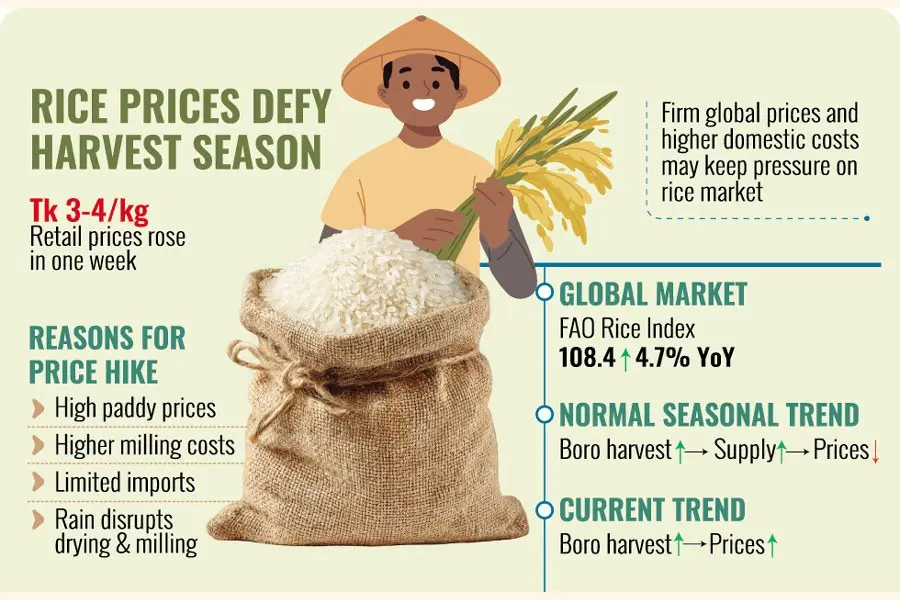
Rice prices are rising in Bangladesh even just after the peak Boro-harvesting season, when increased supplies normally ease market prices, while global quotations have also remained firm.
The unusual domestic trend, coupled with higher paddy, fuel and electricity costs and tighter imports, is raising concerns about further price pressures in the coming months.
According to the latest Food and Agriculture Organisation (FAO) Rice Price Update released in August, the FAO All Rice Price Index averaged 108.4 points in July 2026, up from 108.2 points in June and 4.7 per cent higher than a year earlier.
The relatively firm global market was led by Indica rice, the world’s most traded variety.
Its price index edged up 0.6 per cent in July. Indica is widely consumed in Bangladesh and other South Asian countries.
The FAO said Indica export prices were generally firmer in Asia in July.
Indian quotations were supported by robust sales to African buyers, particularly of parboiled rice.
In Vietnam, rice prices reached 19-month highs, driven by higher costs and thinning supplies amid a delayed and reduced early summer-autumn harvest.
Market sentiment was also affected by uncertainty over import licences in the Philippines and a shift in buying preferences towards 25 per cent broken rice.
FAO’s July export quotations show that Vietnamese 5.0 per cent broken white rice rose to $425.3 per tonne, up 3.0 per cent from June and 12 per cent from a year earlier.
Its 25 per cent broken rice stood at $389.1 per tonne, up 1.0 per cent from June.
In India, 5.0 per cent broken white rice was quoted at $357.9 per tonne, up 3.0 per cent month-on-month, while 25 per cent broken rice rose to $340.8 per tonne, up 3.4 per cent from June.
India’s 5.0 per cent parboiled rice was quoted at $356.9 per tonne, up 5.0 per cent from June.
Pakistan’s 5.0 per cent broken white rice rose to $409.3 per tonne, up 4.0 per cent from June, while 25 per cent broken rice increased to $379.2 per tonne, up 5.6 per cent.
The firm international market comes at a time when Bangladesh’s domestic rice market is showing an unusual seasonal trend.
Rice prices in the country continued to rise during the peak Boro harvesting period, when increased supplies would normally put downward pressure on prices.
Retail prices of most varieties increased by Tk 3.0-4.0 per kg over the past week, according to market sources.
Coarse Swarna rice was selling at Tk 58-60 per kg, while medium varieties such as BRRI dhan-28 and Paijam were priced at Tk 65-70 per kg.
Finer varieties were selling at Tk 75-95 per kg.
The price increase was also reported in major rice-producing and milling districts, including Dinajpur, Naogaon and Nilphamari.
At Hili wholesale market in Dinajpur, the price of a 50-kg sack of Miniket rice increased to Tk 3,350 in August from Tk 3,250 a month earlier.
BRRI dhan-28 rose to Tk 2,850 per sack from Tk 2,700, while Swarna increased to Tk 2,500 from Tk 2,250.
Rice mill owner Shamsul Hoque in Nilphamari said paddy prices had remained high since harvesting began and had increased further over the past two months.
He said rice imports had virtually stopped during the Boro procurement season, reducing market supplies.
Heavy rainfall in several districts, particularly Rangpur and Rajshahi, also disrupted paddy drying and milling operations.
Agricultural economist Professor Golam Hafeez Kennedy said higher paddy, fuel and electricity prices had pushed up milling costs, while firm international rice prices could exert additional pressure on Bangladesh’s domestic market in the coming months.
He said the government had set a target to purchase 0.5 million tonnes of rice from the international market.
“The government should expedite the purchases as rice prices are still much lower in India, Pakistan and Vietnam. It should select the country offering the most competitive price,” he said.
He said the government’s domestic procurement programme had also shown a positive trend, with more than 1.5 million tonnes of rice already procured under the Boro procurement programme.
He added that, in the event of any major disaster, the government should have storage capacity for at least 2.5 million tonnes of rice to ensure food security.
Consumers Association of Bangladesh (CAB) Secretary Humayun Kabir Bhuiyan said ordinary consumers were bearing the brunt of the latest price increase.
“Income has not increased, but the prices of rice and other essentials continue to rise. If rice becomes unaffordable, it will create serious hardship for low-income families,” he said.
He urged the government to ease imports if necessary and strengthen market monitoring to prevent further volatility.
According to the Department of Agricultural Extension, Bangladesh targeted around 43 million tonnes of rice production from the Aus, Aman and Boro seasons in FY26.
The Directorate General of Food currently holds around 2.1 million tonnes of rice in public stocks and has already procured around 1.5 million tonnes from domestic sources during the ongoing Boro procurement programme, which runs from April to August.
tonmoy.wardad@gmail.com
https://thefinancialexpress.com.bd/trade/rice-prices-rise-despite-boro-harvestPublished Date: August 10, 2026



 READ
READ