Downloads
 Login
Login
 Register


Tags
Rice exports maintain growth in first half as sector moves up value chain
VOV.VN – Vietnam’s rice exports continued to increase in volume in the first half of 2026, although export value declined due to lower prices.
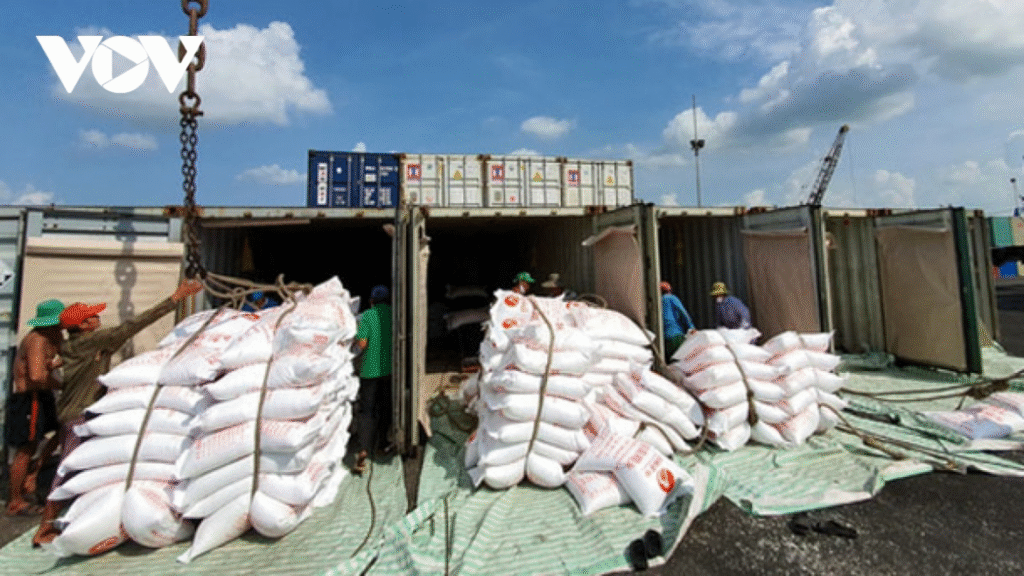
As global market conditions remain uncertain, the rice sector is moving toward lower-emission production and higher-value output to maintain its competitive edge.
Export volume rises while value declines on lower prices
According to the Ministry of Agriculture and Environment, Vietnam’s rice exports in June 2026 were estimated at around 910,000 tonnes, with export value reaching US$373.1 million.
During the six-month period, rice exports reached an estimated 5.2 million tonnes worth US$2.38 billion, up 9.9% in volume but down 2.5% in value from the same period in 2025. The decline in export value was mainly due to lower prices, with the average export price falling 11.3% year-on-year to around US$459.6 per tonne.
The Philippines remained the largest importer of Vietnamese rice, accounting for about 45% of total export turnover. China ranked second with 19.4%, followed by Ghana with 8.5%.
Notably, rice export value to China rose 87% over the past five months of the year, while exports to the Philippines fell 3.8% and shipments to Ghana dropped 24.7%. This indicates that exporters are gradually diversifying markets, though reliance on several traditional buyers remains significant.
Vietnam’s rice export prices edged up in June amid concerns that El Nino could affect supply from the upcoming crop season in Asia.
The country’s 5% broken rice was quoted at US$410-415 per tonne, slightly higher than at the end of May. Meanwhile, Thai rice prices climbed sharply to US$480-500 per tonne, about US$30 higher than the previous month. The higher prices led many buyers, particularly in Africa, to switch to cheaper Indian rice priced at around US$340-346 per tonne.
International traders are closely monitoring crop production across Asia, as El Nino is forecast to intensify in July and August, potentially disrupting global supply.
Domestically, the rice market in the Mekong Delta recorded mixed movements across different rice varieties. Overall, however, prices stayed stable or edged slightly higher.
Exports expected to stay stable as sector moves up value chain
Le Thanh Tung, Vice Chairman and Secretary General of the Vietnam Rice Industry Association (VIETRISA), said global rice demand in the second half of the year is expected to be broadly stable.
Global rice supply and demand remain within expectations, although El Nino could affect production in the 2026-2027 crop year across several Southeast Asian countries. Additional supply in the coming months will mainly come from the summer-autumn and autumn-winter crops, though output is not expected to be substantial. As a result, Vietnam’s rice exports are likely to stay stable in the second half of the year, he went on.
On prices, Le Thanh Tung said short-term spikes could occur in major importing markets such as the Philippines or China if demand rises sharply. However, such fluctuations are expected to be temporary.
He stressed that farmers and businesses need to stay calm and proactively plan production rather than react to short-term market swings.
According to Le Thanh Tung, low-emission rice production is no longer optional but has become a necessity for Vietnam’s rice sector.
With around 3.8 million hectares of rice farmland and more than 7 million hectares under cultivation annually, adopting low-emission solutions can reduce input costs, enhance grain quality, raise farmers’ incomes and better meet increasingly stringent export market standards.
Technical solutions should be applied flexibly across different ecological zones. While the Mekong Delta should prioritize reducing seeding density, the Red River Delta should leverage mechanization to cut labor costs and raise production efficiency, Tung emphasized.
Cooperatives, in particular, continue to play a key role in restructuring the rice sector. Linking farming households into concentrated production areas will help accelerate mechanization, promote advanced farming practices, reduce emissions and build more sustainable supply chains.
Tung stressed that that the rice sector needs to change its mindset, shifting from building large-scale fields with fewer farmers to developing large-scale production areas involving more farmers through cooperatives.
This direction suits Vietnam’s production conditions and will help strengthen the rice sector’s competitiveness in the years ahead, he added.
VOV
Published Date: July 5, 2026


 READ
READ