Downloads
 Login
Login
 Register


Tags
Reused tailwater shows significant water savings in rice production
Mississippi researchers’ tailwater recirculation system in rice production reduces water usage by about 30% compared with traditionally grown rice.
Bonnie Coblentz
At a Glance
- Rice accounts for about half of Mississippi River valley aquifer groundwater extraction.
- Tailwater recirculation system reduces water use to 19 inches annually.
- System cuts freshwater demand by 30% compared to traditional flooding.
Rice production requires a significant amount of water. Mississippi still has a plentiful water supply, but careful managers are finding ways to cut use of this diminishing resource.
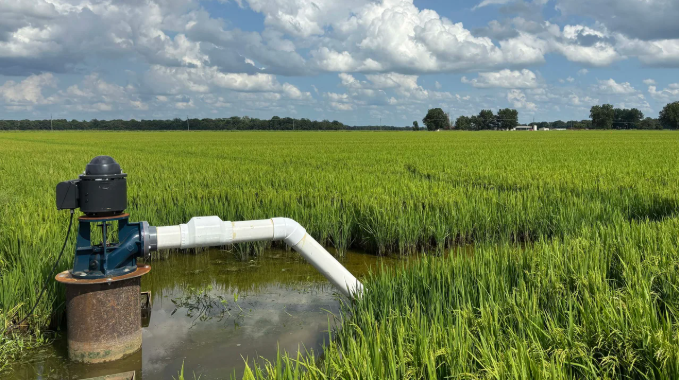
One method that shows tremendous promise is recirculating tailwater in rice production. Tailwater is water from precipitation or irrigation that runs off the field. In a recirculating system, that runoff water is reused by being sent back on the field.
Even though the Southeastern rice crop is relatively small, almost half of the groundwater extracted from the Mississippi River Valley Alluvial Aquifer is used to grow it. For the last three years, Mississippi State University researchers have been recirculating tailwater in furrow-irrigated rice and finding significant water savings.
In 2025, Mississippi harvested 161,000 acres of rice, slightly up from the previous year. It ranks last among the row crops grown in the state but still accounts for a large portion of withdrawals from the aquifer.
Traditional production
Dave Spencer, irrigation and water quality specialist with the Mississippi State University Extension Service, said traditional rice production uses a constant freshwater flood.
“In the Midsouth, rice is drill-seeded, then grown in upland, or non-flooded, conditions for roughly six weeks,” he said. “Water is typically pumped from ground wells to flood rice fields once seedlings are established. That flood is maintained for the next 10 to 14 weeks as the rice grows.”
Although rainfall sometimes helps, maintaining that flood strains on the state’s water resources. Other crops draw on the alluvial aquifer, but rice uses it at the highest rate per acre.
“Reduced groundwater levels have been documented for 100 years, but the decline has been particularly noticeable in the past 40 to 50 years,” Spencer said.
MSU has been leading a multistate research project that has been recirculating tailwater in rice production and investigating the effects on yield and water use.
“Thus far, we have reduced water use to about 19 inches per year in the fields with tailwater recirculation,” Spencer said. “Tailwater reuse reduced freshwater demand by at least 30% compared to a continuous flood or row rice grown without recirculation.
“This is less water use than any rice system except for zero grade,” he added. “We’ve found yields have been similar to traditional methods of rice water management.”
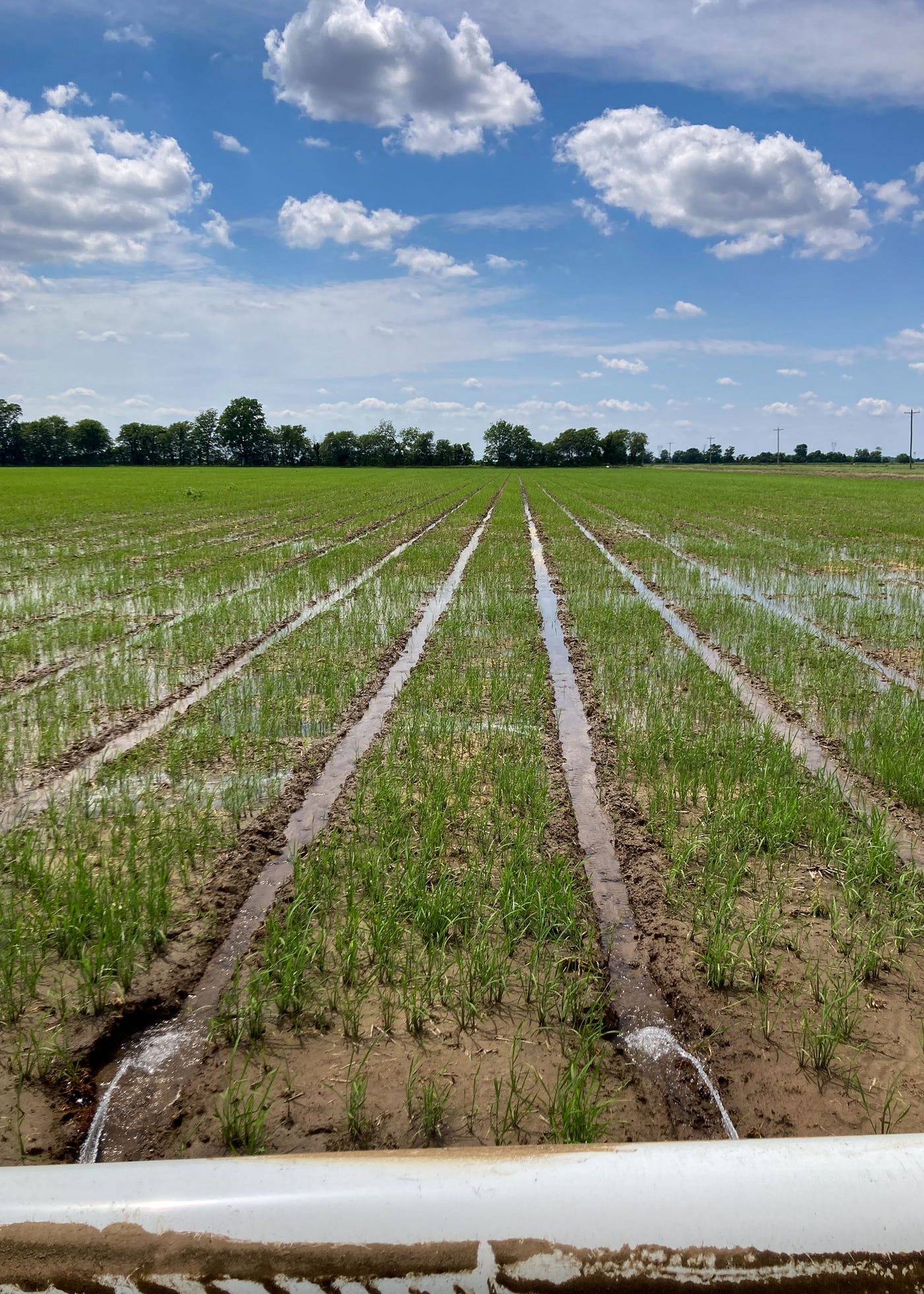
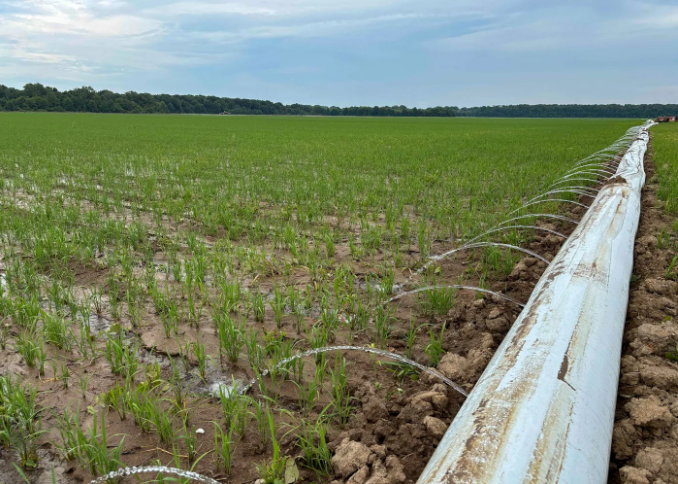
Careful growers are finding ways to reduce water use in rice production. Furrow-irrigated rice was growing in this Sunflower County, Miss., field May 20, 2024.
Rotation systems
Zero grade rice production, or rice fields with no slope, does not work well in crop rotation systems.
“When we rotate rice with soybean, zero grade ground has a yield penalty for the soybean crop because of poor drainage, which delays planting and can prolong saturated soil conditions,” Spencer said.
This rice tailwater recirculation project has been active for three years across Mississippi, Arkansas, Louisiana and Missouri. The method has been tested at 28 locations across the Midsouth, with 10 active sites this year in the participating states.
“We are evaluating a system that pairs furrow-irrigated rice grown in rows with a pitless tailwater recirculating pump,” Spencer said. “Rather than relying entirely on new groundwater, the system captures and recycles field runoff.”
Spencer said water is captured at the deepest part of the field, eliminating the need for constructing permanent retention ponds. The pitless nature of the pump also means minimal disturbance to the field.
“Preliminary measurements suggest that 30% to 35% of water applied to the field crown is from the captured tailwater,” Spencer said.
This system was originally patented by Chris Henry and the University of Arkansas, key collaborators in the project.
Source: Mississippi State University Extension
https://www.farmprogress.com/rice/reused-tailwater-shows-significant-water-savings-in-rice-productionPublished Date: August 6, 2026



 READ
READ