Downloads
 Login
 Register


Tags
Punjab Rice Stubble Burning Persists Despite Ban and Fines
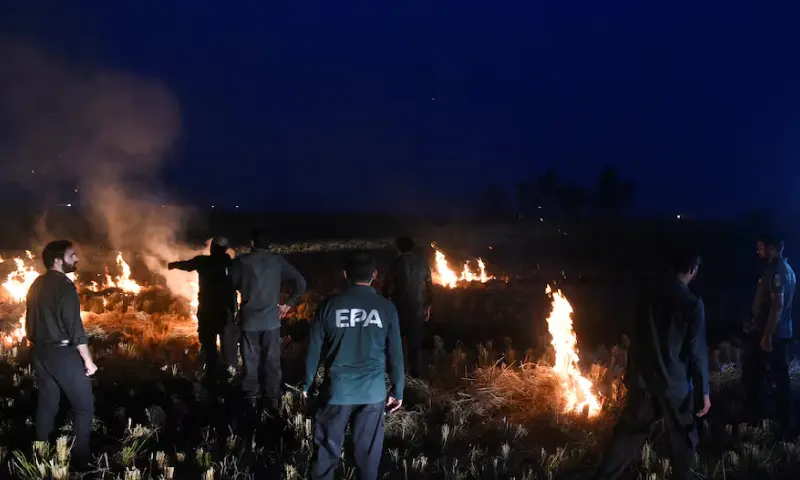
Rice stubble burning in Punjab continues as the paddy harvest winds down, even though the practice is banned and penalties are in force. The main reason is practical. Farmers have only 10 to 15 days between rice harvesting and wheat sowing, and there is no cost-effective alternative for clearing the fields in that time. Burning is the quickest and cheapest option.
Why farmers burn rice residue
The problem is rooted in Punjab’s rice-wheat cropping pattern. Rice is grown on about 6.8 million acres, second only to wheat. Mechanised harvesting leaves large quantities of residue in the field, with some estimates putting the total at 8.5 million tonnes.
Collecting, transporting and processing that residue within the short window requires labour, machinery and money. For many farmers, the speed of mechanised harvesting outpaces the residue-management options available to them. Stubble burning therefore persists not only because rules are ignored, but because affordable alternatives are scarce.
Satellite data on field fires: two different pictures
Monitoring systems give widely varying estimates, although both show the problem continues.
- Pakistan Air Quality Initiative (PAQI): Satellite data from October 1 to November 9 recorded 18,825 fire detections across Punjab, of which about 16,714 were classified as likely crop-residue fires. The highest daily count was 1,102 detections on November 1.
- Space and Upper Atmosphere Research Commission (Suparco): Its data showed 643 fire anomalies between August 1 and November 10, down 21 percent from 817 in the same period of 2025. Of these, 18 were in August, 12 in September and 613 from October 1 onwards. The estimated burnt area fell 36 percent, from 898.5 acres in 2025 to 579 acres in 2026.
Air quality impact
According to PAQI, Lahore’s average PM2.5 concentration reached 126 micrograms per cubic metre from October 1 to November 9. That is more than eight times the WHO’s 24-hour guideline of 15 micrograms per cubic metre, although the two figures cover different averaging periods. Multan, Faisalabad, Bahawalpur and Gujranwala also face serious pollution levels.
A former director general of the agriculture department cautions against blaming stubble burning alone. In November and December, low temperatures, weak winds and atmospheric inversions limit the dispersal of pollutants. Smoke from field fires mixes with emissions from vehicles, industry, brick kilns, construction and waste burning, as well as urban dust. Fine particulate matter poses particular health risks for children, older people and people with respiratory or cardiovascular disease.
Rules and enforcement
The Punjab Environmental Protection (Smog Prevention and Control) Rules, 2023 prohibit stubble burning and provide for penalties. The Environmental Protection Agency (EPA) carries out inspections and satellite-based monitoring, and district administrations are directed to act against violators.
EPA figures for August 1 to November 10, 2026 show:
- Fire-related evidence: found at 423 sites
- FIRs registered: 80
- Fines imposed: Rs3.08 million
- Fines collected: Rs2.71 million
Published Date: November 16, 2026


 READ