Downloads
 Login
Login
 Register


Tags
Pakistan, Qatar discuss Europe trade links as Hormuz crisis strains shipping
NAIMAT KHAN
- Officials explore routes through Middle East, Central Asia to Türkiye, onward to EU markets
- Talks come as war has sharply curtailed shipping through Strait of Hormuz, driven up freight costs
ISLAMABAD: Pakistan and Qatar are exploring trade links through the Middle East and Central Asia to Türkiye and onward to Europe, the commerce ministry said on Monday, as war-driven disruption to the Strait of Hormuz exposes the region’s dependence on vulnerable maritime routes.
The discussions come as months of conflict involving the US and Iran have sharply curtailed commercial shipping through Hormuz, the narrow waterway connecting the Gulf to the Arabian Sea. The disruption has driven up freight and insurance costs and complicated trade for Gulf states and countries such as Pakistan that depend heavily on maritime commerce with the region.
The crisis is particularly significant for Pakistan and Qatar. Qatar is one of the world’s largest exporters of liquefied natural gas and a major supplier to Pakistan, while Islamabad also exports agricultural products including meat, rice, onions and potatoes to the Gulf state.
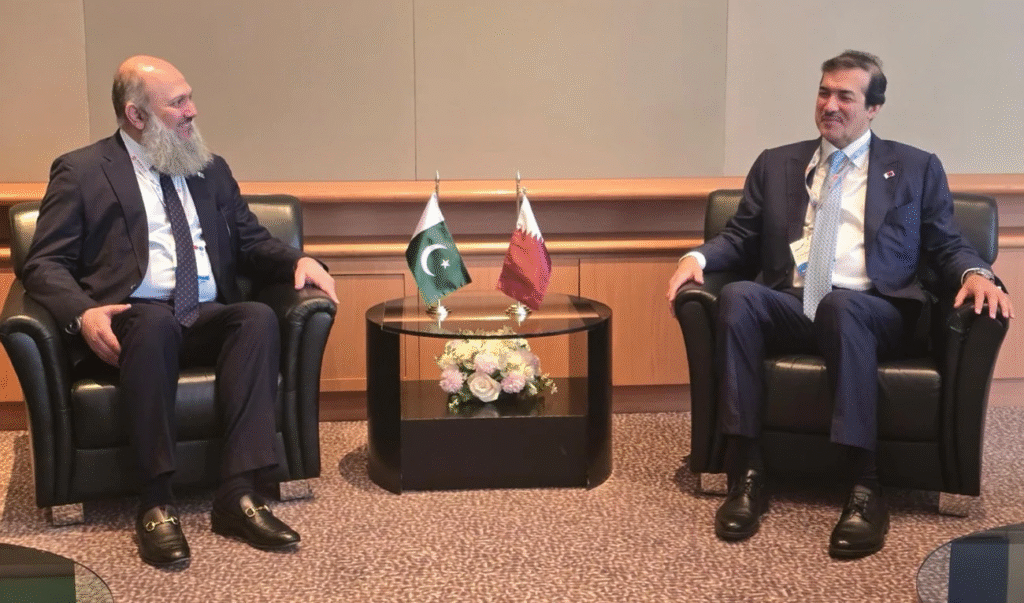
Pakistan’s Commerce Minister Jam Kamal Khan and Qatar’s Minister of State for Foreign Trade Affairs Ahmad bin Mohammad Al Sayed discussed expanding regional connectivity on the sidelines of the Belt and Road Summit in Hong Kong last week.
“Both sides discussed connectivity in the region and through BRI as the future,” Chaudhry Naveed ul Haq Kallu, spokesperson for Pakistan’s Ministry of Commerce, told Arab News.
“They also discussed exploring new avenues of transit and trade through Middle East and Central Asia. Connecting Pakistan and Qatar through the Middle East to Turkiye and beyond into Europe was also discussed.”
Neither side has announced a proposed route, mode of transport, investment commitment or timetable for establishing the links discussed in Hong Kong.
The talks nevertheless come as Pakistan has stepped up efforts to diversify the corridors connecting its ports and exporters with Central Asia, Türkiye and European markets.
In July, Pakistan and Türkiye agreed to pursue the revival of the Islamabad-Tehran-Istanbul freight railway and develop it into a commercial corridor connecting South Asia with Central Asia and Europe. Pakistan has also been expanding road-based transit links under the international TIR customs system, which allows goods to move across borders in sealed vehicles with simplified customs procedures.
Those efforts have acquired greater urgency as conflict disrupts traditional maritime supply chains across the Middle East.
Vessel traffic through Hormuz fell to seven transits on Sept. 10, according to shipping data cited by Reuters, compared with a pre-war average of around 125 a day. War-risk and cargo insurance costs have also surged, with some oil shipments facing millions of dollars in additional transit costs.
Pakistan’s exporters have already reported a steep increase in shipping costs. Waheed Ahmed, patron-in-chief of the All-Pakistan Fruit and Vegetable Exporters, Importers and Merchants Association, told Arab News in August that shipping a 40-foot refrigerated container of mangoes to Gulf markets was costing between $8,000 and $8,500, compared with $1,000-$1,400 last year.
Ahmed said mango export volumes to the region had fallen by around 50 percent amid the disruption.
Pakistan has also sought to strengthen its own shipping capacity. A spokesperson for the state-run Pakistan National Shipping Corporation told Arab News last month that the company was considering acquiring or chartering three to five feeder vessels to expand regional services.
https://www.arabnews.pk/pakistan/pakistan-qatar-discuss-europe-trade-links-as-hormuz-crisis-strains-shipping-3001271Published Date: September 15, 2026


 READ
READ