Downloads
 Login
Login
 Register


Tags
Indonesia’s rice bowl gets bigger
Duncan Graham
Indonesia’s claims of rice self-sufficiency clash with import deals, opaque data and the growing political control of the food system.
Rice isn’t just a meal for half the world. In Indonesia it’s also an essential ingredient in national sovereignty – and big money deals. Mao Zedong was wrong about “all political power growing out of the barrel of a gun.” In Indonesia it grows in the paddy.
Are all Indonesians now dining on their own home-grown rice with not one imported grain, as the government says? If so, it’s a stunning achievement towards self-sufficiency directed by President Prabowo Subianto and a great boost to national pride.
It should also lead to lower prices.
But is it true?
The rice trade is controlled by the State-owned monopoly and public corporation, Bulog, Badan Urusan Logistik (Logistics Affairs Agency). It runs grain depots around the country and sets the floor price, currently Rp 6,500 (AUD 52 cents) a kilo.
Overall Indonesia produces about 55 million tonnes a year and is the world’s fourth largest grower.
Bulog is the principal source of data on crops, plantings and deliveries. It’s an agency with a record of alleged corruption, mainly concerning illegal sales.
This year it “absorbed” the equivalent of 840,000 tonnes of rice – representing a 2,000 per cent increase from the same period last year. This happened despite major flooding, particularly in Sumatra.
Even assuming yields have been boosted by better cultivation, new varieties and fertilisers, this figure is so astonishing that it deserves scrutiny. So far, the Indonesian media and academic researchers have found better meals elsewhere.
Apart from keeping food on the table, there’s another agenda: to manage everything in the food business and put the Prez in charge without waving a weapon.
Bulog, formerly a civilian agency, is now being run by the Army. Major General Ahmad Rizal Ramdhani was appointed last year. He said his job was to “transform the state-owned food company into a major autonomous body directly under the President.
“The hope is that, in line with the President’s wishes, Bulog will return to its former glory, like it did in (the Soeharto era). Bulog shouldn’t just be managing rice, but managing everything, so as to guarantee food self-sufficiency.”
Soeharto, Indonesia’s second president, died in 2008. He was also a former general. For a time his son-in-law was Prabowo.
Last year Ahmad’s predecessor Lieutenant Novi Helmi Prasetya lasted four months as Bulog’s boss. No reason was given for his return to the ranks.
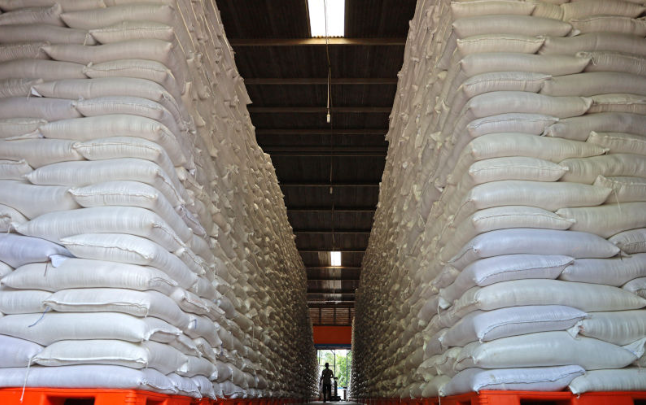
Bulog’s warehouses reportedly hold 2.4 million tonnes, a figure that could rise to three million by the end of the month, potentially marking a new national record. New depots are planned.
The Indonesian NGO Prakarsa (Initiative), “an institution for research and policy advocacy” in Jakarta , reported that in the Agreement on Reciprocal Trade signed with the US in February, Indonesia had “committed to importing 1,000 tonnes of rice.
“Quantitatively, the figure appears small … however, this commitment has sparked controversy. Indonesia, while claiming a rice surplus, is locking in rice imports from countries that are not major global rice producers.
“This is where the question arises: does the food import commitment in the trade agreement erode the food self-sufficiency and sovereignty that has been touted so far?”
In 2024, Indonesia imported 4.52 million tons of rice, a 47 per cent increase from more than three million tonnes the previous year.
A sudden surplus of more than four million tonnes in 2025 looks curious, particularly when credited to Prabowo during his first year in office.
Former presidents also promised – and failed – to make the nation self-sufficient in foods.
Since 2008, when the population was 240 million, Indonesia has imported rice, mainly from Vietnam and Thailand, to ensure the staple ingredient is always available.
Any dearth could lead to food riots, as at the turn of the century, when the nation’s crops were damaged by the El Niño drought.
The other factor in poor harvests at the time was Krismon – the economic crisis caused by student riots and the dethroning of the autocratic second president, Soeharto.
The population is now 285 million. Land available for cultivating the grain has shrunk as roads, industry, and housing have moved onto the flattest areas in an archipelago of mountains.
According to Indonesia Corruption Watch_,_ Bulog originally served as a food provider and distributor for the people.
“With broader authority, including price stabilisation, supplier selection, and food security, Bulog has become a cash cow. Trillions of rupiah can flow into Bulog at any time.
“Its position as an institution directly under the president allows Bulog to access non-budgetary funds outside the state budget … This makes it difficult for the House of Representatives or the Supreme Audit Agency to access Bulog.
“(Two) former Bulog heads were only able to be investigated after President Soeharto left power. Both were tried and convicted after being found guilty of corruption.
“Bulog had to disburse Rp 40 billion (AUD 3,300) from a non-budgetary account, allegedly for Golkar Party campaign expenses. Bulog will always be a magnet for various political parties and the ruling elite to compete for.”
This month, Bulog claimed its warehouses held 2.4 million tonnes and had enough to start exporting. The often unhusked grain is held in 50 kg sacks and usually has to be lugged on the backs of youths dashing up swaying planks to load trucks. Mechanisation is rare.
It’s then sold to private companies for cleaning, refining and marketing under brands and retailed in five and ten-kilo plastic bags.
During the rule of the first President, Soekarno, Indonesia exported rice with a reputation for high quality. Those glory days are regularly recalled by politicians claiming the nation can be food self-sufficient again.
It has now apparently achieved that goal and given Prabowo’s reputation a big tick.
https://johnmenadue.com/post/2026/04/indonesias-rice-bowl-gets-bigger/Published Date: April 15, 2026


 READ
READ