Downloads
 Login
Login
 Register


Tags
India’s farm carbon market reaches smallholders as Punjab, Haryana farmers receive first digital payments
More than 2,500 farmers receive carbon-linked payments as India connects regenerative agriculture, scientific carbon measurement and additional farm income
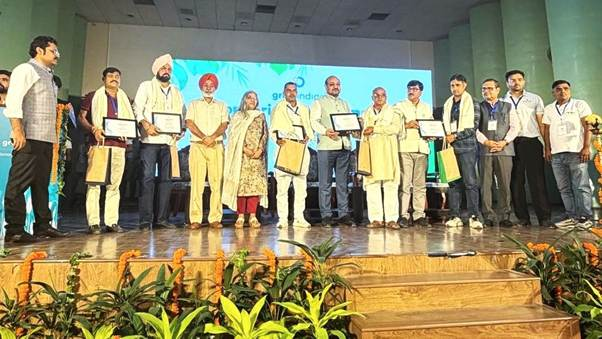
India’s emerging agricultural carbon market has moved another step closer to the farm gate, with more than 2,500 smallholder farmers in Punjab and Haryana receiving digital payments for adopting regenerative and climate-smart farming practices. The first payments were released at a programme organised at Punjab Agricultural University (PAU), Ludhiana, where Dr M. L. Jat, Secretary, Department of Agricultural Research and Education (DARE) and Director General, Indian Council of Agricultural Research (ICAR), initiated the Direct Benefit Transfer (DBT) to participating farmers.
The development marks an important shift in the way agricultural carbon markets are being positioned in India—from an environmental accounting mechanism to a potential supplementary income stream for farmers who adopt practices that reduce greenhouse-gas emissions, conserve resources and build soil carbon.
The payments are part of ‘Aadi’, a farmer carbon programme launched by Grow Indigo in 2019 with technical guidance from ICAR. Between 2019 and 2022, participating farmers adopted practices including Direct Seeded Rice (DSR), reduced tillage and improved crop-residue management. The resulting reductions in greenhouse-gas emissions and increases in soil carbon were measured, independently verified and subsequently converted into carbon credits. The programme currently spans more than two million acres and over 100,000 farmers across seven states, with agricultural carbon credits issued under the Verra VM0042 methodology.
From farming practice to verified carbon asset
The central proposition behind the programme is straightforward but technically demanding: farming practices that alter water use, soil disturbance, residue management and carbon storage can generate measurable environmental outcomes, provided those outcomes are quantified and independently verified.
For farmers enrolled between 2019 and 2022, the carbon benefits were assessed through a multi-year monitoring process. Scientific inputs from ICAR institutions covered greenhouse-gas accounting, crop-simulation modelling, soil-sampling protocols, device validation, field-team training and satellite and remote-sensing approaches.
ICAR–Indian Agricultural Research Institute (IARI), New Delhi, contributed to these scientific processes, while Grow Indigo has also been working with ICAR–Agricultural Technology Application Research Institute (ATARI), Zone 1, to advance regenerative agriculture at the field level. The first carbon-credit issuance covered around 30,000 acres and more than 50,000 carbon credits, with participating farmers receiving approximately ₹3,000–₹15,000, depending on their share of the carbon credits generated from their fields.
That payment structure is significant because it links an environmental outcome directly to the farmer responsible for generating it.
Putting a price on soil carbon
Grow Indigo released the payments from its own funds before the carbon credits were fully sold, allowing farmers to receive their money without waiting for the final sale proceeds. Participating farmers could choose between an assured upfront payment or 75 per cent of the net carbon revenue after the credits were sold.
The model effectively introduces a new financial layer into farm economics: farmers are compensated not only for the crops they produce but also, subject to measurement and verification, for environmental outcomes generated through changes in farming practices.
Dr Usha Barwale Zehr, Executive Director, Grow Indigo, described the payment as the first instance in India of farmers being paid for carbon stored in their soil. She also acknowledged the patience and confidence of participating farmers through the extended period required for scientific measurement and verification. Farmers including Harinderjeet Gill of Nurpur Bet, Ludhiana, and Amandeep Kaur of Sangrur shared their experiences of adopting regenerative practices, highlighting both the economic and environmental dimensions of reducing crop-residue burning and changing conventional cultivation practices.
Water, residue and air-quality dividends
The carbon payment is only one component of the potential economic value of regenerative farming. DSR can reduce irrigation requirements compared with conventional puddled and transplanted rice cultivation, while improved residue management can reduce the need to burn paddy straw after harvest. For fields enrolled during 2019–2022, the programme estimates that participating practices resulted in 45 billion litres of water savings and kept more than two lakh tonnes of crop residue out of fires, avoiding an estimated 1,000 tonnes of PM2.5 emissions.
The figures underline the broader policy proposition behind agricultural carbon markets: a single change in farm practice can potentially generate multiple benefits across water use, soil health, air quality and greenhouse-gas emissions. The challenge, however, is converting those benefits into outcomes that can be measured consistently enough to support credible carbon-credit issuance.
That is where ICAR’s scientific role becomes important.
ICAR’s Lab-to-Land model gets a carbon-market layer
The initiative builds on a broader network of agricultural research institutions, agricultural universities, Krishi Vigyan Kendras (KVKs), ATARIs and State agencies working to move climate-smart technologies from research systems into farmers’ fields. During his visits to Punjab under the Viksit Krishi Sankalp Abhiyan, and in subsequent interactions with farmers and agricultural institutions, Union Minister for Agriculture and Farmers’ Welfare Shri Shivraj Singh Chouhan has emphasised farmer-centric research and field-level adoption of sustainable technologies, including DSR and residue-management practices.
During his June 2025 visit to Punjab, Chouhan interacted with farmers and reviewed farming practices as part of the campaign. Dr M. L. Jat said the initiative demonstrates how climate-smart farming practices, supported by scientific assessment and rigorous verification, can create additional income opportunities for smallholder farmers while contributing to water conservation and improved air quality.
The approach effectively adds another dimension to ICAR’s Lab-to-Land framework: research is not only expected to improve productivity but can also help establish the scientific architecture required to monetise measurable environmental outcomes.
Punjab’s residue challenge is becoming a measurable opportunity
The development comes against the backdrop of Punjab’s long-running crop-residue challenge. Government data show that Punjab recorded 5,114 farm-fire incidents during the 2025 paddy harvesting season, the lowest level since monitoring under the present framework began. This represented a 93 per cent reduction from 2021 and a 90 per cent reduction from 2022. At the village level, the Ransinh Kalan model in Moga provides another example of sustained residue-management adoption. The village maintained a 100 per cent residue-burning-free status across 1,310 acres for six consecutive years.
Such outcomes matter for carbon markets because the value of regenerative agriculture ultimately depends on whether changes in farming behaviour can be sustained, measured and verified at scale. The carbon programme’s experience suggests that environmental incentives can become another lever alongside regulation, technology, extension services and farmer awareness.
The next payment cycle is already in motion
Farmers who joined the programme after 2022 are part of the next monitoring cycle. Their payments will follow as the corresponding carbon credits are measured, verified and issued. This creates a longer-term pipeline rather than a one-time payment programme. The economics of that pipeline will depend on several variables, including the volume and quality of carbon credits generated, verification costs, carbon-market prices, farmer participation and the ability to maintain the underlying agricultural practices over multiple seasons.
From Punjab’s fields to a BRICS agricultural network
India’s push to institutionalise regenerative agriculture is also expanding beyond individual programmes. At the 16th BRICS Agriculture Ministers’ Meeting, held in Indore in June 2026 under India’s chairship, participating countries agreed to establish a BRICS Network of Centres of Excellence on Agroecology and Regenerative Agriculture for Climate Resilience and Productivity. Initial coordination has been assigned to ICAR–Indian Institute of Farming System Research (IIFSR), Modipuram. The BRICS New Delhi Declaration, adopted in September 2026, subsequently welcomed strengthened cooperation through the network.
The development places India’s farm-level experience within a wider international effort to exchange scientific knowledge and scale regenerative agricultural systems.
Carbon payments move the debate closer to the farmer
The significance of the Ludhiana programme extends beyond the first batch of payments. For years, agricultural sustainability has largely been discussed in terms of technology adoption, resource efficiency and environmental outcomes. Carbon markets introduce another question: can farmers who generate those environmental benefits capture part of their economic value?
The first payments to Punjab and Haryana farmers provide an early field-level example of how that proposition can work when agricultural practices are backed by scientific measurement, independent verification and a mechanism for sharing carbon revenue with farmers. The model does not replace the economics of crop production. Rather, it creates a potential additional revenue stream around practices that can simultaneously address water use, soil health, residue management and emissions.
The larger test will be whether this architecture can scale across millions of smallholders while maintaining scientific credibility, transparent payment mechanisms and sustained adoption. For India’s agricultural transition, that could prove to be the more consequential question: not simply how much carbon agriculture can remove or avoid, but whether measurable environmental performance can become a tangible economic asset for the farmer.
https://agrospectrumindia.com/news/48/34853/indias-farm-carbon-market-reaches-smallholders-as-punjab-haryana-farmers-receive-first-digital-payments.htmlPublished Date: September 24, 2026


 READ
READ