Downloads
 Login
 Register


Tags
How Mulkanoor Farmers Cooperative Is Building Climate-Ready Agriculture
By Urban Acres
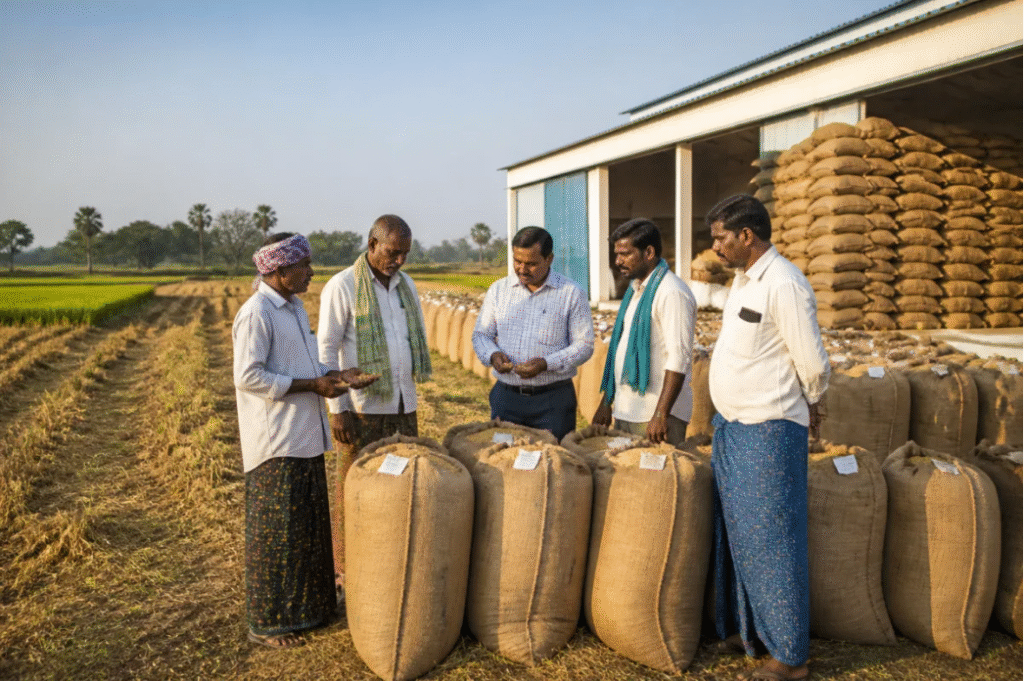
The Mulkanoor farmers cooperative in Telangana is preparing to send its branded rice to the United States, but the more consequential story lies in the system that made that ambition possible. In Mulkanoor village in Hanumakonda district, the Mulkanoor Cooperative Rural Credit & Marketing Society combines farm inputs, credit, storage, quality control and market access within one local institution. Its experience shows how collective infrastructure can reduce the vulnerabilities that usually confront small farmers when climate stress, informal credit and uncertain markets converge.
The cooperative’s first proposed export shipment is expected to comprise 25 tonnes of Telangana Sona and Jai Sriram rice. Dispatch is expected within a month, subject to regulatory clearances, after the society partnered with US-based Harvest Link cooperative to explore access to the American market. The cooperative expects overseas sales to earn a premium of 10-15% above domestic prices, although that outcome remains dependent on clearances and the performance of the export arrangement.
The proposed shipment is therefore not simply a trade development. It is the latest stage in an institutional model that has developed over decades. Established in 1956 with 373 members and share capital of ₹2,300, the society now has more than 7,500 members. It provides seeds and fertilisers before cultivation, offers farm equipment and credit, purchases members’ harvests and stores produce in its own godown. It also sells branded rice varieties and supplies seeds through a dealer network.
## Mulkanoor farmers cooperative and the infrastructure of security
For farmers, the significance of the cooperative is its ability to connect several parts of the agricultural chain that are often separated. A farmer may need credit before sowing, reliable inputs during cultivation, technical and water-management support as crops develop, and a buyer and storage facility after harvest. When these functions are fragmented, farmers can face delays, quality losses, dependence on intermediaries and difficulty securing affordable finance.
The accounts cited in the report suggest that Mulkanoor’s model addresses these gaps locally. Farmers said the cooperative provides seeds before cultivation and purchases the harvest once the crop is ready. Its representatives carry out regular quality checks, while village storage helps maintain produce quality and reduces the immediate pressure to find buyers. The cooperative also pays bonuses of ₹200-400 per quintal in addition to the minimum support price, according to farmers.
Bollampally Kumar Swamy, a 45-year-old farmer and director on the cooperative’s board, said members did not have to deal with brokers or leave the village to find agricultural solutions. His family has been associated with the institution for three generations and owns three acres. He described the cooperative as a source of local self-reliance because it brings inputs, credit, storage and marketing together.
That local integration matters because agricultural vulnerability is not created only by rainfall or crop yields. It is also shaped by the institutions through which farmers access money, sell produce and manage risk. A weak market position can turn a moderate production shock into a severe income crisis. A stronger local institution cannot eliminate that risk, but it can give farmers more control over the timing and terms of transactions.
## Climate stress exposes the value of local systems
The cooperative’s performance is being discussed against the backdrop of El Niño-related conditions. Suresh Cheekatla, a spine surgeon working in Hyderabad who jointly owns more than 35 acres with his family in the village, said his farm produced around 900 bags of paddy, weighing approximately 40 kg each, or about 405 quintals, in the previous year. He expects around 750 bags this year despite the impact of El Niño.
Cheekatla attributed the expected output partly to assistance with borewell management over the years. The report does not establish that the cooperative alone caused the projected yield, nor does it provide a comparative yield assessment against farms outside the cooperative. It does, however, place water management inside the wider set of services available to members. That is important because climate resilience is not only a question of introducing new technology. It also depends on whether farmers can maintain and coordinate basic systems such as irrigation, storage, credit and market access.
The figures also show that climate stress can produce a significant reduction without necessarily resulting in a complete collapse of production. The expected decline from about 900 bags to 750 bags represents a substantial impact for a large farm operation, even as the farmer anticipates a harvest. For smaller holdings, where a crop loan and a single season may determine household income, the financial consequences can be more severe.
Kumar Swamy said crop loans could be processed in one day at interest rates as low as 7%, while medium- and long-term loans were available at 10%. He also said the cooperative extended support beyond agriculture to children’s education, medical bills and other expenses. These claims are reported statements from a farmer and are not accompanied in the supplied material by loan books or audited financial documents. They nevertheless indicate how members perceive the cooperative’s role: not only as a procurement body, but as a broader community finance institution.
## From credit institution to market institution
The society’s near-zero non-performing assets, cited by villagers, are central to the story because they suggest a lending model built around repeated local relationships. The report does not provide an audited NPA figure or explain the cooperative’s loan-recovery procedures, so the claim cannot be treated as independently verified financial performance. Even so, its significance is clear. Credit availability is useful only when it is connected to production, repayment capacity and a credible market for the resulting crop.
The cooperative’s structure also creates a direct relationship between membership and governance. Nearly 90% of its employees are said to belong to farming families from the same community, while farmers participate through the board. This does not automatically guarantee effective administration, but it places operational knowledge within the institution and may help explain why members regard it as more responsive than a distant or purely transactional service provider.
The planned US export is a test of whether that local system can move beyond domestic procurement. Exporting requires more than producing rice. It requires consistent quality, storage, packaging, regulatory compliance, logistics and a buyer able to place the product in a foreign market. The proposed partnership with Harvest Link cooperative gives Mulkanoor a route into the American market, where demand is expected from the Indian, particularly Telugu, diaspora. The first shipment remains subject to regulatory clearances, and the supplied report does not specify the detailed compliance, logistics or packaging arrangements.
The export plan also changes the cooperative’s market proposition. Its rice varieties are no longer being positioned only as a crop to be sold after harvest, but as branded products capable of reaching consumers outside Telangana. If the expected premium is achieved, a greater share of value could potentially remain within the producer institution. The report does not establish how the premium would be distributed among members, so that question remains open.
## The policy gap between support and security
Political scientist and environmentalist Puroshottam Reddy described the cooperative model as a form of collective security. He contrasted it with income support under the Rythu Bandhu scheme, saying such assistance is inadequate on its own and leaves farmers dependent on government support. His argument, as reported, is that a cooperative can provide longer-term security by organising services and markets rather than offering only financial assistance.
That distinction highlights two different approaches to rural economic resilience. Direct support can help households manage immediate costs, but it does not necessarily create storage capacity, improve bargaining power or establish a reliable buyer. A cooperative can address those institutional functions, but it too requires sound administration, access to finance, quality control and viable markets. The Mulkanoor example contains elements of both social protection and productive infrastructure, though the supplied material does not provide enough financial data to evaluate its full performance.
The institution’s growth from 373 members in 1956 to more than 7,500 today is the clearest available indicator of its scale. Membership alone does not prove that every member receives equal benefits, but the expansion shows that the cooperative has remained relevant across multiple agricultural and economic cycles. Its continued presence also demonstrates that a rural institution can operate as part of a wider built and economic system: it depends on storage, water infrastructure, transport, credit channels and market connections.
## The larger urban question
Although Mulkanoor is a village-level case, its implications extend to cities. Urban food systems depend on the ability of rural producers to grow, store, process and move food through increasingly complex supply chains. When farmers lose value because of weak storage or broker dependence, the consequences travel beyond the farm gate, affecting the reliability and cost of food reaching urban consumers.
The case also complicates the usual division between urban infrastructure and rural development. A godown, a borewell-management system, a credit mechanism and a quality-control process may not look like conventional city infrastructure, but together they perform a similar function: they reduce friction in a critical system. They connect production to consumption and help communities absorb shocks.
The evidence supplied about Mulkanoor supports a cautious conclusion. Its cooperative has created an integrated local platform for farm inputs, finance, storage and marketing, and it is now attempting to connect that platform to an overseas market. Its reported climate resilience and near-zero NPAs require more documentary evidence before they can be assessed independently. The next important milestones are the regulatory clearances, the dispatch of the proposed 25-tonne shipment and whether the export arrangement delivers the expected premium for the cooperative’s members.
https://urbanacres.in/how-mulkanoor-farmers-cooperative-is-building-climate-ready-agriculture/Published Date: October 22, 2026


 READ