Downloads
 Login
Login
 Register


Tags
Chinese astronauts harvest rice in space for the first time
Shenzhou-23 crew harvested the first batch of rice samples grown from seeds taken to the Chinese Space Station in May.
By BL Chennai Bureau
It was something even Steven Spielberg didn’t imagine in his science fiction movies. But the Chinese have done it. Chinese astronauts have harvested rice for the first time in space.
The crew of Shenzhou-23, an ongoing Chinese space mission, has successfully harvested the first batch of rice samples grown from seeds taken to the Chinese Space Station in May, according to the Chinese daily Global Times. The harvested rice included seeds that were generated in orbit in 2022.
The development could support future in situ (on-site) food production beyond Earth, the daily said, quoting China Central Television (CCTV). It is also seen as a sustainable food production effort that could source supplies on its own rather than depend on resupply from Earth.
Purpose of experiment
China Science Daily said the purpose of this experiment is to explore the genetic stability and regenerative capacity of rice in a microgravity environment.
The astronauts carried Japonica rice seeds into space. The Japonica variety adapts well and has a 3–4-month growth cycle. The seeds comprised two groups – the first consisted of seeds that never left the Earth’s surface, and the other consisted of those harvested in orbit in 2022. These were then bred for three seasons on Earth.
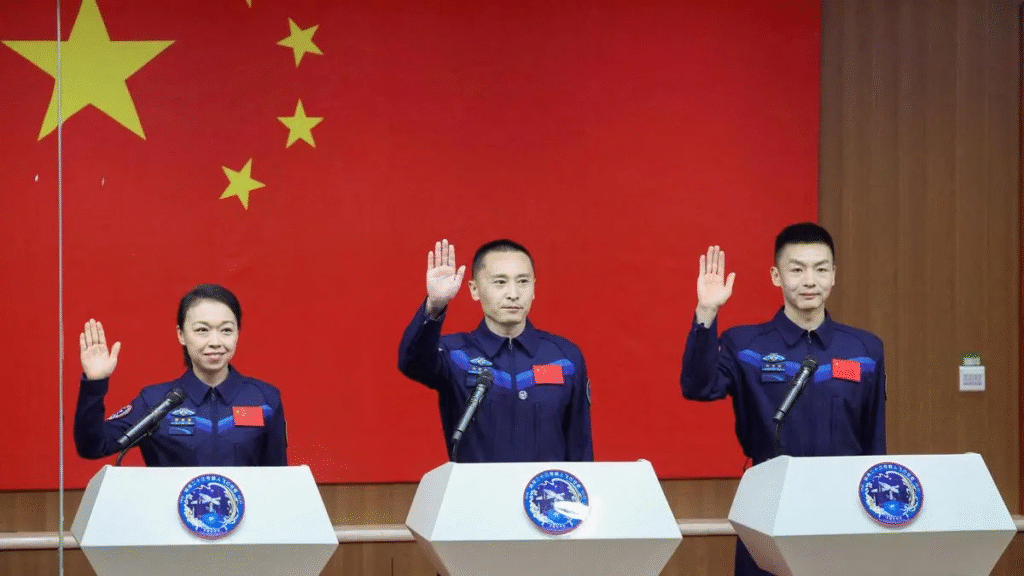
The Shenzhou-23 spacecraft was launched on May 24. It carried rice seeds and other experimental materials to China’s space station. Since entering China’s space station, three astronauts – Zhu Yangzhu, Zhang Zhiyuan and Lai Ka-ying- carried out a series of space science experiments.
They completed the collection and storage of the first batch of rice samples for the mission’s first experiment on the molecular mechanisms of multi-generational genetic stability and environmental adaptability in space-grown rice a few days ago.
Key to human achievement
The China Science Daily said scientists view this as the key to determining whether humans can achieve in situ plant cultivation and establish stable food supplies in space.
The experiment’s objective is to cultivate two consecutive generations of rice in orbit – from seed to seed to seed – enabling scientists to investigate how prolonged exposure to microgravity influences the crop’s genetic stability, the Global Times report said.
China had carried out the world’s first seed-to-seed rice cultivation experiment in orbit in 2022. Then, six rice seeds were cultivated in orbit, producing 59 first-generation space-grown seeds over 120 days. This was carried out by the crew of another space mission, Shenzhou-14.
In the current experiment, the astronauts planted six seeds in each of the four units they had. These four units were divided into two groups based on the reproduction methods of rice.
In one group, after the seeds mature, rice panicles will be harvested and transferred to new cultivation boxes for the growth of the second generation. The experiment will examine the “transgenerational memory” formed through sexual reproduction – specifically, whether seeds that have previously been exposed to space are more adaptable to the space environment than seeds that have never left Earth.
On the job since 2006
The other group will adopt a ratooning rice cultivation model. After the rice matures, only the root will be retained, allowing new shoots to regenerate from the remaining stubble and produce another crop. The experiment will compare the differences in adaptability between vegetative reproduction and sexual reproduction under the space environment, the report said
The astronauts will return rice panicles, seeds and frozen plant samples to Earth for research, helping inform the selection of future space agriculture models.
The China Science daily said Chinese scientists have been carrying out experiments for nearly two decades now. In 2006, the “Shijian-8” satellite mission conducted experiments on plant flowering and pollination.
https://www.thehindubusinessline.com/economy/agri-business/chinese-astronauts-harvest-rice-in-space-for-the-first-time/article71327364.ecePublished Date: August 10, 2026


 READ
READ