Downloads
 Login
 Register

Building a National Brand: Establishing a Sustainable Position and Affirming the Identity of Vietnamese Rice in the World
From its achievements in world-class rice competitions to its journey of asserting its value in the international market, Vietnamese rice faces a new challenge: building a brand based on quality, science and technology, and the collaboration of businesses, cooperatives, and farmers.
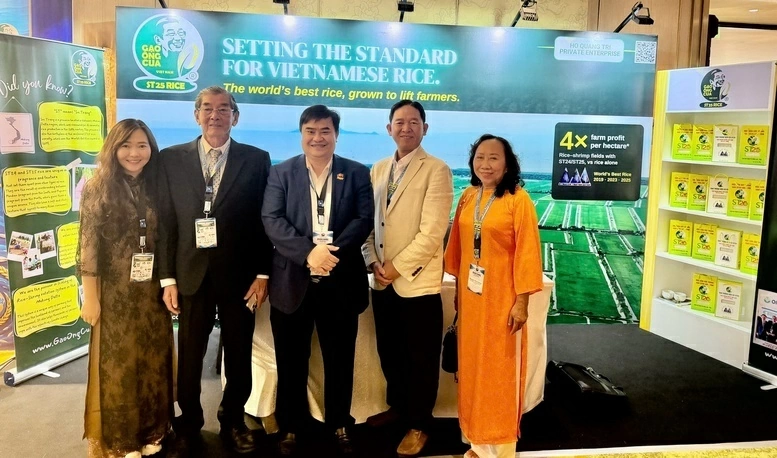
At the 2026 World’s Best Rice Competition held in Manila, Philippines, ST25 rice under the Ong Cua brand was once again honored with second place. This is the ninth time ST25 has participated in the competition, and all nine times it has been in the top 3, including three first-place wins in 2019, 2023, and 2025.
This achievement further affirms the quality and competitiveness of Vietnamese rice in the international market, and demonstrates the role of scientific research and innovation in enhancing the value of agricultural products.
The gap between rice seed quality and product value.
Behind these awards lies the persistent research of a team of scientists, including engineer and Labor Hero Ho Quang Cua. According to him, the research process to develop a rice variety usually takes more than 10 years. From ST24, ST25 to the recently developed ST26, each product is the result of a long journey of investment in knowledge and technology.
Since 2017, engineer Ho Quang Cua’s research team has continuously participated in conferences and competitions for the best rice in the world. Throughout this journey, Vietnamese rice has consistently ranked among the top three products, winning first prize three times. These achievements contribute to promoting the quality of Vietnamese rice, enhancing its recognition and position in the international market.
According to Mr. Ho Quang Cua, one of the outstanding advantages of ST25 is that it is a short-day rice variety, allowing for multiple harvests per year. Meanwhile, many famous fragrant rice varieties worldwide belong to the seasonal rice group, with low yields and only one harvest per year. Towards the end of the storage cycle, the quality and aroma of the rice may deteriorate, thus creating a competitive advantage for Vietnam’s ST25 supply.
However, the reputation and quality of a rice variety do not necessarily mean that its full commercial value has been exploited to the fullest extent.
Labor Hero Ho Quang Cua noted that the reality of rice exports shows that the Vietnamese rice industry is facing many more difficulties than about three years ago. Although varieties like Dai Thom 8, OM18, and OM5451 are of good quality, their export prices are not significantly different from many common rice varieties. This affects the profits of businesses and the income of farmers, especially in seasons with unfavorable weather conditions.
This reality necessitates a shift from a focus on quantity to a focus on value, in which branding becomes a crucial factor in enhancing the competitiveness of Vietnamese rice.
One of the notable issues in rice branding is the gap between the quality of the rice variety and the value of the product when it reaches the consumer.
Citing the example of the Chinese market, engineer Ho Quang Cua stated that Vietnamese businesses export approximately 300,000 tons of ST25 rice to this market annually. However, for the same rice variety, the regular product sells for only slightly more than half the price of ST25 rice packaged and distributed by reputable businesses.
This shows that the value of rice lies not only in its variety but also depends on brand reputation, quality management processes, processing methods, packaging, and market organization. When a product is guaranteed in terms of origin, quality, and has a trustworthy brand, businesses have a stronger foundation to access higher-value market segments.
A brand doesn’t start with packaging.
Mr. Le Minh Hoan, former Vice Chairman of the National Assembly and former Minister of Agriculture and Environment, believes that the current mindset in rice production needs to shift from seasonal transactions to co-creation of value. Businesses should not only appear on harvest day but should participate from before the harvest season, working with cooperatives and farmers to select seeds, establish standards, forecast markets, organize raw material areas, and manage risks.
In particular, businesses should not view farmers as simply suppliers aiming to buy at the lowest possible price. Farmers and cooperatives should be seen as partners working together to build a brand.
According to Mr. Le Minh Hoan, a rice brand doesn’t start with packaging. A brand begins with the seeds, the rice paddy, the water source, the use of fertilizers and pesticides, the harvesting and preservation methods. In other words, a brand is formed right in the rice field.
It’s a shift from “buying from each other” to “working together,” from sharing the benefits of a deal to jointly creating a larger value pie and then sharing that value.
Mr. Le Minh Hoan emphasized: “If buyers only want to buy at the lowest price and sellers only want to sell at the highest price, then the two sides are on opposite sides of the negotiating table. But if they both want to produce better, greener, branded rice that can access better markets, then businesses, cooperatives, and farmers are sitting on the same side of the table. That is true co-creation. And if they are creating value together, they must also share the benefits and the risks.”
This perspective suggests that building a brand for Vietnamese rice should be viewed as a long-term collaborative process, in which each entity has a role and responsibility. Businesses need to participate in organizing production, guiding the market, and investing in branding; cooperatives play a connecting and coordinating role in raw material areas; and farmers are the direct creators of product quality in the fields.
When all links in the chain work towards a common goal, quality control and traceability will have a more solid foundation. More importantly, the benefits from the brand built are not only concentrated in the processing and distribution stages but can also extend to those directly involved in production.
Compete through quality and differentiation.
ST25’s achievements in international competitions demonstrate that Vietnamese rice is competitive in terms of quality and differentiation. However, for these successes to become a long-term advantage, a comprehensive branding strategy is needed, encompassing everything from seed research and production organization to quality standards, processing, and distribution.
The proposal to build a national brand for ST25 rice is noteworthy, especially in the context of needing to enhance the commercial value of high-quality rice varieties. However, the broader goal is to gradually build an image of Vietnamese rice that is reputable, distinctive, and capable of meeting the increasingly high demands of the international market.
This requires long-term investment in science and technology, innovation, quality management, and the development of organized raw material areas. At the same time, it is necessary to strengthen the links between businesses, cooperatives, and farmers, ensuring product quality from the field to the table.
According to engineer Ho Quang Cua, although its contribution to the Gross Domestic Product (GDP) is not very large, the rice industry still has special significance for the livelihoods of millions of farmers. Therefore, building a national brand for ST25 rice, linked with quality management and production reorganization, is a solution that needs attention to enhance the value of rice grains and improve the lives of rice farmers.
https://www.vietnam.vn/en/xay-dung-thuong-hieu-quoc-gia-tao-dung-vi-the-ben-vung-khang-dinh-ban-sac-gao-viet-nam-tren-the-gioiPublished Date: November 26, 2026


 READ