Downloads
 Login
 Register


Pakistan-Russia Trade Push Offers Opportunity to Revive Rice Exports After 96% Decline
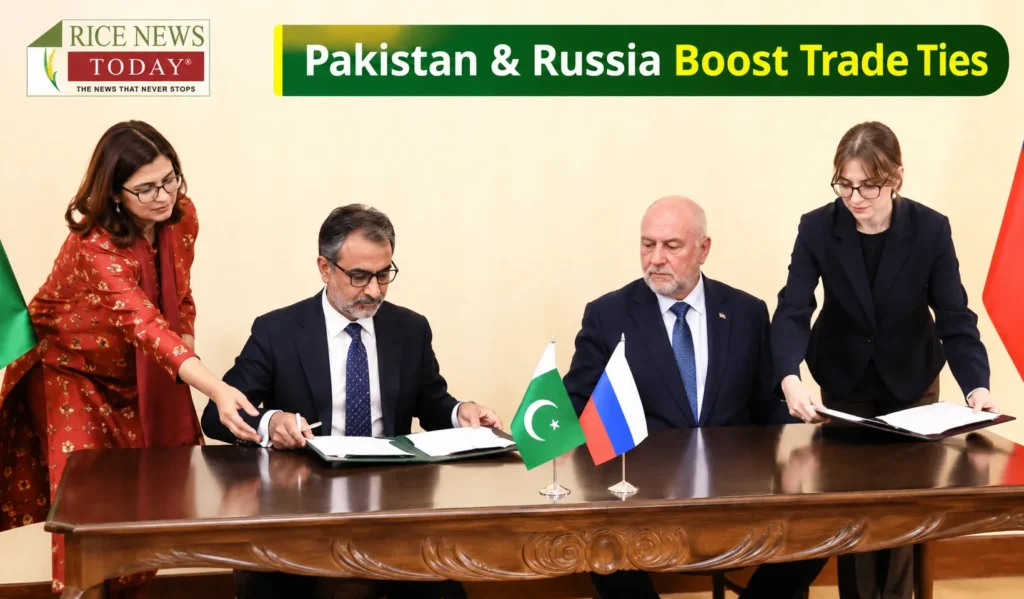
Pakistan and Russia are seeking to strengthen bilateral trade and expand agricultural cooperation, potentially opening new opportunities for Pakistani rice exporters to rebuild shipments to the Russian market. However, Pakistan’s rice exports to Russia have declined sharply over the past year, highlighting the need to translate renewed diplomatic engagement into actual trade orders and sustained market access.
The two countries agreed to increase bilateral trade to US$5 billion by 2030 following the 11th Pakistan-Russia Intergovernmental Commission (IGC) meeting held in Moscow on November 25. The agreement includes a broader framework for economic cooperation, with agriculture, trade facilitation, investment, logistics and business-to-business engagement identified as areas for further development.
For Pakistan’s rice sector, the renewed engagement comes at a time when shipments to Russia have contracted significantly, leaving considerable room for exporters to regain market share.
Pakistan’s Rice Exports to Russia Drop 96%
According to trade data compiled from UN Comtrade and published through World Bank’s World Integrated Trade Solution (WITS), Pakistan exported approximately 5,999 tonnes of rice to Russia in 2024, valued at US$4.37 million. However, shipments declined to just 245 tonnes in 2025, with export value falling to approximately US$246,240.
This represents a year-on-year decline of around 96% in export volume and approximately 94% in export value, indicating a substantial contraction in Pakistan’s presence in the Russian rice market.
The sharp decline highlights the importance of strengthening commercial relationships, identifying the reasons behind lost shipments, and improving the competitiveness of Pakistani rice against alternative suppliers. The figures also suggest that Russia remains a market where Pakistan’s export presence could potentially be rebuilt, provided exporters can secure buyers and compete effectively on pricing, quality, logistics and market requirements.
Russia Remains a Competitive Rice Import Market
Despite Pakistan’s declining shipments, Russia continues to import rice from several major origins, creating a competitive market for exporters.
In 2025, India remained Russia’s leading rice supplier, exporting approximately 154,475 tonnes, valued at US$75.49 million. Kazakhstan supplied around 43,793 tonnes, followed by China with 17,771 tonnes and Thailand with 16,897 tonnes.
Pakistan’s exports of just 245 tonnes placed it well behind these major suppliers, illustrating the competitive gap that Pakistani exporters would need to address to regain a stronger position.
The market’s existing supplier base demonstrates that Russia maintains established sourcing channels. Pakistan’s ability to increase shipments will therefore depend not only on trade agreements and diplomatic engagement but also on competitive offers, suitable rice varieties, reliable delivery arrangements and stronger relationships with Russian importers.
Pakistan-Russia Agreement Targets $5 Billion in Bilateral Trade
At the 11th session of the Pakistan-Russia Intergovernmental Commission in Moscow, both countries signed the commission’s protocol and the Programme of Economic Cooperation for 2026–2030.
The framework aims to increase bilateral trade to US$5 billion by 2030 and promote greater economic engagement through improved market access, investment facilitation and stronger business-to-business connections.
Agriculture and food security were among the priority areas discussed, with both sides agreeing to expand agricultural trade and strengthen cooperation in livestock, fisheries, aquaculture, veterinary products and value addition.
The agreement provides a broader platform for commercial cooperation, although the US$5 billion target covers overall bilateral trade and is not a specific target for rice or agricultural exports.
For Pakistan’s rice industry, the challenge will be to ensure that the renewed trade agenda creates practical opportunities for rice mills, exporters and importers rather than remaining limited to high-level agreements.
Improved Logistics and Market Access Could Support Rice Trade
Transport connectivity is another area that could influence future agricultural trade between the two countries. Pakistan and Russia have agreed to pursue a pilot cargo train, reflecting their interest in improving logistics and trade connectivity.
More efficient transport arrangements, predictable transit times and competitive freight costs could help Pakistani exporters evaluate alternative routes and improve their ability to serve Russian buyers. However, rice shipments would still need to remain commercially viable against competing origins, considering freight, handling, delivery schedules and destination-market requirements.
Market access and regulatory compliance will also remain important. Exporters need to ensure that their products, processing facilities and documentation meet Russian import requirements, while maintaining consistent quality and shipment reliability.
Russia’s Agricultural Cooperation Could Extend Beyond Trade
Pakistan and Russia have also been exploring wider cooperation in agriculture, including agricultural machinery, technology, fertilizers, pesticides and other agricultural inputs.
In August 2026, Pakistan’s Ministry of National Food Security and Research held discussions with Russian representatives on expanding agricultural cooperation, with Russian companies expressing interest in supplying machinery, agricultural inputs and related technologies.
Although these discussions are broader than rice trade, stronger agricultural cooperation could support the development of commercial relationships, technical exchanges and business connections between the two countries.
Outlook: Rebuilding Russian Market Share Will Require Commercial Follow-Through
Russia could offer an opportunity for Pakistan to diversify its rice export destinations, but recovering lost market share will require more than diplomatic agreements. Exporters will need to identify active Russian buyers, understand their preferred varieties and specifications, offer competitive prices, and establish dependable shipment arrangements.
The sharp decline in Pakistan’s rice exports to Russia in 2025 underscores the scale of the challenge. With bilateral trade expansion now a stated priority, closer engagement between government agencies, trade bodies, rice exporters and Russian importers could help revive shipments and strengthen Pakistan’s position in the market.
The success of the renewed trade initiative will ultimately depend on whether it translates into actual rice export orders, completed shipments and sustained commercial relationships.
By RiceNewsToday | Sources: CSCR, Radio Pakistan, WITS/World Bank, APP, PID, Dawn
Published Date: November 26, 2026



 READ