Downloads
 Login
Login
 Register

Tags
Agricultural workshop maps investment pathways for climate-smart farming in ASEAN
The workshop aims to produce concrete outputs, including policy recommendations on low-emissions rice and identification of viable financial instruments.
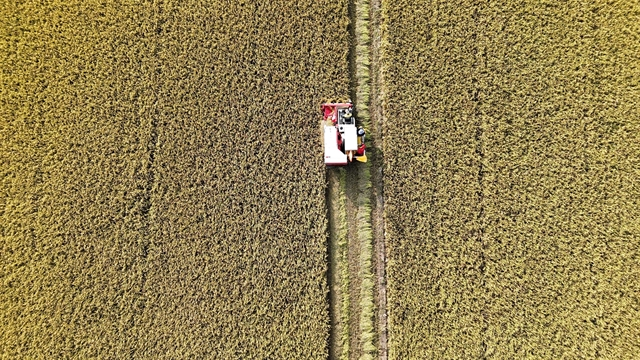
HÀ NỘI — As the world’s largest rice producers, Southeast Asian countries are seeking to cut methane emissions and transform farming practices as they advance their climate commitments.
Representatives from six ASEAN countries are convening in Hà Nội this week for a landmark workshop to develop coordinated strategies for transforming the region’s rice production toward lower emissions.
Taking place from January 21 to 23, the event brings together 70 delegates from Việt Nam, the Philippines, Thailand, Indonesia, Cambodia and Laos, including senior government officials, researchers, private sector leaders and farming representatives.
Addressing agriculture’s climate impact at scale and food security, the workshop was organised by the International Rice Research Institute (IRRI) and Việt Nam’s Institute of Strategy, Agricultural Policy and Environment (ISPAE), with support from the Clean Air and Climate Coalition, the Methane Reductions Accelerator in Southeast Asia project and the German Agency for International Cooperation (GIZ).
Southeast Asia produces the vast majority of the world’s rice, sustaining tens of millions of farming families. Yet rice cultivation in flooded paddies is a significant source of methane emissions.
As ASEAN countries advance their Nationally Determined Contributions under the Paris Agreement, the rice sector faces growing pressure to transform.
Jongsoo Shin, IRRI’s Regional Director for Asia, said: “This is a pivotal moment for ASEAN to uphold its global pioneering position in low-emissions rice production.
“We are not just protecting the environment, but also opening new markets, enhancing value chain worth and improving sustainable livelihoods for millions of farmers.”
Countries at different transformation stages offer valuable lessons. Thailand has made significant achievements with alternate wetting and drying techniques, and the Philippines has integrated climate-smart practices into national programmes.
Việt Nam is transforming one million hectares in its Mekong Delta towards high-quality, low-emissions production, while Indonesia, Cambodia and Laos are developing innovative strategies.
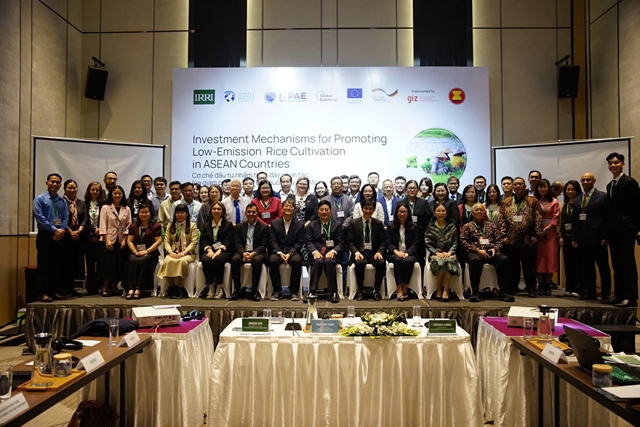 |
| Speakers and participants at the three-day workshop in Hà Nội pose for a commemorative photo. — VNS Photo Trần Như |
The workshop aims to produce concrete outputs, including policy recommendations on low-emissions rice price premiums, credit, subsidies and agricultural insurance, as well as identification of viable financial instruments such as results-based payments, carbon credits and blended finance.
It also looks into cost-effective monitoring frameworks and institutional mechanisms for ongoing knowledge exchange.
ISPAE director Dr Trần Công Thắng emphasised: “ASEAN has the opportunity to not only respond to climate change, but also lead the global green transformation in the rice sector. Our success will shape the food and climate future for billions of people.”
Beyond Southeast Asia, the outcomes have global implications. As major rice producers, ASEAN countries’ approaches will influence international markets, shape consumer expectations and potentially establish standards for other regions.
The mechanisms developed may offer models applicable to rice production worldwide and other agricultural sectors facing similar transformation challenges.
Day one of the workshop features comprehensive presentations from the Philippines, Việt Nam and Thailand on national policies and challenges. Research findings from household surveys across thousands of farms provide empirical evidence on emissions reduction technologies.
Day two focuses on financing transformation at scale. International partners, including GIZ, the Global Green Growth Institute, Asian Development Bank, UN Global Compact and Food and Agriculture Organization, present mechanisms for mobilising climate finance and private investment.
The third and final day examines Việt Nam’s Mekong Delta, which accounts for over 90 per cent of Việt Nam’s rice exports, as a detailed case study applicable across Southeast Asian rice regions.
IRRI researchers present economic modelling and cost-benefit analysis for Cần Thơ City and a part of Cà Mau Province (formerly Bạc Liêu), demonstrating economic viability when appropriate support mechanisms are in place. — VNS
https://vietnamnews.vn/society/1764272/agricultural-workshop-maps-investment-pathways-for-climate-smart-farming-in-asean.htmlPublished Date: January 22, 2026



 READ
READ