Downloads
 Login
 Register

Tags
Two Years of A Prabowo Administration Determined Sustainable Rice Self-Sufficiency
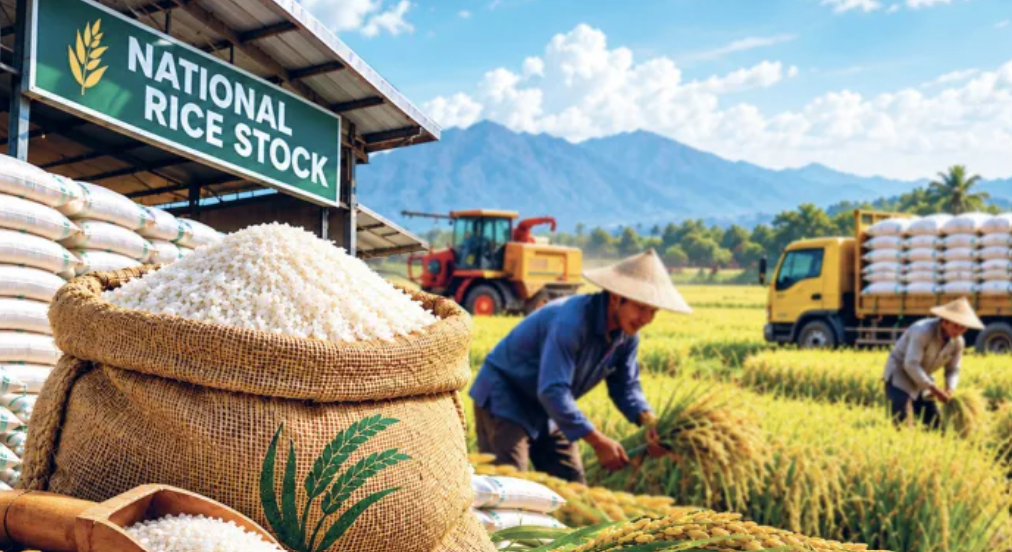
Jakarta, IO – Various national and international reports indicate that the Indonesian government has consistently implemented policies, programs and strategic initiatives to strengthen national food security and self-sufficiency. These efforts focus on increasing production, bolstering rice reserves and enacting policies that favor farmers. Such strategic measures have yielded positive results: according to a release by BULOG in October 2026, national rice stocks reached 4.6–4.7 million tons³a remarkably significant achievement and the highest level recorded in the history of national rice stock fluctuations.
On several occasions, Minister of Agriculture Andi Amran Sulaiman has emphasized that food security is further supported by an estimated 10 million tons of rice currently in the fields standing crop, approximately 10 million tons held by households, the hospitality sector and other entities, as well as 4.6 million tons stored in warehouses.
Beyond ensuring national food availability, the Government has simultaneously sought to improve farmers’ welfare by reducing cutting prices by 20 percent—thereby lowering agricultural production costs— and by raising the Government-mandated purchase price for unhusked rice. These policies have played a tangible role in boosting the Farmers’ Terms of Trade to 131—a highly significant milestone for the national rice farming sector.
The performance of the national agricultural sector over the past two years is also rejected in its strengthened contribution to the national economy, evidenced by a 5.74 percent growth in the agricultural Gross Domestic Product. In terms of trade, the Government has recorded an increase of IDR 166 trillion in agricultural export value, alongside a IDR 41 trillion reduction in imports. To sustain food self-sufficiency³beyond efforts in intensification and diversification—the Government is preparing to develop 2 million hectares of mineral soil land. This initiative is planned for phased implementation, beginning with the cultivation of 500,000 hectares through a synergy between the Ministry of Agriculture and several strategic partners. This measure is part of a long-term strategy to bolster national food production capacity, in line with population growth.
Nevertheless, despite the significant success achieved in rice self-sufficiency, the global agricultural community currently faces high-risk pressures regarding a potential decline in food production, resulting from the emergence of a “Godzilla El Niño”. The Ministry of Agriculture has been—and continues to be—engaged in strategic actions to strengthen anticipation, mitigation and adaptation measures against climate change— including the impacts of El Niño and La Niña—while simultaneously maintaining the stability of national food prices.
National Rice Production
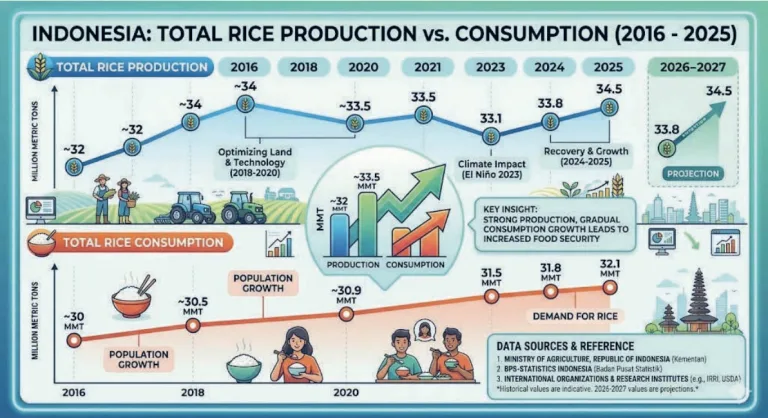
Over the last decade (2016–2025), the dynamics of the rice sector in Indonesia have experienced significant macro-level fluctuations, driven by various factors—including climate challenges such as El Niño and La Niña, the extensive conversion of agricultural land and shifts in public food consumption patterns.
In general, the trends for these two indicators can be divided into two main phases. The 2016–2023 period was characterized by a narrow surplus and climate-related pressures. Early in this period (2016–2018), rice production figures appeared quite high; however, following the implementation of an improved calculation method by Statistics Indonesia—the Area Sampling Framework—in 2018, the actual national production figures were adjusted to a range of 31 to 34 million tons per year. The situation reached a critical point in 2023, when an extreme El Niño event caused production to drop to approximately 31.1 million tons. Meanwhile, national rice consumption continued to climb alongside population growth, remaining stable in the range of 30 to 31.2 million tons annually. Due to the slim surplus—and even prolonged monthly deficits toward the end of 2023—the Government was compelled to authorize large-scale rice imports, totaling 3.06 million tons in 2023, to maintain the Government Rice Reserve (Subejo, 2026).
Furthermore, an analysis by Subejo (2026) indicates that the second phase—under the administration of President Prabowo, covering the 2024–2025 period—served as a phase of recovery and record-breaking surpluses. Beginning in 2024 and peaking in 2025, Indonesia’s agricultural sector experienced a substantial leap forward. Through acceleration programs—such as the optimization of swamplands, large-scale installation of irrigation pumps and an increase in the subsidized fertilizer allocation to 9.55 million tons—domestic rice production rebounded. By 2025, Indonesia’s rice production reached a significant record surplus. 1ational output surged well beyond domestic demand, while national consumption levels were successfully contained and managed through local food diversification programs. This substantial surplus in filled B8/2G·s warehouses to capacity and drastically reduced reliance on imported rice, as of the end of the year.
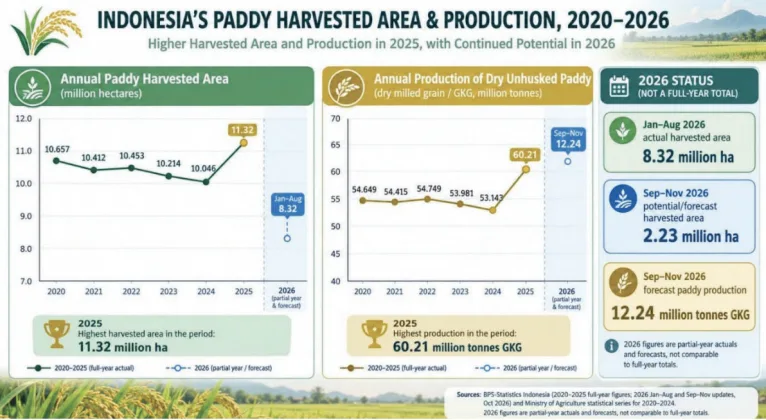
Data from this shorter timeframe (2024–2025) reveals a significant expansion in rice cultivation areas: by 2025, the harvested area for rice reached 11.32 million hectares. This had a tangible impact on total unhusked rice (grain) production: while output stood at 53.14 million tons in , it significantly surged, to . million tons in 2025.
Ensuring the stability of national food production in Indonesia has become increasingly complex over time. The challenges requiring strategic attention and action go beyond mere sufficiency in seeds and fertilizers; they now encompass the capacity to respond effectively to extreme conditions, such as climate anomalies and infrastructure limitations.
A critical issue in Indonesia’s agricultural and food sector over the past few years has been the management of—and equitable access to—water resources. When the land is affected by such extreme phenomena as El Niño, Indonesia’s secondary and tertiary irrigation networks often prove inadequate for even distribution of water, characterized by a drastic decline in reservoir volumes, putting millions of hectares of rice paddies at severe risk of total crop failure.
This situation is exacerbated by the financial vulnerability of smallholder farmers, who serve as the primary drivers of our food production. Lacking such safeguards as comprehensive agricultural insurance, social security and fair pricing at harvest, these farmers are highly vulnerable to bankruptcy when faced with droughts or pest outbreaks triggered by hot weather. Such a scenario poses a grave threat to the stability of national food production and food security.
Therefore, a key factor in maintaining stable national food production and adequate stocks lies in the rapid modernization of water management infrastructure—including irrigation systems, large-scale pumping operations and the development and activation of village-level reservoirs. These efforts must be coupled with ongoing guidance and support from agricultural extension workers to find ways to reinforce the economic resilience of the farmers who stand on the front lines of Indonesia’s food production.
Indonesia’s Status Among Major Global Rice Producers
The world’s five leading rice producing nations have all shown a steady, year-on-year upward trend in harvest volumes; Indonesia is a key player in global rice production, while India holds top position with the largest output, followed by China in second place. Bangladesh, Indonesia and Vietnam round out the group, with roughly comparable production volumes.
In a global context, Indonesia ranks as the fourth-largest rice producer, with output consistently on the rise: from 34 million tons in 2023, to a projected 35 million tons in 2024 and 36 million tons in 2025.
Our role in, and contribution to global rice production are also rejected in its productivity of rice: over the past three years, we have consistently ranked third on average, trailing only China and India. Indonesia’s rice productivity stood at 5.3 tons/ha in 2023, inching up to 5.4 tons/ha in 2024 and set to reach 5.5 tons/ha in 2025, when its productivity ranked only behind that of India (7.3 tons/ ha) and Vietnam (6.2 tons/ha). The Government of Indonesia continues to introduce and refine rice cultivation innovations and technologies— in collaboration with universities, research institutions and corporate entities—making it highly plausible that, in the future, our average rice productivity could logically approach levels seen in India and Vietnam.
Food Security Extends Beyond Rice Self-Sufficiency
The achievement of national rice self-sufficiency over the last two years is highly commendable, demonstrating to the global community that Indonesia has become a key player in global rice production. Domestically, this holds strategic importance, given that rice is the staple food for the entire Indonesian population—a commodity that must be available at all times, in every location and to everyone, while maintaining a standard of high quality.
This milestone in rice self-sufficiency serves as a vital momentum for the Indonesian government to formulate policies and strategic measures aimed at strengthening national food security. A point of concern, however, is Indonesia’s ranking in the 2025 Global Food Security Index, where it sits at 72nd place. Although this number reveals how our ranking has declined, the nation’s total score has actually improved—rising from 58.2 in 2020 to a projected 64 by 2026—which suggests that other nations are also making significant progress.
Indonesia’s standing in the Global Food Security Index is also linked to its imports of several major food commodities, including wheat, corn, soybeans, meat and livestock products. If the comprehensive policies and breakthroughs applied to rice were to be consistently replicated across other strategic national food commodities—such as corn, soybeans, meat and livestock products—there would be a golden opportunity to substantially reduce Indonesia’s imports. Ultimately, this would lead to a marked improvement in the nation’s overall food security status.
The “Godzilla El Niño” Threat: Adaptation and Mitigation Strategies
A report by the ANTARA news agency (2026) indicates that national rice production for the period of January–October 2026 is projected to decline slightly, down by 0.08 percent and reaching 31.41 million tons (down from 31.44 million tons during the same period in 2025) as a result of the impact of what is nicknamed an extreme “Godzilla El Niño” climate phenomenon. Statistics Indonesia has noted a potential marginal decrease in rice and paddy production, resulting from drought conditions and delays in planting schedules. During a previous El Niño event (January–April 2024), national rice production suffered a sharper decline—dropping by 2.28 million tons, or 17.52 percent. Certain regions, including Java, Bali, West Nusa Tenggara and East Nusa Tenggara, faced more severe dry seasons due to the combined effects of El Niño and a positive Indian Ocean Dipole.
National media reports have highlighted several alternative strategies implemented by the Indonesian government, through the Ministry of Agriculture, to mitigate the impact of the Godzilla El Niño. These include: (a) securing primary food reserves (rice), (b) implementing a water-pumping program, (c) optimizing swampland for agricultural use and (d) providing drought-adaptive rice seeds.
As part of efforts to secure primary food reserves, by October 2026 the Government had successfully built-up Government Rice Reserves stored in BULOG warehouses, totaling 4.6– 4.7 million tons. This bulwark is supplemented by an estimated 10 million tons of rice currently in the field (standing crop), alongside approximately 10 million tons held within the hospitality sector, households and other areas. To anticipate the risk of water shortages for agriculture, the Government has distributed tens of thousands of water pumps—with a target of reaching 56,000 units— across key rice-producing regions. These pumps are intended to draw water from rivers or other nearby sources to irrigate rice paddies when they threaten to dry out.
In addition to the deployment of water pumps, a swamp land optimization program is also being implemented. This initiative aims to transform swamp areas—which are prone to either drying out or flooding-by stabilizing their water management systems. Through this program, land that previously yielded only one rice harvest per year will see its cropping intensity increased to two or three harvests annually.
Another program implemented by the Government—and one that will be sustained—is the provision of drought-resistant rice seeds. The Ministry of Agriculture has distributed rice varieties – developed by the Indonesian Center for Rice Research – that are adaptive to drought stress, such as Inpari, Inpago and Situbagendit, as well as varieties with shorter harvest cycles. Furthermore, in recent years, Universitas Gadjah Mada has developed and commercialized the Gamagora 7 rice variety, which is modified to deal with climate change.
In addition to existing government programs, several adaptive and mitigative strategies to address the risks posed by a “Godzilla El Niño”—such as accelerating planting schedules, adopting adaptive cropping patterns and diversification and managing small-scale reservoirs —must be developed on a large scale and implemented immediately.
Accelerating the planting schedule is an option farmers can pursue to anticipate water scarcity. Farmers should have prepared their land and replanted rice within a maximum of 14 days after harvest, taking advantage of residual soil moisture before water supplies were completely depleted at the peak of the dry season in August 2026.
Adaptive cropping patterns and diversification are also viable alternatives for regions where water availability is severely limited. In areas identified as having critical water reserves—such as West Nusa Tenggara, East Nusa Tenggara and parts of Kalimantan—farmers should be encouraged to shift from rice to other food crops or secondary crops such as corn, sorghum, soybeans or forage grasses, vegetation which requires significantly less water and is characterized by shorter growth cycles.
Another urgent measure is the management of small-scale reservoirs. Central, regional and village governments must promptly inventory and strictly reactivate village-level reservoirs, to ensure that remaining rainwater can be distributed equitably for agricultural purposes, without depleting the clean water sources relied upon by local residents.
Strengthening Human Resources and Agricultural Extension Services
In the context of preparing farmers at the grassroots level for projected negative impacts of the Godzilla El Niño, a key challenge lies in shifting the farmers’ mindset—moving away from a reactive approach (where they often struggle to find solutions once water supplies dwindle or run out) toward a proactive one, where they are encouraged to prepare well before seeds are even sown. The success of mitigating the effects of this Godzilla El Niño hinges on how actively and effectively agricultural extension workers support farmer groups and individual farmers.
As guides and facilitators for farmers, agricultural extension workers play a highly strategic role in determining their success (farmers are, in effect, agricultural entrepreneurs) as their primary point of contact, in implementing adaptation and mitigation measures against a “Godzilla” El Niño. These extension workers must collaborate with strategic partners—such as researchers from local universities, research institutions, non-governmental organizations and others—to develop climate-change adaptation innovations, ultimately enabling farmers to minimize the adverse impacts of the Godzilla El Niño.
Agricultural extension workers need to integrate modern climate knowledge with local wisdom and traditional knowledge to determine an optimal timing for planting. They can act as navigators for planting calendars and digital applications, translating complex macro-climate data into practical guidance for farmers— such as when to sow seeds or how to meet “speed planting” targets (ideally within 14 days post-harvest). They assist farmer groups in utilizing tools like the Integrated Planting Calendar and Siscrop—both developed by the Ministry of Agriculture—as well as other relevant applications, to map potential drought risks at sub-district and village levels with greater precision.
Ultimately, water will become the most precious commodity during the 2026 dry season. Agricultural extension workers must lead the adoption of technologies that conserve water without compromising agricultural productivity. Agricultural extension workers need to introduce the Alternating Wetting and Drying (AWD) irrigation technique. An AWD pilot project—conducted by the Faculty of Agriculture at UGM, in collaboration with Sumitomo Corp and the Kediri Regional Government—successfully demonstrated in 2025 that AWD is effective in conserving water, increasing productivity and cutting carbon emissions.
In practice, agricultural extension workers educate farmers on installing perforated PVC pipes in their rice paddies to monitor the groundwater level. Instead of keeping fields flooded continuously, water is only released when its level drops to 15 cm below the soil surface. Studies indicate that this Alternate Wetting and Drying technique can save up to 30% of water. Extension workers also ensure that government-provided water pumps and deep wells reach their intended beneficiaries, while coordinating water-sharing schedules among farmers to forestall any horizontal conflicts.
Agricultural extension workers play a crucial role in crop selection and diversification. If water availability in a region is deemed insufficient for rice cultivation, they must make firm yet persuasive recommendations. They introduce and oversee the use of adaptive, early-maturing rice varieties with shorter growth cycles. furthermore, in areas identified as high-risk for drought, they advise farmers to switch to drought-resilient food crops—such as sorghum, maize, or sweet potatoes—or to forage grasses for livestock.
To anticipate outbreaks of plant pests and diseases triggered by the Godzilla El Niño phenomenon, agricultural extension workers—in collaboration with pest surveillance officers—will act as “plant doctors.” The hot, dry conditions caused by El Niño create an ideal environment for the proliferation of such pests as brown planthoppers, locusts and various aphids. Together, these extension workers and surveillance officers conduct weekly field monitoring to provide early warnings. Additionally, they teach farmers how to produce biological control agents or natural pesticides and how to use organic mulch and biochar to retain soil moisture while deterring pest attacks.
Agricultural extension workers also play a vital and strategic role in the implementation of agricultural insurance, which serves to mitigate the impact of crop failure. Extreme drought increases the risk of total crop failure; therefore, the role of agricultural extension workers is to provide protection against such risks. These extension workers actively register farmers and encourage them to enroll in the Rice Farming Business Insurance program before the peak of the dry season. If a farmer’s rice fields suffer more than 75% damage from drought, the extension workers assist with the claims process, ensuring that farmers receive the capital needed to replant in the following season (Subejo, 2026).
Strengthening the capacity and competence of agricultural extension workers in climate change mitigation and adaptation has become an absolute necessity. In the face of the real threat posed by global climate change, the role of agricultural extension workers must evolve—moving beyond merely teaching cultivation techniques to becoming climate risk managers at the grassroots level. National food stability depends heavily on how adaptable are these extension workers in supporting farmers in the field.
Strategies to enhance the competence of extension workers should focus on three key pillars. First, the transformation of digital agroclimatology literacy: extension workers must be trained to interpret weather data from the Meteorology, Climatology and Geophysics Agency (BMKG) and to utilize climate adaptation tools— such as the “Planting Calendar”—to provide tactical guidance for farmers. Second, the mastery of circular technologies and water conservation, including the implementation of waterefficient irrigation, reservoir management and the use of seed varieties highly resilient to extreme stress. Third, the development of persuasive and effective communication skills— for instance, through Climate Field Schools—to shift farmers’ mindsets toward a proactive, rather than a reactive, attitude.
Further, Subejo (2026) argues that agricultural extension workers will transcend their traditional role as mere conduits for policy and production technology through such systematic capacity-building. Instead, they will serve as a robust line of defense in safeguarding the nation’s food sovereignty, amidst global climate uncertainty, acting as facilitators and consultants for farmers. As articulated by the FAO-UN in “The Future of Rural Advisory Services” (2026), agricultural extension workers of the future must shift away from a one-way, topdown approach, evolving instead into multi-stakeholder facilitators who are proficient in digital technology and ecological—or agroecological—innovations.
https://observerid.com/two-years-of-a-prabowo-administration-determined-sustainable-rice-self-sufficiency/Published Date: October 31, 2026


 READ