Downloads
 Login
 Register

Tags
Many challenges in rice exports.
In the first nine months of 2026, the global rice market continued to experience complex developments due to the impact of supply and demand fluctuations, unfavorable weather conditions, and geopolitical tensions, which increased competition and put pressure on international rice prices, thereby significantly affecting Vietnam’s rice exports.
Báo Cần Thơ
Difficulties in rice exports
According to the Vietnam Food Association, in the first nine months of 2026, importing countries continued to prioritize ensuring food security and controlling domestic prices, while adjusting import policies to suit supply and demand situations. Meanwhile, major exporting countries such as India, Thailand, Vietnam, Pakistan, and Malaysia continued to compete on price, quality, and market share. In this context, Vietnam’s rice exports were affected by increased competition, price fluctuations, logistics costs, and changes in import policies of key markets. Exporting businesses faced difficulties in balancing supply sources and proactively planning exports.
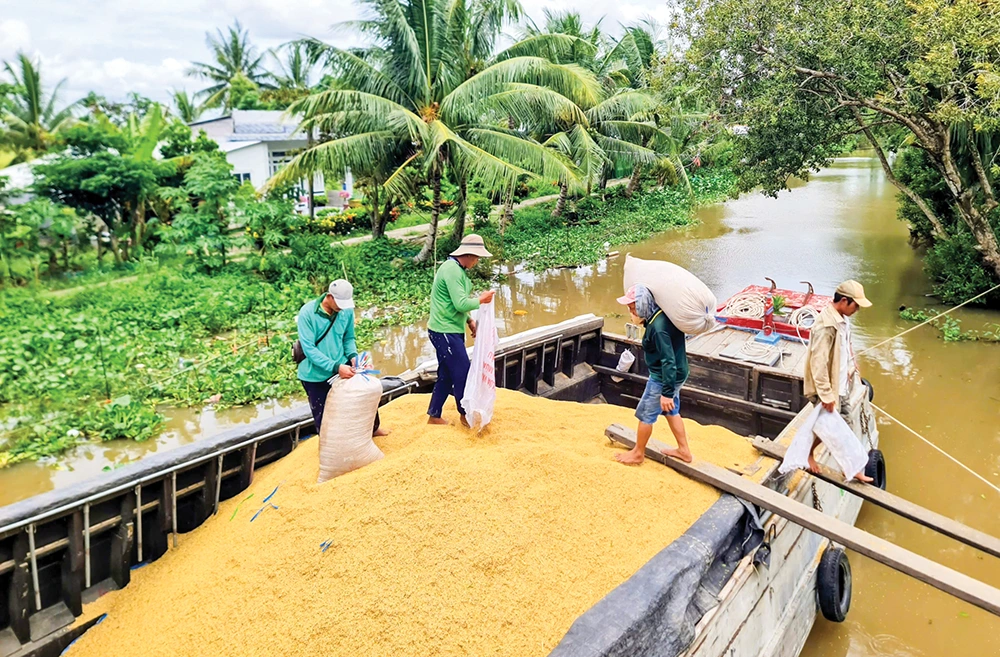
According to compiled data, cumulative rice exports in the first nine months of 2026 reached 6.363 million tons, valued at US$3.057 billion, with an average export price of US$480.41 per ton. Compared to the same period in 2025, there was a decrease of 6.72% in volume, a decrease of 12.26% in value, and a decrease of 6.72% in average price (a decrease of US$30.34 per ton). The Philippines continues to be Vietnam’s largest rice export market. However, this market has undergone several adjustments in rice import policies. Notably, the temporary suspension of import permits due to plant and animal quarantine regulations for imported rice during the peak harvest season is expected to affect Vietnam’s export progress in the remaining months of the year. Meanwhile, exports to China and some African markets have grown, contributing to the expansion and diversification of export markets, but this has not fully offset the decline in the Philippines.
The structure of rice exports continues to shift towards diversification and quality improvement. Several high-quality rice varieties, including fragrant rice, Japanese rice, Jasmine rice, and glutinous rice, increased compared to the same period last year; Dai Thom and OM 18 rice continued to account for the largest share in the export structure, reaching approximately 47.65%, demonstrating that these remain the main product groups of Vietnamese rice.
Meanwhile, the average prices of paddy, rice, and by-products in the first nine months of 2026 fluctuated differently across different commodities. Generally, the price of paddy and most rice and by-products increased compared to the same period, while some types of raw rice and finished rice for export decreased. From mid-August 2026, domestic and export prices of paddy and rice tended to decrease, putting pressure on procurement, processing, and business performance of enterprises. Specifically, the average price of fresh long-grain paddy at the field was 6,079 VND/kg, an increase of 37 VND/kg; regular paddy was 5,757 VND/kg, an increase of 262 VND/kg compared to the same period last year. For grade 1 brown rice, the average price was 9,206 VND/kg, an increase of 133 VND/kg compared to the same period in 2025; grade 1 milled white rice was 10,513 VND/kg, a decrease of 282 VND/kg compared to the same period last year.
Efforts in the final months of the year
According to the plan, in the last three months of the year, Vietnam will export an additional 1.14-1.34 million tons of rice to reach the annual export target of 7.5-7.7 million tons. According to the Vietnam Food Association, in the final months of the year, rice exports will continue to be affected by fluctuations in the global market, adjustments in import policies of other countries, and increased competition among exporting nations. Therefore, it is necessary to implement comprehensive solutions to overcome difficulties for businesses, maintain existing markets, and simultaneously expand and diversify rice export markets.
The export market is increasingly focusing on quality, food safety, traceability, and sustainable production, in addition to requirements for price and supply stability. The export orientation for 2026 and subsequent years will continue to prioritize high-quality rice and fragrant rice; these are segments with significant growth potential, contributing to enhancing the value and competitiveness of Vietnamese rice.

For low-emission rice, market demands extend beyond simply reducing emissions; they also require proof of production processes, traceability, planting area codes, and cultivation data. To consistently meet market requirements, it’s necessary to shift from individual production models to large-scale, standardized raw material areas linked to consumption and with clear verification and traceability mechanisms. This will create a stable supply, consistent product quality, and high added value.
Mr. Nguyen Van Thich, Director of Tan Long Cooperative, Vinh Tuong commune, Can Tho city, said: The cooperative specializes in cultivating high-quality rice on an area of over 500 hectares with varieties such as ST 24, ST 25, OM 18, OM 5451, and developing models for safe and organic rice production. The cooperative guides its members in innovating agricultural production thinking, building a high-quality, environmentally friendly rice value chain. Besides growing rice varieties that meet export standards, the cooperative also collaborates with external partners and guarantees the purchase of organic and high-quality rice from farmers outside the cooperative, covering hundreds of hectares to serve domestic consumption and supply a large quantity of rice for export.
According to Ms. Nguyen Thi Giang, Deputy Director of the Department of Agriculture and Environment of Can Tho City, since the beginning of the year, rice has been the most stable commodity in terms of output, making a significant contribution to the growth of the industry. Purchasing activities for processing and export have remained at a relatively high level. The city continues to promote linkages between farmers, cooperatives, and businesses, especially in areas producing high-quality, low-emission rice. Developing raw material areas, producing according to standards, and ensuring traceability create conditions to improve the quality, value, and marketability of products, thereby contributing to increasing product value and ensuring outlets for farmers.
Text and photos: HOAI THANH
Source: Báo Cần Thơ
https://www.vietnam.vn/en/nhieu-thach-thuc-trong-xuat-khau-gaoPublished Date: October 19, 2026


 READ