Downloads
 Login
Login
 Register

Tags
Pakistan Adds 70,000 Tonnes of Rice Exports
by News Desk
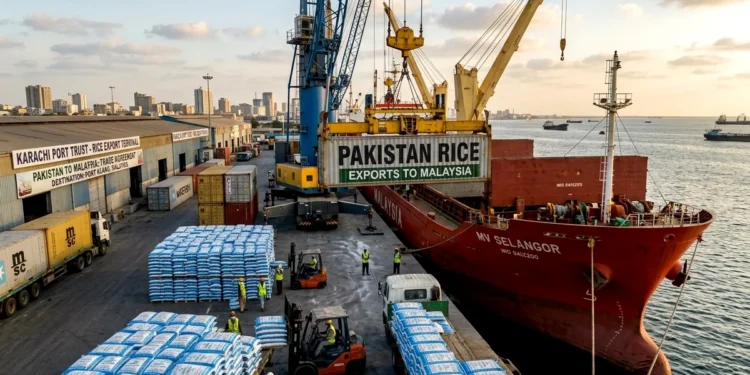
Pakistan is set to export an additional 70,000 metric tonnes of rice to Malaysia between October and December. The deal marks another step in expanding Pakistan’s agricultural exports.
The new volume follows recent talks between Pakistani officials and Malaysian institutions. Discussions focused on rice procurement, food safety, halal certification, and wider market access.
New Rice Export Opportunity
Federal Secretary for National Food Security and Research Amer Ali Ahmed, Commerce Secretary Jawad Paul, and Pakistan’s High Commissioner to Malaysia Syed Ahsan Raza Shah held meetings in Kuala Lumpur.
They met representatives of BERNAS, Malaysia’s national rice procurement agency, along with officials from JAKIM and the Ministry of Agriculture and Food Security.
The September 27 discussions covered Pakistani exports, Malaysian quality standards, halal certification, and food-security cooperation.
As a result, the additional 70,000-tonne export volume gives the talks a clear commercial outcome.
Prime Minister Shehbaz Sharif welcomed the development. He credited the relevant ministries and officials for supporting the new export opportunity.
Malaysia Remains a Major Rice Importer
Malaysia has a significant demand for imported rice. The country imported around 1.5 million tonnes of rice in 2024, while domestic production stood at about 1.4 million tonnes.
Rice imports also increased by 17% that year. Therefore, Malaysia remains an important market for international rice suppliers.
Pakistan has been working to expand its position in this market. In October 2024, the Commerce Ministry arranged B2B meetings between 20 Pakistani agro-exporters and six Malaysian buyers.
At the time, Malaysian buyers were expected to procure around 100,000 metric tonnes of rice.
Trade Links Extend Beyond Rice
The latest discussions also covered meat, poultry, fisheries, aquaculture, and fruits. Officials discussed animal health, biosecurity, halal standards, and supply chains.
Malaysia continues to depend heavily on imports for several food categories. In 2025, its import-dependency ratio reached 90.7% for mutton and 82.6% for beef.
Squid also recorded an import-dependency ratio of 68%.
These figures do not represent confirmed purchases from Pakistan. Instead, they highlight areas where Pakistani exporters could seek greater market access.
Halal Certification and Quality Standards
Expanding agricultural exports will require Pakistani suppliers to meet Malaysian regulations. Rice exporters must comply with local quality requirements.
Meanwhile, meat and animal products face additional requirements. These include halal certification, animal-health controls, traceability, and reliable supply chains.
Moreover, the existing Malaysia-Pakistan trade framework provides a foundation for expanding bilateral commerce.
Pakistan-Malaysia Trade Ties
The rice development comes as Pakistan and Malaysia continue to strengthen economic relations.
Prime Minister Shehbaz Sharif and Malaysian Prime Minister Anwar Ibrahim have reaffirmed their commitment to expanding bilateral cooperation. Economic ties remain an important part of that engagement.
In addition, recent meetings in Kuala Lumpur have created opportunities for cooperation in food security, halal trade, and agricultural exports.
What Comes Next for Rice Exports
The announced 70,000 metric tonnes provides a clear benchmark for Pakistan’s latest export push.
Shipments between October and December will show how much of the announced volume reaches the Malaysian market.
Furthermore, future trade data will indicate whether talks on meat, poultry, fisheries, fruits, and other halal products translate into actual commercial shipments.
https://thedailycpec.com/pakistan-adds-70000-tonnes-of-rice-exports/Published Date: October 7, 2026


 READ
READ