Downloads
 Login
Login
 Register

Tags
Regenerative agriculture: A solution for green growth and reduced emissions.
Faced with the pressures of climate change, the agricultural sector in Dak Lak province is strongly shifting from an “exploitation” mindset to a “nurturing” mindset through circular economy models and regenerative agriculture.
Báo Đắk Lắk
Transforming by-products into resources
Dak Lak province has the potential and favorable conditions for developing agricultural production and has created a value chain for key products of the province, the region, and the nation. However, Dak Lak is also facing a relatively large amount of agricultural by-products released into the environment each harvest season.
To address this issue, the province has strongly encouraged the development of circular agricultural production methods to utilize agricultural waste products for reuse as fertilizers and animal feed in a closed-loop system. Accordingly, many agricultural production facilities following green, clean, circular, emission-reducing, and climate-change-adaptive farming practices have been established and developed.
For example, the circular economy model at Dong Din General Agricultural Business Cooperative is a clear example of “closing the value chain.” Instead of discarding or burning pineapple peels and leaves, causing environmental pollution, the cooperative has utilized the water used to soak the peels to produce safe, biodegradable floor cleaner and dishwashing liquid; and simultaneously composted the peels and pineapple eyes into microbial organic fertilizer.
Mr. Nguyen Hoang Chuong, Director of Dong Din General Agricultural Business Cooperative, affirmed that the unit’s new production mindset is to transform waste from one stage into raw materials for the next. The recycling of organic fertilizer back into the fields helps the cooperative reduce chemical fertilizer costs by 30-40%, contributing to a 20-30% increase in members’ income and successfully developing products that have achieved OCOP 4-star certification.
Similarly to coffee plants, the Nescafé Plan program has guided farmers to make full use of agricultural by-products. Calculations show that each ton of harvested coffee beans removes 41 kg of nitrogen, 80 kg of potassium, and many other minerals from the soil; therefore, returning nutrients from these by-products is the optimal solution to combat soil depletion. Organic residues such as coffee husks, dry branches, and leaves after pruning, instead of being burned, are retained to mulch the base of the plants or composted into bio-fertilizer to be returned to the garden.
Mr. Pham Phu Ngoc, Head of Nestlé Vietnam’s Central Highlands Branch, emphasized: “For sustainable coffee plantations, the soil must be nourished with organic matter. Practical implementation shows that by utilizing this organic source combined with maintaining the grass cover, farmers have saved 40-60% of irrigation water, reduced chemical fertilizers and pesticides by 20%. These regeneration solutions not only optimize input costs but also help maintain stable coffee yields of 3.5-4 tons/ha, thereby increasing farmers’ income by 30-150%.”
Anticipating the carbon credit market
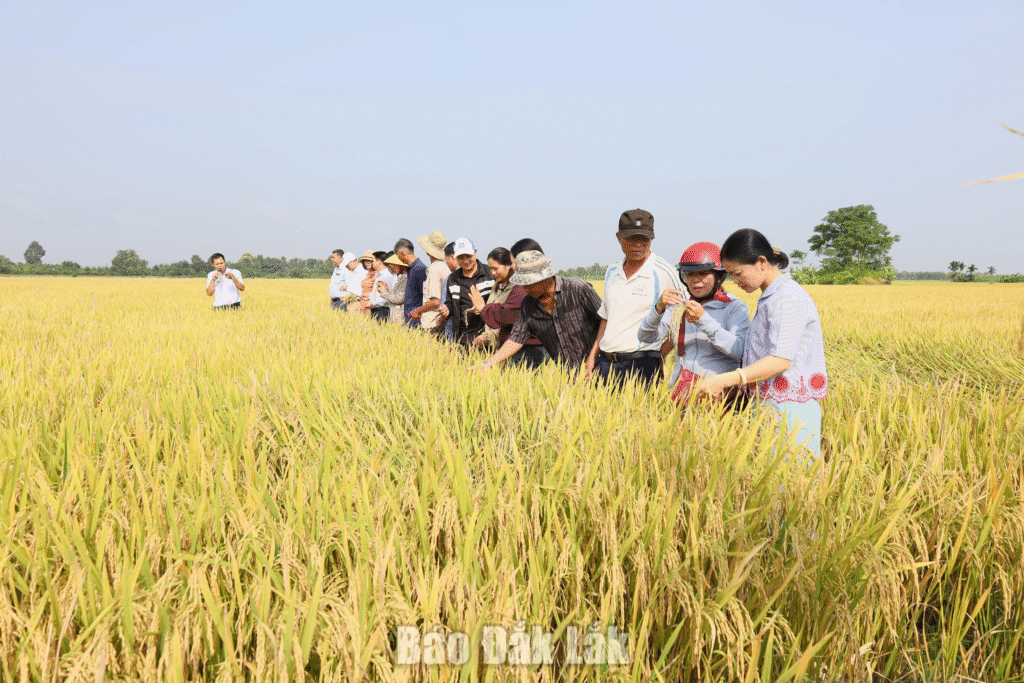
Not only successful in industrial and fruit crops, emission-reduction farming has also made a significant impact on rice fields in many localities. This model applies a synchronized “alternating wet-dry” (AWD) water management process and collects 100% of straw after harvest, completely eliminating the polluting practice of burning rice stalks.
Practical implementation over five seasons in Hoa Phu commune showed that the amount of rice seeds sown was reduced to 80-130 kg/ha, equivalent to a 30-40% reduction compared to traditional practices. These reasonable technical adjustments helped farmers save 1.2-2.5 million VND/ha per season in production costs, while the average annual yield increased by 0.61 tons/ha (an 8.4% increase). Environmentally, the model has been assessed and certified by international organizations for successfully reducing 286.58 tons of CO2e.
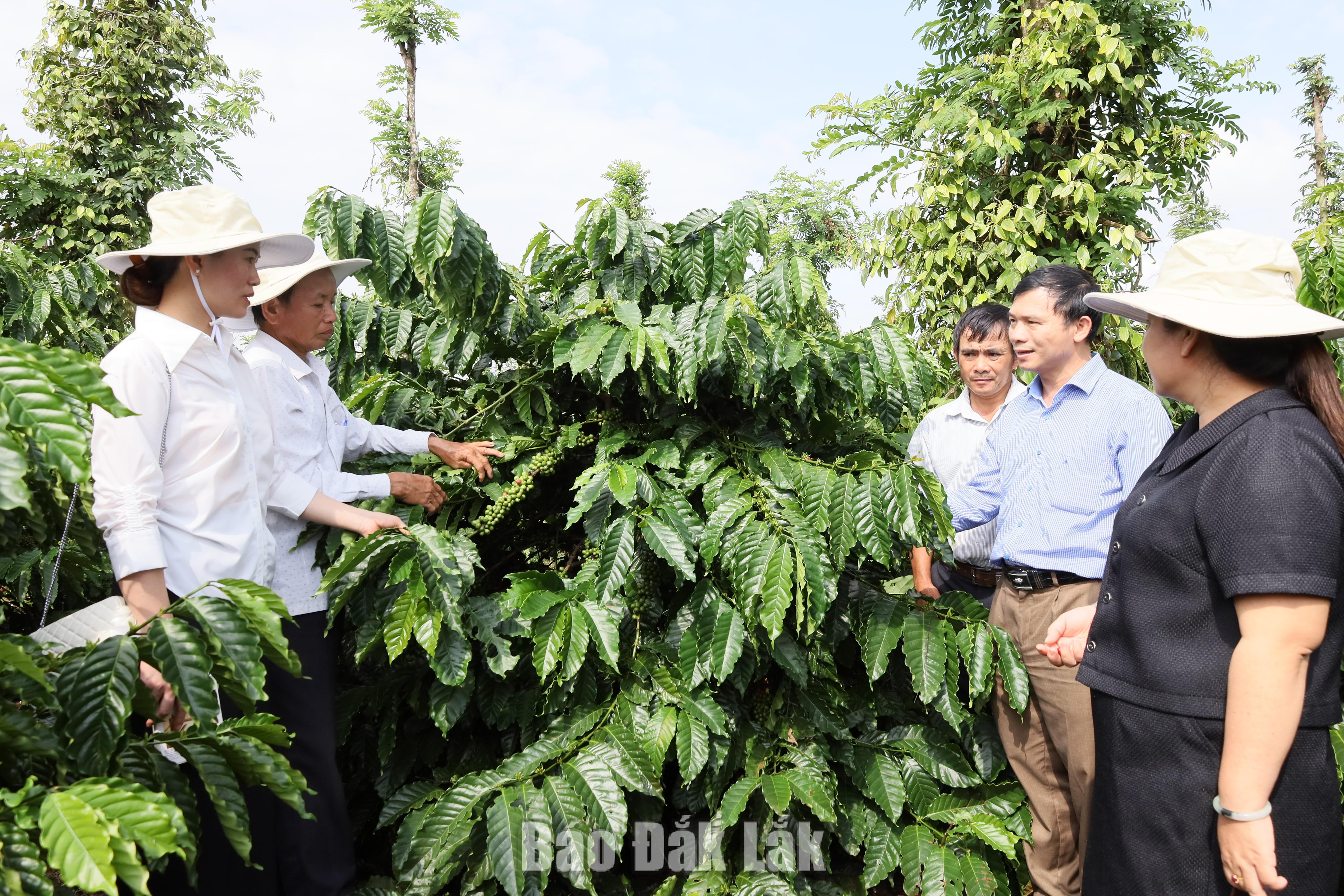 |
| Coffee plantations cultivated using sustainable ecological practices in Ea Ning commune. |
This process helps farmers achieve “three reductions” (reduced seed quantity, reduced chemical fertilizer use, reduced pesticide use) and “three increases” (increased productivity by 15-20%, improved field quality, and increased economic efficiency). The transition to low-emission agriculture is also a strategic step for farmers to increase profits from non-traditional value sources.
According to Mr. Do Van Chung, Deputy Head of the Agricultural Systems Department (WASI Institute), this is a carbon-reducing rice farming model in line with Vietnam’s sustainable agricultural practices. “Currently, not only this model but also five other models have been implemented in Ea Sup district. We work directly with fertilizer dealers and farmers to reduce NPK fertilizer use to decrease greenhouse gas emissions. Farmers in Ea Sup have applied this solution to their second crop and highly appreciate it, even though the amount of NPK fertilizer used has decreased by at least 25-30%,” Mr. Chung shared.
Investing in rice fields using this model is both economical and safe, while ensuring stable yields. Therefore, it is necessary to continue promoting this model to change farmers’ old mindsets, helping them understand the value of proper fertilization in creating a cleaner environment, maintaining productivity, and increasing economic efficiency. This is the most important key to replicating this model for rice farmers as well as those growing other crops today.
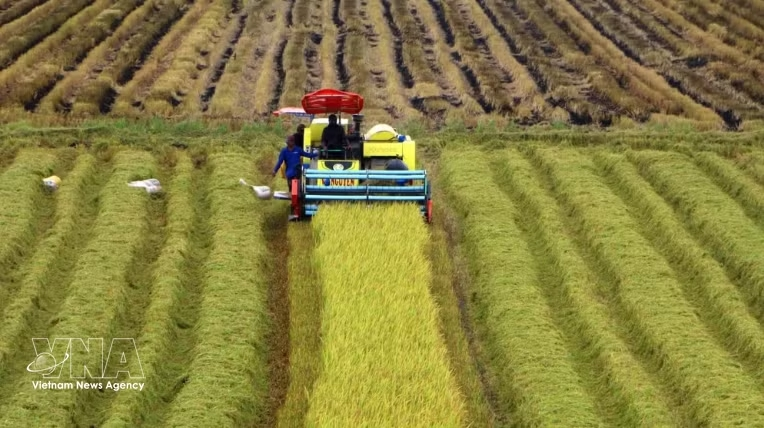
Dak Lak currently has over 170,000 hectares of rice paddies, producing 1.32 million tons per year, ranking first in the South Central Coast and Central Highlands regions. With two cropping seasons and a reliable irrigation system, Dak Lak is ideally suited for rice production aimed at reducing greenhouse gas emissions. In particular, by the end of 2028, the government will require companies discharging pollutants to report their carbon footprint, at which point the carbon footprint of the agricultural sector will become paramount. This presents an opportunity to achieve significant reductions in emissions from rice cultivation, contributing to the sale of carbon credits and directly increasing farmers’ income.
To seize this opportunity, the Provincial Agricultural Extension Center is proposing continued priority allocation of funds to upgrade the on-farm irrigation system, promote synchronized mechanization, and gradually build and replicate the model in key rice-growing areas and communes throughout the province. This aims towards a modern, circular, and climate-resilient agricultural system.
| Dak Lak currently has over 170,000 hectares of rice paddies, producing 1.32 million tons per year, ranking first in the South Central Coast and Central Highlands regions. With two cropping seasons and a reliable irrigation system, Dak Lak is ideally suited for rice production aimed at reducing greenhouse gas emissions. |
Minh Thuan
https://www.vietnam.vn/en/nong-nghiep-tai-sinh-giai-phap-cho-tang-truong-xanh-va-giam-phat-thaiPublished Date: September 23, 2026


 READ
READ