Downloads
 Login
Login
 Register

Tags
Experts urge Punjab farmers to exercise caution while using urea in paddy
Experts say excessive use of urea increases input costs and adds to environmental pollution.
Manav Mander
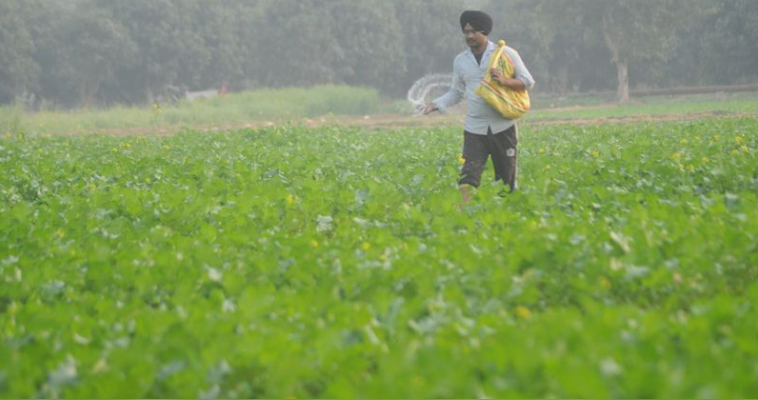
With the area under paddy increasing every year, there is also a corresponding increase in the use of urea, which serves as a crucial fertiliser for the crop.
However, agricultural experts have cautioned the farmers to use urea judiciously, stressing that excessive use increases input costs and adds to environmental pollution.
The area under paddy cultivation in the state stood at 31.79 lakh hectares in 2023-24 and increased by two per cent to 32.43 lakh hectares in 2024-25. The primary cause behind the increase is better availability of water for irrigation.
According to agriculture experts, urea plays a crucial role in ensuring higher yields, when applied judiciously and in recommended doses. They say it enhances productivity, and helps reduce unnecessary input costs and minimise pests and diseases.
However, they say farmers often apply urea in quantities higher than recommended.
“Excessive use of urea increases the cost of cultivation and contributes to environmental pollution. It also makes the crop excessively lush and soft, increasing its susceptibility to lodging under strong winds or heavy rainfall. Moreover, over-application of nitrogen delays crop maturity and can adversely affect the grain quality,” said Ashok Kumar Garg Punjab Agricultural University’s (PAU) Farm Advisory Service Centre.
Using recommended amounts of urea enables farmers to achieve optimal yields while maintaining soil health and reducing production costs, he added.
According to the experts, application of urea should always be guided by soil testing to ensure efficient and balanced nutrient use.
Farmers should get their field soil tested before deciding urea requirement as it helps in applying the right dose of the fertiliser, avoiding deficiency as well excess, added Dr Garg.
The experts said direct sowing of paddy (DSR) and basmati is generally more successful in medium to heavy soils as iron deficiency tends to be more prevalent in sandy soils.
DSR requires comparatively higher nitrogen as compared to transplanted paddy as the crop remains in the main field for its entire growth duration, unlike transplanted rice where the initial growth occurs in the nursery.
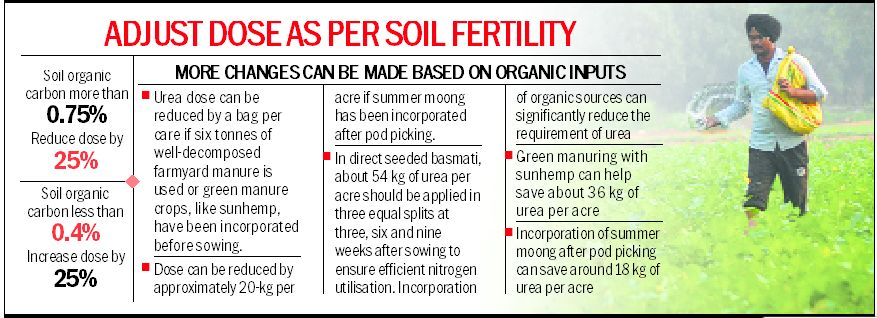
Under normal conditions, about three bags of urea per acre (135 kg) can be applied in equal splits. Experts advise application of first dose at four weeks after sowing, second at six weeks and third dose at nine weeks.
Paddy and basmati are predominantly cultivated by raising seedlings in a nursery and subsequently transplanting them into the main field. Farmers were advised not to apply multiple bags of urea during puddling as it leads to higher nitrogen losses, increased input cost and a higher risk of diseases and lodging.
After incorporation of green manure, application of poultry manure (2.5 tonnes per acre) or press mud (six tonnes per acre), about 55 kg of urea per acre can be saved.
Similarly, incorporation of summer moong residues or application of six tonnes of farmyard manure (FYM), 2.4 tonnes of dry biogas slurry, or two tonnes of stubble char per acre can help save approximately 35 kg of urea per acre, the experts said.
In basmati, no urea application is required if green manure has been incorporated or summer moong residues have been properly mixed into the soil before transplanting.
https://www.tribuneindia.com/news/ludhiana/experts-urge-punjab-farmers-to-exercise-caution-while-using-urea-in-paddy/Published Date: July 20, 2026


 READ
READ