Downloads
 Login
Login
 Register

Tags
Safeguarding rice production as dry season and El Nino loom
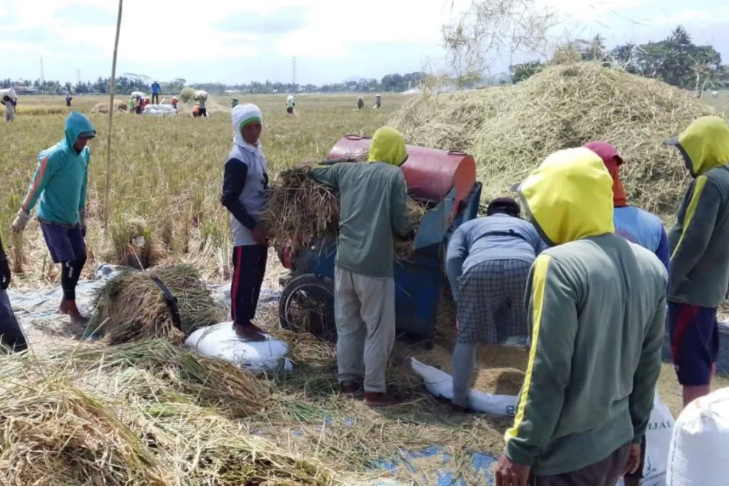
Cilacap, C Java (ANTARA) – While many parts of Indonesia continue to experience rainfall as of April, the looming threats of El Niño and an intensified dry season in 2026 have prompted regional authorities to ramp up preparations.
In Central Java one of the main rice-producing regions in Indonesia, a forecast of a prolonged dry season has triggered the government and farmers to accelerate the planting season and optimize water resources to ensure food production remains stable and secure.
The 2026 dry season is projected to be longer and drier than usual, driven by intensifying El Niño in the Pacific. El Niño is known to suppress rainfall, raise temperatures, and hinder crop growth. With this extended duration, the threat to food security has become a significant concern.
The Meteorology, Climatology, and Geophysics Agency (BMKG) has released its dry season projections as a guide for authorities and farmers.
Teguh Wardoyo, head of the Data Services and Information Dissemination Team at the Tunggul Wulung Meteorological Station in Cilacap, stated that the onset of the dry season in the southern region of Central Java is generally expected in May 2026.
In Cilacap District, the dry season is expected to begin in the second ten-day period of May.
However, southeastern coastal areas, such as Binangun and Nusawungu Sub-districts, are likely to enter the dry season earlier, during the first ten days of May. The season is projected to last between 140 and 180 days, peaking in August.
Banyumas District will see a gradual onset of the dry season. The southeastern region is forecast to enter the dry season in the first ten days of May, followed by the southwest and south in the second ten-day period. Northern and central Banyumas are not expected to enter the dry season until the second ten days of June, with a projected duration of 110 to 180 days.
Meanwhile, in Purbalingga District, the dry season is predicted to begin in its northern areas during the first ten days of June, expanding to the northwest and south by the second ten-day period, with an estimated duration of approximately 120 days.
According to Wardoyo, the key concern for this year’s dry season is that rainfall will fall below the climatological average.
This prediction is different from that of the previous year because in 2025, several southern regions of Central Java even experienced rainfall nearly year-round, without a distinct dry season. However, this year the pattern is reversing, with a shift toward much drier conditions.
On a global scale, the El Niño-Southern Oscillation (ENSO) the interaction between the ocean and atmosphere in the tropical Pacific that drives global climate variations—is currently in a neutral phase with an index of -0.28. However, there is a significant chance for El Niño to develop by the beginning of the second half of 2026.
Similarly, the Indian Ocean Dipole (IOD) a similar phenomenon in the Indian Ocean characterized by sea surface temperature differences between the west (near East Africa) and the east (near Indonesia) is also in a neutral state and is expected to persist through mid-year. Meanwhile, sea surface temperatures in Indonesia are projected to range from normal to slightly warmer, between 0.5 degrees Celsius and 2 degrees Celsius.
The Australian Monsoon is predicted to dominate starting in May 2026, bringing dry air masses to southern Indonesia, including Central Java.
The combination of these factors increases the potential for a prolonged dry season, which could have widespread impacts, particularly on the water-dependent agricultural sector.
Agriculture expert from Jenderal Soedirman University (Unsoed) Prof. Totok Agung Dwi Haryanto noted that the prolonged dry season could put pressure on food production.
“The impact is clear: plants face two main pressures, namely water scarcity and high temperature,” he said.
Water shortages hinder nutrient absorption, while high temperatures accelerate evaporation and worsen plant stress. If not anticipated early, productivity will drop, and the risk of crop failure will rise.
Therefore, comprehensive mitigation is essential, and one of the strategies is accelerating the planting season. By moving up the schedule, crops can still utilize the remaining rainfall before the dry season starts.
To achieve this, nurseries can be established before the first harvest is complete, allowing land to be tilled and replanted immediately without any downtime.
Crop selection is also crucial; drought-tolerant varieties, such as upland rice, can significantly reduce the risks of experiencing losses. In addition, optimizing water resources through the use of retention basins, wells, and pump-based irrigation systems will help farmers maintain a steady water supply.
Nevertheless, this measure requires sufficient energy, thereby necessitating a supportive policy, especially for fuel access and prices.
Furthermore, the irrigation system must also be managed wisely. Thus, channel maintenance and drainage should be carried out selectively to ensure water distribution is not disrupted during critical periods.
In this regard, the Cilacap District Agriculture Office is taking concrete steps to safeguard food production, with planting acceleration serving as a primary strategy.
Sigit Widayanto, the office’s head, stated that accelerating the planting schedule aims to capitalize on remaining rainfall while minimizing the risk of drought during critical growth phases.
Agricultural extension workers are also assisting farmers closely to ensure planting patterns align with the drier climate. On the water management side, the use of retention basins, trench dams, and deep wells along with the expansion of pump and pipe-based irrigation is being continuously optimized.
The management of irrigation networks, from primary down to quaternary levels, is being strictly maintained to ensure water distribution remains effective.
Farmers are also encouraged to use drought-tolerant rice varieties, such as Inpari 46, Cakrabuana, and Respati.
With a rice field area of 67,031 hectares, Cilacap serves as a strategic rice production region for Central Java. In 2025, rice production reached 855,042 tons of dry milled grain equivalent to 507,438 tons of consumable rice maintaining a significant surplus relative to local demand.
This achievement provides a key buffer as the 2026 dry season looms, though vigilance remains essential given the projected limitations in water supply.
The public has been urged to remain alert for extreme weather during the transition from the rainy to the dry season throughout April and May 2026. Intense, short-duration rainfall, lightning, strong winds, and even whirlwinds can occur at any time.
Safeguarding food amid the threat of El Niño is not merely about addressing water limitations; it is about the ability to adapt, strengthen coordination, and maintain a balance between nature and human needs.
As the rice fields slowly dry, hope grows alongside seedlings sown with careful precision. Provided these efforts and collaborations persist, food security is expected to remain resilient, even in the face of a prolonged dry season.
Editor: Rahmad Nasution
Copyright © ANTARA 2026
Published Date: April 15, 2026


 READ
READ