Downloads
 Login
Login
 Register


Tags
Biochar helps rice fields cut greenhouse gases while sustaining yields, new study finds
Biochar Editorial Office, Shenyang Agricultural University
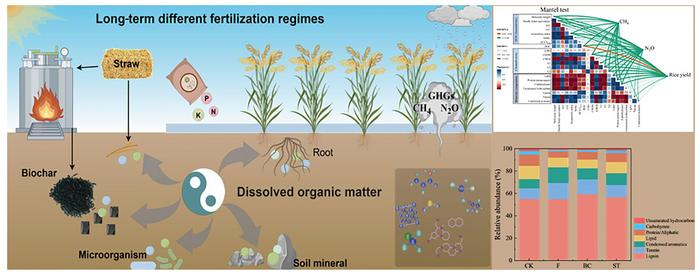
A new long-term field study reveals that adding biochar to rice paddies can significantly reduce greenhouse gas emissions while maintaining or even improving crop yields, offering a promising pathway toward more sustainable agriculture.
“Understanding how soil carbon behaves at the molecular level is key to designing climate-smart farming strategies,” said the study’s corresponding author. “Our results show that biochar can reshape soil chemistry in ways that suppress emissions without sacrificing productivity.”
Rice paddies are a major global source of methane, a potent greenhouse gas. Scientists have long known that farming practices influence these emissions, but the underlying mechanisms have remained unclear. In this study, researchers conducted a multi-year field experiment comparing four fertilization regimes: no fertilizer, chemical fertilizer, straw incorporation, and biochar combined with fertilizer.
The team focused on dissolved organic matter, or DOM, a highly reactive component of soil organic carbon that plays a central role in microbial processes and greenhouse gas production. Using ultrahigh-resolution mass spectrometry, they analyzed how different fertilization strategies altered DOM at the molecular level.
The results revealed that long-term fertilization significantly increased the amount of DOM in paddy soils, with biochar showing the strongest effect. However, not all DOM is equal. Chemical fertilizers increased the diversity and reactivity of DOM, which was associated with higher methane and nitrous oxide emissions. In contrast, biochar shifted DOM toward more stable, complex compounds, particularly lignin-like molecules that are more resistant to decomposition.
This shift in molecular composition had important climate implications. The study found that biochar substantially reduced methane emissions compared with conventional fertilization. Over the growing season, methane emissions under biochar treatment were dramatically lower than those under chemical fertilizer and straw treatments. As a result, the overall global warming potential of the system was significantly reduced.
Nitrous oxide emissions also decreased under biochar, though to a lesser extent. Together, these reductions translated into a lower greenhouse gas emission intensity per unit of rice produced, indicating improved environmental efficiency.
Importantly, these climate benefits did not come at the cost of productivity. Rice yields under biochar treatment increased by more than 13 percent compared with chemical fertilizer alone. This suggests that biochar can simultaneously support food production and climate mitigation goals.
The researchers also uncovered a key link between DOM chemistry and greenhouse gas emissions. They found that unstable, easily degradable compounds in DOM promoted methane and nitrous oxide production, while more persistent compounds suppressed emissions. Biochar favored the accumulation of these stable compounds, effectively limiting the substrates available for gas-producing microbes.
“Our findings highlight that it is not just how much carbon is in the soil, but what kind of carbon,” the authors noted. “By steering soil organic matter toward more stable forms, biochar creates conditions that are less favorable for greenhouse gas generation.”
The study provides new molecular-level insights into how agricultural practices influence soil carbon cycling and climate impacts. It also underscores the potential of biochar as a practical tool for sustainable rice cultivation, particularly in regions where emissions from paddy fields are a major concern.
As global demand for rice continues to grow, balancing productivity with environmental protection will be critical. This research suggests that biochar could play a central role in achieving that balance, helping farmers produce more food while reducing their climate footprint.
The authors conclude that optimizing fertilization strategies, especially through biochar application, offers a viable pathway toward low-emission, high-efficiency agriculture.
Credit: Yuanyuan Sun, Weiming Zhang, Liqun Xiu, Wenqi Gu, Di Wu, Liang Tang & Wenfu Chen
https://www.eurekalert.org/news-releases/1123384Published Date: April 9, 2026


 READ
READ