Downloads
 Login
Login
 Register

Tags
Vietnam doubles low-emission rice target early by cutting adoption risks
By Amanda Lim
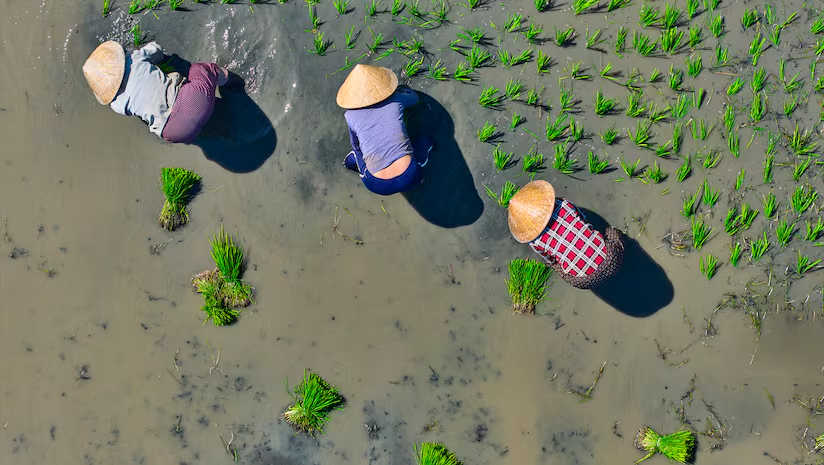
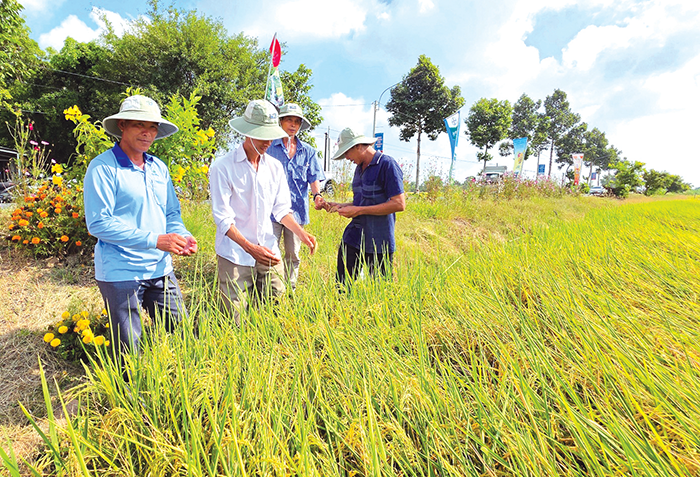
Vietnam has nearly doubled its low-emission rice target as adoption risks reduce for farmers across the Mekong Delta.
The Ministry of Agriculture and Environment (MAE) of Vietnam has reported that its Sustainable Development of One Million Hectares of High-Quality, Low-Emission Rice project has exceeded expectations early.
The flagship rice initiative was built on the Vietnam Sustainable Agriculture Transformation (VnSAT) project.
It initially aimed to cultivate about 180,000 hectares of low emission rice from 2024 to 2025.
However, it expanded much rapidly than expected, reaching over 354,000 hectares by the end of 2025, nearly double of its original target.
Reducing risks
MAE attributed the acceleration to reducing the risk for farmers by guaranteeing off take for all rice produced under the model through contract farming arrangements.
This ensured stable market access for farmers while they adopted improved cultivated techniques on their farms, from mechanised seeding to efficient water management.
This helped ensure that all model fields had reliable irrigation and drainage, reducing climate-related production risks and supporting more consistent yields.
Alongside environmental gains, farmers participating in the low-emission rice models have experienced clear economic benefits.
MAE said average income rose by 13.4%, reflecting improved farming efficiency and stable purchasing commitments from its private sector partners.
A key component of the programme was the development of a Measurement, Reporting and Verification (MRV) system designed to track emissions reductions.
In 2025, Vietnam piloted the MRV process in 11 models, with both technical staff and farmers able to carry out the procedures effectively.
The ministry formalised this progress, paving the way for broader and more confident adoption of low-emission practices.
Economic and environmental gains
The new cultivation methods have reduced emissions by an estimated three to four tonnes of $\text{CO}_2$ equivalent per hectare compared with traditional rice-growing systems.
Together, Vietnam has been able to build its brand of “green rice” brand.
More than 5,000 hectares have already been certified under this label, signalling emerging opportunities for market differentiation and climate-aligned trade.
Looking ahead, the government plans to expand the programme by an additional 800,000 hectares leading up to 2030.
During this phase, the government will work to upgrade production infrastructure.
Six localities have registered for participation following administrative mergers, with An Giang accounting for the largest planned area at about 530,000 hectares, followed by Dong Thap with 190,000 hectares and Tay Ninh with around 140,000 hectares.
https://www.agtechnavigator.com/Article/2026/03/12/vietnam-low-emission-rice-cutting-adoption-risk-accelerates-programme-expansion/Published Date: March 12, 2026


 READ
READ