Downloads
 Login
Login
 Register


Tags
What’s happening to India’s rice output?
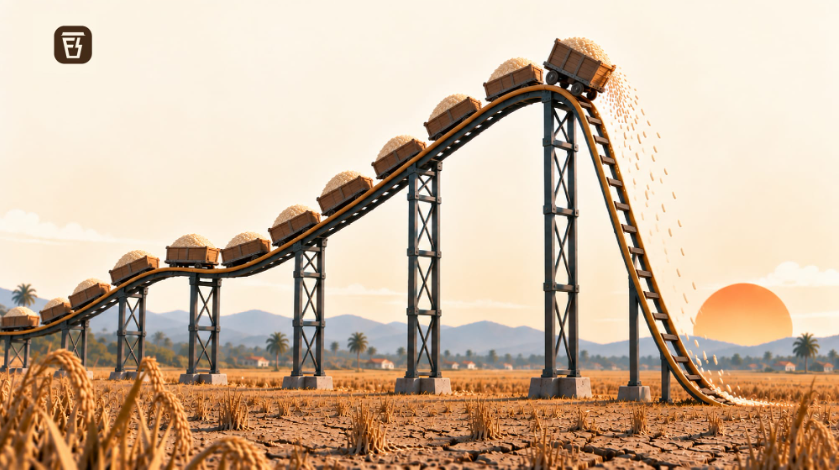
In today’s Finshots, we tell you why India is facing a huge drop in rice output and what that could mean for you and me.
But before we begin, if you’re someone who loves to keep tabs on what’s happening in the world of business and finance, then hit subscribe if you haven’t already. We strip stories off the jargon and deliver crisp financial insights straight to your inbox. Just one mail every morning. Promise!
If you’re already a subscriber or you’re reading this on the app, you can just go ahead and read the story.
The Story
In 2009, India’s rice output fell sharply by 15-18% because of a rainfall deficit and droughts across about a third of the country. That meant lower incomes for farmers, a sharp spike in food inflation, and lower rice exports for countries that depended on India.
And today, almost two decades later, India seems to be facing a similar problem. Rice production this year could fall by about 6.5%, or 10 million tonnes, from last year to around 144 million tonnes. The drop may not look as severe as in 2009-10, but it would still be the biggest fall in rice output since then.
The reason is similar too. As of mid-September, India had received 15% less rainfall than normal since the monsoon began. And the deficit was as high as 42% in some major rice-growing states such as Uttar Pradesh and Jharkhand. This was partly because of El Niño, which can weaken the monsoon. The lack of rainfall delayed the sowing of Kharif rice, the summer crop that accounts for most of our annual rice production. It also meant a smaller area was eventually planted with rice.
And that’s a problem because food inflation could rise further. Non-basmati rice prices have already gone up by more than 10%. And with sugar, onions and cooking oil also getting more expensive, the last thing we need is another staple becoming costlier.
There’s also another problem. Higher rice prices can make Indian rice exports less competitive. That’s because India is the world’s largest rice producer, accounting for over a quarter of global production. And if you remember, in 2023, India banned exports of non-basmati rice because of concerns over domestic supplies. But the government reversed the curbs about a year later after the expected shortage didn’t materialise. India then targeted record rice shipments for FY26.
That flood of supply helped push global rice prices down sharply, by roughly 35% from the previous year, as Indian exports returned alongside strong harvests in other Asian countries. But now, if India’s rice output falls, that trend could reverse. Lower domestic supplies could push Indian prices up and make our exports more expensive just as competing exporters such as Thailand and Vietnam are also seeing higher prices.
But there’s one thing that could ease our worries a little: the amount of rice India already has in stock.
See, the Indian government buys rice from farmers every year at a Minimum Support Price (MSP), regardless of what happens to market prices. This ensures farmers get a minimum price for their produce, even when there is a bumper harvest. The government then stores this rice in warehouses run by the Food Corporation of India (FCI) and distributes it cheaply or for free through ration shops. This is India’s public stockholding system, which is meant to ensure food security.
And right now, the government has around 60 million tonnes of rice in stock. That’s roughly 5-6 times the amount it normally aims to maintain. So technically, we shouldn’t have to worry too much about rice prices rising or Indian rice becoming less competitive globally, right?
Well, not quite. Because there are a few problems.
First, the 60 million tonnes doesn’t consist entirely of rice that can be consumed immediately. It also includes unmilled paddy, which still needs to be processed before it can be consumed or exported. That takes time and costs money.
Second, a large part of this stock is meant for the public distribution system. So traders can’t simply access all of it whenever they want. And even the type of rice may not match what the market needs. The government stock contains different varieties, including basmati, non-basmati, parboiled, coarse and broken rice. These aren’t perfect substitutes when there is a shortage of a particular variety that consumers or exporters want.
A large part of the rice in this stockpile is also being used to produce ethanol, which is then blended into fuel. So even though India has a huge rice stockpile, not all of it is necessarily available for food consumption. And that brings us to a trade-off between food security and lower fuel import bills.
And finally, this may not just be a one-season problem. The issue could spill into the winter sowing season because reservoirs that store monsoon water for winter crops are holding less water than normal. That could reduce the area planted with winter-sown rice as well.
So rice prices may not be immune from rising just because India has a large stockpile. And that could create another unseen problem: higher feed costs.
Broken rice, or the small fragments left behind after milling, is an important input for poultry feed and accounts for around 60-70% of poultry feed input costs in India. So if broken rice becomes more expensive or harder to find, the impact could spread to the prices of eggs, chicken and dairy products too. In other words, a rise in rice prices could fuel food inflation beyond rice itself.
So, is there a way out, you ask?
Well, there are two options.
One is the Open Market Sale Scheme (OMSS), under which the government releases rice into the market for wholesalers, retailers and state governments to increase supply and moderate prices. But to make a meaningful difference, the government would need to release rice in large quantities. And that may not be easy because the type of rice available in government stocks may not match what the market actually needs. Releasing small quantities of the wrong varieties may not do much to bring prices down.
The second option is to temporarily restrict exports again. But that could create its own problems. India was already criticised by other countries for threatening global food security when it imposed the rice export ban in 2023. There’s also an ongoing dispute over India’s rice subsidies, which developed countries argue are unfair. We’ve written about that here. So another export restriction could reopen issues India probably doesn’t want to deal with right now.
So yeah, how India tackles this situation is something we’ll have to wait and see.
https://finshots.in/archive/whats-happening-to-indias-rice-output/Published Date: September 22, 2026



 READ
READ