Downloads
 Login
Login
 Register


Tags
Strong baht squeezes rice exports as prices jump
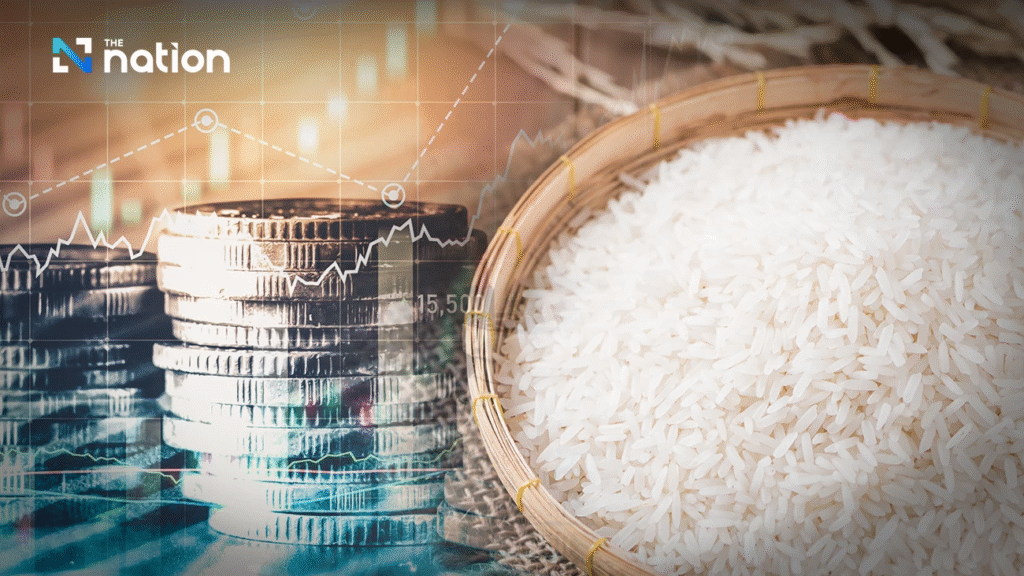
- Every 1-baht rise in the baht pushes Thai rice export prices up by US$15 per tonne, making Thai rice US$50 per tonne more expensive than competitors.
- With Thai rice priced far above rivals, buyers are unwilling to accept the price, leaving exporters barely able to take new orders. Exports in the first quarter of next year are expected to fall.
- A stronger baht directly affects agricultural and food products because they use entirely domestic inputs and have low margins, weakening competitiveness.
- Thai jasmine rice has been hit hard, with prices far higher than Cambodian rivals, causing Thailand to lose market share in key markets such as China and the United States.
The Trade Policy and Strategy Office (TPSO) under the Commerce Ministry reported that exports in November 2025 were worth US$27.445 billion, expanding for a 17th consecutive month at 7.1%. Excluding oil-related products, gold and military supplies, exports rose 11.8%. Imports totalled US$30.172 billion, up 17.6%, resulting in a trade deficit of US$2.726 billion.
Nantapong Chiralerspong, director of the TPSO, said exports were mainly supported by electronics shipments, driven by the upcycle in computers and growth in modern technologies, including AI, keeping industrial exports at a high growth rate.
He said geopolitical issues continue to create uncertainty for trade ahead, with signs of slowdown in major markets such as China, Japan and CLMV. Meanwhile, Thai agricultural exports have contracted due to natural disasters and intense competition in global markets.
For the first 11 months of 2025, exports expanded 12.6%. Excluding oil-related products, gold and military supplies, they rose 13.7%. Imports were valued at US$315.662 billion, up 12.4%, resulting in a trade deficit of US$4.956 billion.
Exports in November 2025, up 7.1%, were driven by industrial goods, which expanded 12.2% for a 20th consecutive month. Key products that grew included computers, equipment and parts; gems and jewellery (excluding gold); telephones and parts; circuit boards; electrical transformers and parts; and switchboards and control panels.
Key products that contracted included automobiles and parts, chemicals and plastic pellets. For the first 11 months of 2025, industrial exports expanded 17.1%.
Export markets
Major markets rose 7.4%, with growth in the United States (37.9%), the European Union (27 countries) (12%) and ASEAN (five countries) (5.7%), but declines in China (7.8%), Japan (8.9%) and CLMV (18%).
Secondary markets rose 7.6%, with growth in South Asia (52.5%), Australia (2.7%) and the United Kingdom (6.5%), but declines in the Middle East (3.6%), Africa (1.9%), Latin America (1%) and Russia/CIS (24.9%). Other markets fell 30.1%.
Thailand–US trade in November 2025 saw exports of US$6.468 billion and imports of US$1.752 billion, leaving a trade surplus with the United States of US$4.716 billion. Over 11 months, Thailand’s trade surplus with the United States totalled US$46.256 billion.
Thailand–China trade in November 2025 saw exports of US$2.781 billion and imports of US$9.447 billion, resulting in a trade deficit of US$6.666 billion. Over 11 months, Thailand’s deficit with China totalled US$60.646 billion.
Farm exports down 15.7% in November
Agricultural and agro-industrial products fell 9.5%. Agricultural products dropped 15.7%, contracting for a fourth consecutive month, while agro-industrial products declined 2.3%, returning to contraction after three months.
Products that expanded included canned and processed fruit, fats and oils from plants and animals, and fresh/chilled/frozen shrimp. Products that contracted included rice, rubber, canned and processed seafood, fresh/chilled/frozen/dried fruit, cassava products, beverages and sugar. For the first 11 months of 2025, agricultural and agro-industrial exports fell 0.7%.
“Exports are still mainly supported by electronics shipments, following the upcycle in computers and growth in modern technologies, including AI, keeping overall industrial exports expanding at a high level,” Nantapong said.
He estimated December exports at around US$25 billion. If exports fall within this range, Thailand’s full-year export value is expected at US$335.707 billion, up 11.6%. If exports reach US$26.5 billion, full-year exports would be US$337.207 billion, up 12.1%.
Farm exports down 4.3% over 11 months
On the baht’s strength, Nantapong acknowledged a direct impact on Thai exports in agriculture and food, which have low margins. Agricultural exports account for about 8% of total exports, and the 11-month figure was still down 4.3%.
He said 2026 export growth is expected to range from -3.1% to 1.1%, slowing due to a weaker global economy and major trading partners. The impact of US tariff measures is becoming clearer, while pricing issues and a stronger baht are hurting competitiveness. Ongoing geopolitical risks and severe weather are also expected to affect agricultural products.
He said in 2026 the Commerce Ministry will focus on concluding reciprocal trade negotiations with the United States, tightening rules of origin, cracking down on nominee businesses, and pushing forward negotiations and utilisation of free trade agreements (FTAs) to gain a trade advantage, in cooperation with the private sector, to drive export growth amid weak demand.
“A 1-baht gain” lifts Thai rice prices by US$15
Chookiat Ophaswongse, honorary president of the Thai Rice Exporters Association, said the baht’s continued appreciation is hurting agricultural exports more than other industries because they use 100% domestic raw materials and do not rely on imported components to offset exchange-rate impacts.
He said that for every 1-baht appreciation, even if domestic prices do not change, exporters must immediately raise FOB prices by US$15 per tonne to cover costs, pushing Thai rice export prices up quickly. Thai 5% white rice is currently priced at US$415–420 per tonne, compared with US$360 for Vietnam, US$350 for India and around US$360 for Pakistan—making Thai rice about US$50 per tonne more expensive than competitors.
“With a price gap like this, you simply can’t sell. Buyers won’t accept it. If the gap is only US$10, you can still explain it on quality. But a US$50 gap means it’s over,” he said. Because prices have risen too quickly, exporters are now barely taking new orders, with current export volumes reflecting old contracts signed earlier. He said exports in the first quarter next year could fall to below 500,000 tonnes per month.
Concern Thai fragrant rice will lose market share
He said higher domestic rice prices earlier—linked to government-to-government (G2G) sales—had already worsened the situation. Combined with a stronger baht, Thai rice competitiveness has clearly weakened and may later pressure domestic prices to fall.
Thai fragrant rice faces a similarly severe problem, with prices as high as US$1,200 per tonne, compared with US$800 for Cambodian fragrant rice. He said Thailand is clearly losing market share, especially in China. Normally, ahead of Lunar New Year on February 17, 2026, Chinese importers would place advance orders, but this year orders from China are very limited, reflecting Thailand’s competitiveness problems in global markets.
“The exchange rate is a factor the private sector cannot control. If the baht stays at the current strong level, even if domestic prices fall, the price gap with competitors will remain. Rice exports will face extreme difficulty going forward,” he said.
Thai rice “too expensive” in the US market
He said the US market is also a concern after Lunar New Year, with Thai rice priced far above competitors. Thai fragrant rice is at US$1,200 per tonne, and a further 19% import tariff pushes the end price up by about US$20, leaving buyers feeling it is “too expensive” compared with rivals.
Rice from Cambodia and Vietnam—especially Vietnam’s ST variety—costs about US$750 per tonne, making the cost comparison clear and increasing the likelihood US importers will switch away from Thai rice.
He said the baht’s sharp and strong appreciation is inevitably hurting rice exports through higher prices and weaker competitiveness.
Chookiat said in the short term the private sector can only watch whether the baht continues to strengthen, as it is outside their control. He said the baht is partly supported by capital inflows, financial-market trading and funds flowing into gold purchases—when exchanged into baht, adding further support for appreciation.
He urged the government to urgently consider concrete measures to stabilise the baht and ease pressure on exports. If the baht remains this strong, even domestic price cuts would not close the gap with competitors, making exports difficult and risking permanent loss of key markets.
He said exporters and farmers using domestic raw materials—especially rice—are among the hardest hit, as global competition is intense. In 2025 Thailand faces competition from India, Indonesia and Vietnam, which have strong rice output and more competitive pricing. If competitors’ currencies weaken relative to the baht, Thailand is immediately disadvantaged and at high risk of losing markets.
SMEs at risk without FX hedging
Visit Limlurcha, vice chairman of the Thai Chamber of Commerce, said most agricultural export orders for 2025 have already been delivered and are awaiting payment. A key issue is whether exporters have hedged exchange-rate risks—especially SMEs, which often do not hedge, raising the risk of losses.
He said exporters quoted prices when the baht was weaker, before it strengthened from 36 baht per US dollar to around 33. Even though exporters should raise prices when the baht strengthens, this year’s market conditions make price hikes nearly impossible due to weaker global demand. If prices are increased, they risk losing the market immediately, forcing exporters to hold prices and absorb losses from the stronger baht.
Economy not as strong as before
Visit said that over the past 4.5 years, the baht initially strengthened on Thailand’s fundamentals—solid economic growth, exports, investment and tourism—supporting a strong current account balance and higher demand for baht, representing a “natural” appreciation.
But in 2025, he said, the economy is not as strong as before. While exports remain positive, they are slowing, and much of the growth is driven by electronics, which rely heavily on imported inputs—limiting the benefit to domestic producers. The clearest impact therefore falls on producers using domestic inputs, especially agriculture and food.
He added that while export volumes may not be hit as much in the near term, baht-converted revenues will fall and losses are possible.
For 2026, he said key products—especially agriculture and food—are expected to have passed the low point and should not be worse than 2025. A minimum growth target of 5% was set as a level that would allow businesses to survive. Meanwhile, products with strong demand—such as electronics and AI-related goods—are expected to grow well as many countries seek these technologies to cut costs and improve competitiveness.
https://www.nationthailand.com/news/general/40060352Published Date: December 27, 2025


 READ
READ