Downloads
 Login
Login
 Register


Tags
Rising heat and pollution threaten rice production in northern states, Bengal stable
Earlier studies have examined how warming and pollution affect rice yields across the country, but the new research used more detailed mapping than previous work to separate their combined effects across the Gangetic plains.
G. S. Mudur
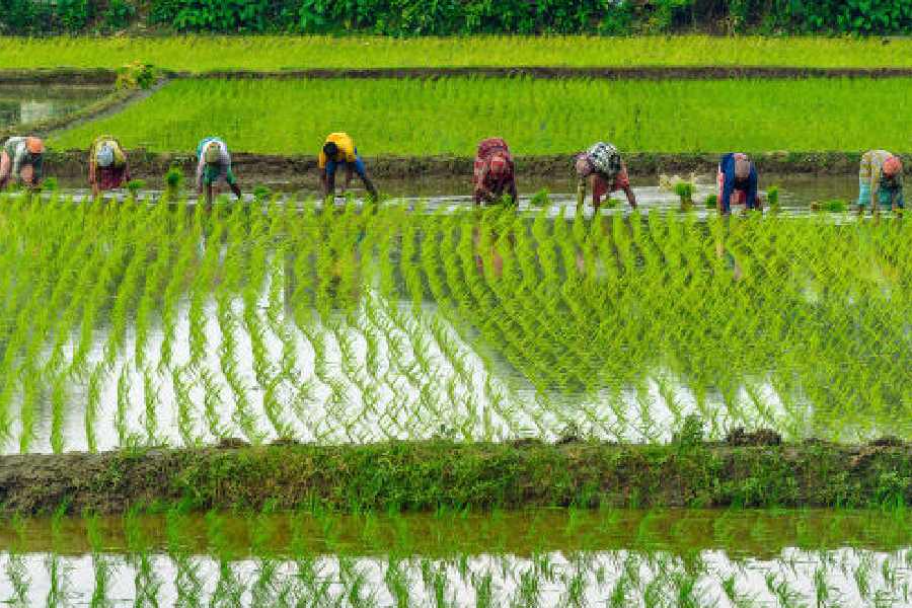
Rising temperatures and air pollution could cut rice yields by up to 75 per cent in parts of Punjab, Haryana and Uttar Pradesh by 2035, while yields in Gangetic Bengal are likely to remain stable, new research suggests.
The findings sharpen long-standing concerns that heat and pollution could disrupt production of rice a staple for a majority of Indians in the northern granary states, leading to greater reliance on eastern regions such as Bengal and increasing pressure on procurement and buffer stocks.
Earlier studies have examined how warming and pollution affect rice yields across the country, but the new research used more detailed mapping than previous work to separate their combined effects across the Gangetic plains.
“The more detailed the mapping, the more clearly we can see where yields are likely to fall and where they might hold,” Prasenjit Acharya, assistant professor and remote sensing specialist at Vidyasagar University in Bengal, who led the study, told The Telegraph.
Acharya and his colleagues found that under projections of rising temperatures and pollution levels, rice yields could drop by 15 to 75 per cent in parts of Punjab, Haryana and western Uttar Pradesh, and by up to 25 per cent in eastern Uttar Pradesh and Bihar by 2035.
Their study has just been published in the journal Science of the Total Environment.
“We’ve taken into account temperature and rainfall, solar radiation, particulate matter, which affects the amount of sunlight reaching the ground, and ground-level ozone, which can slow photosynthesis and reduce yields,” Acharya said.
Scientists have long known that rising temperatures can disrupt rice growth at critical stages.
“When temperatures rise above 33 degrees Celsius during the growing stages, evaporative loss of water can affect growth,” said S. Sreekesh, professor of geography at Jawaharlal Nehru University in New Delhi and a member of the research team.
A decline in rice yields in northern India by 2035 may appear at odds with a steady increase in the country’s overall rice output over decades — from about 2 tonnes per hectare in the 1990s to 4.2 tonnes per hectare in the mid-2020s.
“But amid those overall gains, we may already be seeing signals of change in the northern Indian plains,” Acharya said.
The plains saw a steady increase from about 2 tonnes per hectare at the turn of the century to 2.4 tonnes in 2008. Yields then dipped to a little over 2.2 tonnes in 2010 before fluctuating in the following years — rising to 2.8 in 2012, slipping to 2.6 in 2015, rising again to 3.0 in 2017 and falling to 2.8 in 2018.
“We believe this fluctuation is driven by both weather and air pollution,” Acharya said. “The projected declines could impact prices and the broader economy.”
In contrast, the lower Gangetic plains — mainly Bengal — show little to no decline in rice yields under projected changes in temperature and air pollution.
The relative resilience of Bengal is likely rooted in lower pollution levels and less extreme temperature variation, Sreekesh said, raising the prospect that eastern regions may play a larger role in sustaining rice supplies in the years ahead.
The Vidyasagar-JNU scientists combined weather, air pollution and rice yield data with climate models to project rice output across 500-metre grids in five states under two warming pathways: one leading to 1.6 degrees Celsius, the other to 2.1 degrees Celsius warming by 2050.
A crop scientist not associated with the study said the forecast of a 75 per cent yield decline exceeds past simulations. “Similar exercises have earlier predicted a 2 to 10 per cent decrease,” said Pratap Bhattacharyya, head of crop production, at the Central Rice Research Institute, Cuttack.
But, Bhattacharyya said, the projection of stable yields in Bengal is consistent with the CRRI’s field studies showing rice plants in Odisha are less affected by warming, as kharif crops mature in October-November unlike rabi season rice which matures in April-May in Punjab and Haryana.
He said efforts are underway to develop short-duration, heat-tolerant rice varieties that may help improve resilience to changing climate conditions.
https://www.telegraphindia.com/india/rising-heat-and-pollution-threaten-rice-production-in-northern-states-bengal-stable-prnt/cid/2153731Published Date: March 30, 2026



 READ
READ