Downloads
 Login
 Register


Tags
Rice market: Demand recovers, institutions pave the way for reputable brands.
(Chinhphu.vn) – The consecutive international tender wins and the price surge of specialty fragrant rice varieties are creating strong momentum for Vietnam’s rice exports at the end of the year. In the context of rising domestic procurement costs, improving the efficiency of export quota allocation by prioritizing reputable enterprises is considered a key solution to optimize the value of the supply chain.
Strong signs of recovery from key markets.
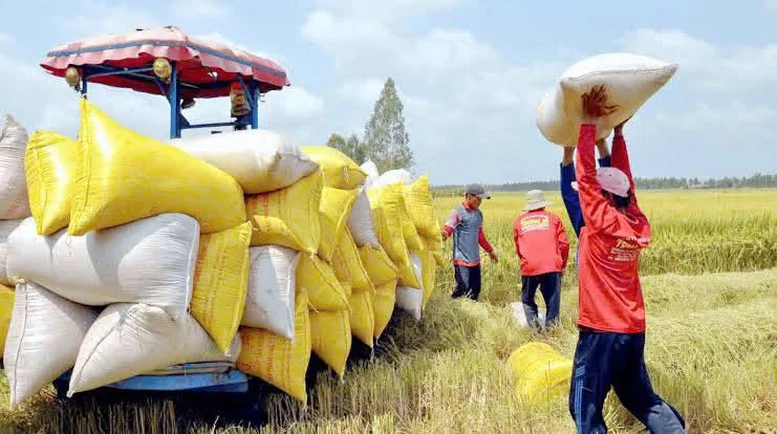
After a period of stagnation, demand for rice imports from Asian countries is increasing again as global rice supplies enter a tight phase at the end of the harvest season.
The most notable signal came from the results of the 8th round of the 2026 rice import tender under the tariff quota (TRQ) organized by South Korea on October 29th. Out of a total of 45,600 tons (out of 60,600 tons offered), Vietnamese rice exporters achieved the biggest victory, winning the bid for 35,000 tons of long-grain broken rice, with transaction prices ranging from 413 to 468 USD/ton.
Vietnam’s impressive bid comes as South Korea faces its fifth consecutive year of declining rice production. According to published figures, South Korea’s 2026 rice production is projected to reach only 3.508 million tons (a 0.9% decrease from the previous year), due to a 1.1% reduction in planted area to a record low of 670,000 hectares as part of the government ‘s crop conversion policy. Although average yields increased slightly by 0.2% (reaching 524 kg/1,000 m²), the prolonged heatwave and drought in July and August resulted in production falling 10,000 tons lower than preliminary forecasts.
After deducting 11,000 hectares under the supply-demand adjustment program, the amount of rice for direct consumption in South Korea is estimated at 3.45 million tons, with the surplus decreasing from 70,000 tons to 60,000 tons. As of November 5th, domestic rice prices in South Korea increased by 0.7% year-on-year, reaching approximately US$42.95 per 20 kg bag. The increased demand for additional food supplies in South Korea has provided significant support for Vietnamese rice exports.
Besides the South Korean market, the recovery in purchasing power from the Philippines , Vietnam’s largest rice consumer market, is also providing further impetus to boost export prices. In November, the Philippines licensed the import of 300,000 tons of rice from Vietnam, marking a strategic shift towards fragrant rice with 25% broken grains instead of the 5% broken white rice of previous years. According to forecasts, the Philippines’ rice import demand in 2027 could reach 5.6 million tons, promising long-term growth potential for Vietnamese rice.
The positive shift in supply and demand has driven a continuous increase in the export price of Vietnamese rice from mid-October to early November.
According to a summary report from the Vietnam Food Association (VFA) and export businesses, the listed price of 5% broken white rice increased from US$440-450/ton on October 15th to US$470-480/ton on October 29th, and reached US$480-490/ton in the first week of November. Thus, in just a few weeks, the price of common export rice increased by approximately US$40/ton, equivalent to an increase of nearly 9%.
The price recovery at the end of the year is significant as it helps improve the overall picture of the rice industry. In the first 10 months of 2026, Vietnam exported 6.8 million tons of rice with a value of US$3.31 billion (a decrease of 4.6% in volume and 9.7% in value compared to the same period last year), with an average export price of US$484/ton (a decrease of 5.4%). The fact that export prices are now on an upward trend is providing a basis for the Vietnam Food Association (VFA) to guide businesses to maintain reasonable export prices, ensuring the interests of both businesses and rice farmers, aiming for a price above US$500/ton.
In parallel with the upward trend in the international market, the purchase price of rice in the domestic market, especially in the Mekong Delta region, has also recorded a sharp increase of 17% to 25% in a short period.
However, the rapid increase in domestic rice purchase prices also poses a significant challenge for rice processing, trading, and distribution businesses. The sudden surge in input material prices puts considerable cost pressure on companies that have already signed export contracts, and also directly impacts the raw material costs of domestic food processing and catering industries.
In light of the complex developments in the global rice market and the need to ensure national food security while developing sustainable exports, the Ministry of Industry and Trade has issued Circular No. 65/2026/TT-BCT detailing some provisions of Government Decree No. 365/2026/ND-CP dated September 23, 2026, on the business of rice export and import.
Some key new points in the operational management include: When two or more traders are designated as key players in a market, a rotational mechanism will be applied. The total amount of rice that key players under the rotational mechanism are allowed to directly export is 20% of the amount of rice in the centralized contract (of which the trader directly signing the contract will execute 2/3 of that 20%, and the remaining 1/3 will be divided equally among the players not participating in the contract). The allocation of rice is linked to the responsibility of coordinating the development of transaction plans, monitoring the market, preparing the supply of goods, and organizing implementation.
The People’s Committee of the province where the business is headquartered will directly review and compile a list of businesses that meet the conditions. Based on this, the Ministry of Industry and Trade will coordinate with the Ministry of Agriculture and Environment to decide on the allocation of entrusted quotas.
Traders who fail to meet their allocated quotas must report in writing the returned portion within 3 days of receiving notification from the local authorities. The returned or unfulfilled amount will be reallocated by the Ministry of Industry and Trade to the main traders. Notably, from January 1, 2028, the mechanism for evaluating the creditworthiness of traders will officially be implemented, whereby the allocation of quotas will gradually decrease among creditworthiness groups.
Looking ahead, Vietnam’s rice export market faces both significant opportunities and systemic challenges.
In terms of opportunities, demand for food in traditional markets such as the Philippines and South Korea continues to remain high. The quality and brand of Vietnamese rice, especially fragrant and specialty rice varieties, have firmly established themselves in the high-price segment.
In terms of challenges, according to forecasts from the Ministry of Agriculture and Environment, the agricultural sector faces negative impacts from climate change, the risk of drought and saltwater intrusion in the Mekong Delta, and the complex developments of the El Niño phenomenon. In addition, the outlook for world rice prices depends on India ‘s rice export policies and production conditions in major supplying countries.
To maintain sustainable growth, state management agencies and the business community need to focus on implementing a comprehensive set of solutions such as: Ensuring transparency in the allocation of export targets, creating favorable conditions and prioritizing targets for reputable and capable enterprises; Strengthening the linkage between export enterprises, cooperatives, and farmers; Building concentrated raw material areas that meet quality standards, ensuring a balance of interests between procurement, processing, and distribution stages; Promoting market forecasting and closely monitoring the domestic supply and demand balance…
Do Huong
https://www.vietnam.vn/en/thi-truong-gao-luc-cau-phuc-hoi-the-che-mo-duong-cho-thuong-hieu-uy-tinPublished Date: November 20, 2026


 READ