Downloads
 Login
 Register


Tags
Eco-Claims Earn Bigger Premiums Than TAP Labels on Taiwan Rice
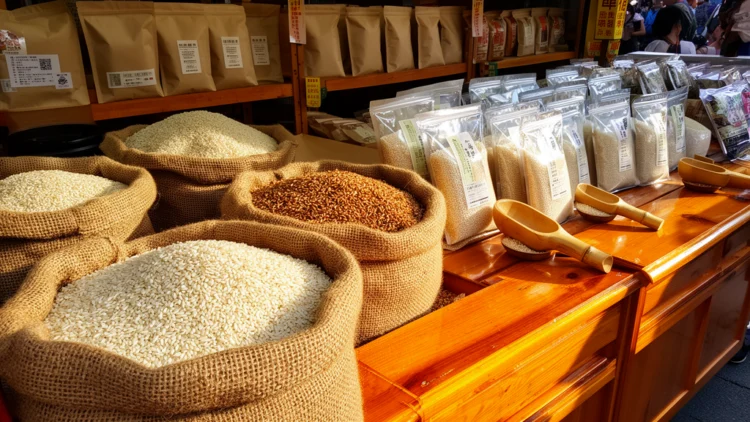
Uncertified ecological wording on packaged rice earned a larger online price premium in Taiwan than the government’s Traceable Agricultural Products (TAP) certification, according to a two-part study of the island’s packaged rice market. The study also found that shoppers view traceable products favourably but do not see them as better value for money. The researchers describe this as a “recognition–reward gap”. It suggests that official verification may struggle to secure a price advantage when many competing labels sit on the same shelf.
How eco-claims compared with TAP certification
The first part of the study analysed retail prices on Momoshop, a major Taiwanese online platform. It tracked twelve top-selling packaged rice products from 2020 to mid-2024, with prices standardised to 1.5-kilogram packages.
A TAP-certified 1.5-kilogram product averaged NT$151.60, almost the same as an uncertified product with ecological claims, which averaged NT$150.73. After adjusting for product attributes, the estimated premiums over products with neither traceability nor ecological markers were:
- Certified organic rice: about NT$72.68
- TAP and ecological claims combined: about NT$45.41
- Ecological claims only: about NT$39.24
- TAP certification only: about NT$18.03
The ecological-only premium exceeded the TAP-only premium by NT$21.22, a gap that was statistically significant at the five percent level.
Consumers value traceability but not as better value
The second part of the study surveyed 1,199 Taiwanese rice purchasers in late 2024. Respondents were 68 percent female, with an average age of 41.17 years and an average monthly income of NT$52,512.
Beliefs about health, environmental responsibility and support for small farmers had the strongest positive influence on consumers’ general attitude toward TAP-labelled rice. Perceived sentiment and self-image also contributed. Shoppers generally saw traceability labels as trustworthy signs of responsible farming.
That goodwill did not carry through to value perceptions. Label awareness was the strongest driver of purchase orientation, followed by overall attitude. Perceived value for money had a negligible and statistically insignificant effect. Overall, 51.3 percent of respondents showed a positive purchase orientation toward TAP-labelled rice.
Several factors were linked to a higher likelihood of a positive orientation:
- Education: Respondents with a university degree were about 29.23 percent more likely to show a positive orientation, and those with a graduate degree about 34.11 percent more likely.
- Label confidence: Respondents who gained confidence from multiple labels were 9.10 percent more likely, and regular QR-code scanners 4.97 percent more likely.
- Grain quality: Respondents who prioritised Chinese National Standards (CNS) grain quality grades under an equal-price scenario were 9.31 percent more likely.
Others were less likely to show a positive orientation:
- Low label attention: 5.83 percent less likely.
- Brand priority: Respondents who prioritised brand identification under the same equal-price scenario were 6.59 percent less likely.
Certification costs and a crowded label environment
The TAP label requires extensive recordkeeping, site assessments and recurring verification fees. Farms under three hectares pay a basic verification fee of NT$22,750 plus an on-site inspection cost of NT$20,350. Operations of three to ten hectares pay an initial verification fee of NT$39,050. Certified farmers can receive annual government subsidies of NT$15,000 per hectare. The study says the overall financial and administrative burden remains substantial compared with unregulated marketing claims.
On supermarket shelves and online, TAP badges sit alongside CNS quality grades, Certified Agricultural Standards (CAS), statutory organic seals, place-of-origin branding, biodiversity narratives and informal phrases such as “ecological coexistence” and “natural farming”. Because rice is a frequently purchased staple and buyers are price-sensitive, the researchers say shoppers often rely on quick heuristics rather than close scrutiny of labels. They call the resulting effect “green signal jamming”: low-cost, weakly verified ecological cues add noise that reduces the distinctiveness of rigorously audited certification.
Study limits and policy implications
The researchers note that the study covers only small-packaged rice, one e-commerce platform and cross-sectional survey data. They conclude that keeping rigorous traceability schemes commercially viable may require stronger regulatory standards for informal green claims, so that verified agricultural standards retain distinct economic value.
https://bioengineer.org/informal-eco-claims-outpace-certified-traceability-premiums-in-taiwan-rice-markets/Published Date: November 20, 2026


 READ