Downloads
 Login
Login
 Register


Tags
Nutrition-rich rice struggles as farmers chase higher yields
Shahadat Hossain
Researchers for integrating high yield with nutrition-rich traits in future rice breeding.
Highlights:
- Farmer abandoned nutrient-rich rice after poor market demand and losses
- 81% of farmers prefer high-yield rice over nutrition traits
- Weak markets discourage cultivation of biofortified rice varieties
- Rice dominates diet, contributing to widespread micronutrient deficiencies
- Zinc-enriched rice grown on only about 1% of farmland
- Experts urge combining high yield with nutrition in breeding
Farmer Mizanur Rahman from Dupchanchia upazila in Bogura cultivated BRRI dhan-84 in 2024, a rice variety enriched with zinc and iron. However, he could not sell it because of the reddish colour of the grain and was eventually forced to sell the harvest at a very low price as poultry feed.
Since then, he has stopped cultivating such nutrient-rich varieties.
Low yields and the absence of a reliable market have prevented nutritionally enhanced rice varieties from gaining popularity among farmers. In Bangladesh, most farmers still prioritise higher yields over nutritional value or climate resilience when selecting new rice varieties.
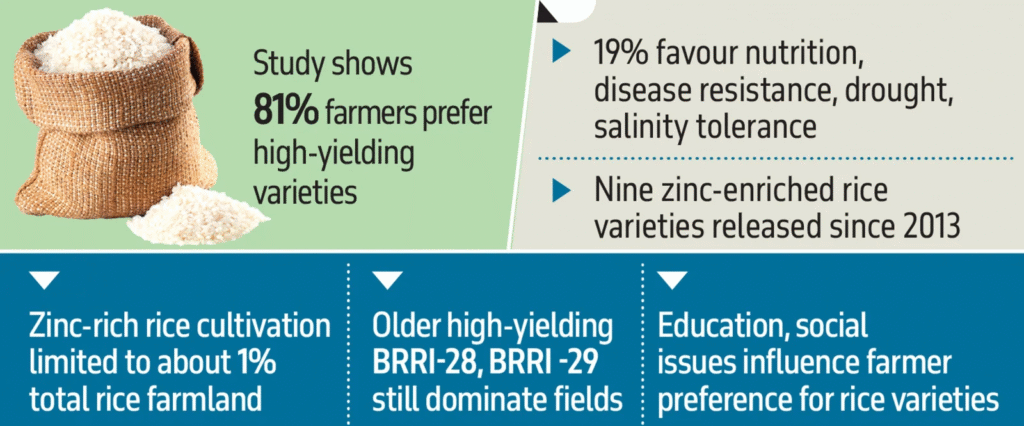
A recent study by the Asian Development Bank Institute (ADBI) found that around 81% of surveyed farmers would favour high-yielding varieties if given the opportunity to adopt new strains.
In contrast, only 19% said they would prioritise traits such as improved nutrition, disease resistance, tolerance to salinity or drought, or reduced requirements for water and fertiliser.
The study was conducted between October and December 2023 across 39 villages in four upazilas of Faridpur district. Researchers analysed data collected from 3,493 farming households.
Farmer Mizanur said he cultivated Jirashail and parboiled rice on 50 bighas of land this season. Last year, he grew BRRI dhan-105, known locally as “diabetic rice”. However, he could not obtain the seed this year.
“When I grew zinc-enriched rice in 2024, shopkeepers returned it because consumers did not recognise its value,” he said. “These varieties are essential for improving nutrition, but farmers incur losses due to weak market demand. If the government promotes them, farmers will adopt them.”
Rice remains Bangladesh’s staple food, accounting for about 63% of daily calorie intake and 48% of protein consumption in 2022. Per capita rice consumption stood at roughly 247 kilograms that year, among the highest levels globally, says the ADBI study.
However, the country’s rice-based diet has contributed to widespread micronutrient deficiencies, often described as “hidden hunger”. The study found that 28% of children under five suffer from stunting, while 36.7% of women of reproductive age are affected by anaemia. It also estimated that between 41% and 57% of women and children face zinc deficiency.
To address these challenges, the government and research institutions have developed several biofortified rice varieties. Since 2013, at least nine zinc-enriched varieties have been released in Bangladesh.
One example is BRRI dhan-100, which contains around 25.7 milligrams of zinc per kg of rice. Besides, several new rice varieties with protein ranging from 8.2% to 10.02% were released during 2023–2024.
Despite these innovations, farmers remain largely dependent on older high-yielding varieties. BRRI dhan-28 and BRRI dhan-29, developed in 1994, are still among the most widely cultivated strains.
Zinc-enriched rice, meanwhile, is grown on only about 1% of the country’s total rice-cultivated land.
The study also found that education and social status influence farmers’ choices. Relatively better-educated farmers show greater interest in nutrition-rich or climate-resilient varieties. Farmers with larger families, more land or ownership of mechanised equipment tend to prefer high-yielding strains.
Researchers concluded that farmers prioritise yield primarily for economic returns and food security. As a result, many newer varieties with improved nutrition or climate tolerance struggle to gain acceptance.
They recommended integrating high yield with enhanced nutritional and climate-resilient traits in future rice breeding programmes. Such an approach could encourage wider adoption while strengthening national food and nutrition security.
Shariful Haque Bhuiyan, director general of the Bangladesh Institute of Nuclear Agriculture, said awareness among farmers and consumers must increase to expand the cultivation of nutrient-rich rice.
“Farmers will naturally consider financial viability,” he said. “We are working with a focus on food security, nutrition security and safe food.”
https://www.tbsnews.net/agriculture/nutrition-rich-rice-struggles-farmers-chase-higher-yields-1388021?ampPublished Date: March 16, 2026


 READ
READ