Downloads
 Login
Login
 Register


Tags
Major grain market reopens in Sindh after stakeholders settle thorny paddy issues
M.B. Kalhoro
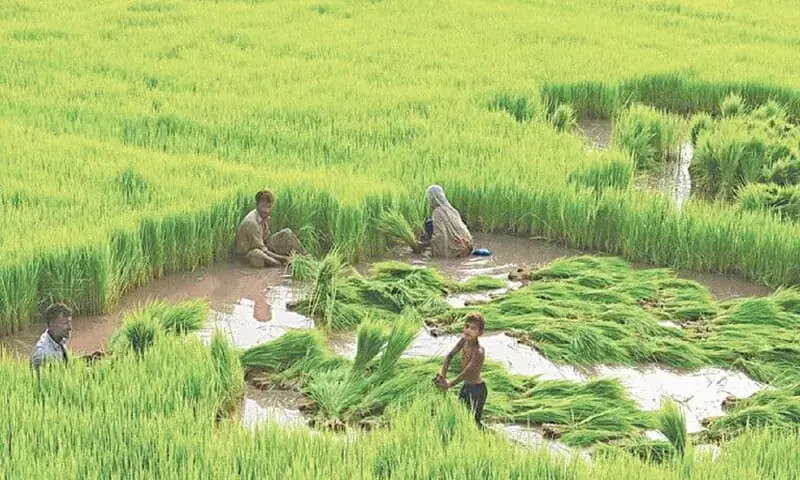
LARKANA: Trading at the major grain market (Anaj Mandi) of Qambar-Shahdadkot district resumed on Monday after weeks-long closure when all stakeholders reached an agreement on a reasonable deduction in paddy crop by rice millers.
While lawmakers of the areas concerned and representatives of rice millers and paddy growers from Sindh and Balochistan were made to negotiate a deal, Qambar-Shahdadkot Deputy Commissioner Imdad Hussain Abro played a vital role in making the whole process a success.
“The most irritant issue of deduction in the paddy crop has been resolved once and for all,” the stakeholders declared at the end of the crucial meeting.
“We have agreed to 65 kilos deduction on 100 maunds of paddy. Hidden taxes have also been slashed,” they said.
Govt slashes ‘hidden’ taxes; farmers and rice millers agree on 65kg deduction per 100 maunds of crop
Speaking to Dawn DC Abro said that an important meeting regarding deductions on paddy and other crops was held in the Darbar Hall of his office on Monday. He said the meeting was chaired by MNA NA-196 Qambar-Shahdadkot-I Khursheed Ahmed Junejo; MPA PS-16 Qambar Sardar Ahmed Khan Chandio (who is also chieftain of the Chandio tribe); and MPA PS-14 Shahdadkot Mir Nadir Ali Khan Magsi; besides him.
“It was a hard task to bring all stakeholders to the negotiation table, but our efforts bore fruit when the elected representatives, leaders of the Sindh Abadgar Board (SAB), Sindh Hari Ittehad (a nascent entity) and Sindh Balochistan Rice Millers and Traders Association sat together and openly discussed the issue to resolve it once and for all,” the DC said.
‘Hidden taxes’ was a big issue as the levy ranged from Rs18 to Rs20 per kg was the key hindrance, coupled with the deduction issue, the DC said. These taxes had always affected growers and by discontinuing these charges, abadgars would be benefited. They cultivate crops amidst increased rates of agricultural inputs. When growers and rice millers distanced due to the disputes, the situation resulted in the closure of Anaj Mandi and all trading activities came to a grinding halt, the DC pointed out.
There are a round 140 rice mills functioning in this district and a huge load of paddy comes from the adjoining parts of Balochistan, said DC Abro. Therefore, he added, Shahdadkot is the hub of rice trade for Sindh and Balochistan.
Expressing his happiness over the agreement, he said it’s the first example in the province where all stakeholders sat together and decided to remove all the obstacles and barriers to encourage trading activities at the Mandi. This, in turn, would give a boost to all economic activities in the region, he added.
Ishaque Mughiri, a former president of SAB’s Qambar-Shahdadkot chapter who participated in the talks, clarified that the agreed upon deduction of 65 kilos on every 100 maunds will be applicable across the district. “No other type of deduction will be allowed,” he said.
“A fine thing that transpired from the negotiations is that this formula will be applicable on both Kharif and Rabi (rice, wheat and other) crops,” he said, and added that its benefits would trickle down to growers without undermining millers’ interest.
He said that rice is the backbone of the regional economy and a major export commodity, contributing more than US$3.9 billion annually to the national exchequer. He said the Larkana division contributes nearly Rs90 billion annually from rice production. In Shahdadkot alone, there are around 16,000 registered workers associated with 150 rice mills. With the resumption of trading at Anaj Mandi, daily wage earners in a huge number are engaged again in their livelihood. Growers are also at ease to sell their produce.
Asad Tunio, the General Secretary of the Sindh Balochistan Rice Millers and Traders Association, speaking to Dawn, termed the agreement a ‘good omen’. He said that around 400 rice mills functioning in Qambar-Shahdadkot district which had stopped procurement due to the dispute over the deduction issue have started purchasing paddy.
He said that 4,000 to 5,000 daily wage earners were engaged in these mills during the season. “We were insisting on the deduction on account of moisture measured through the standard meter, as is globally practised, but the growers were not accepting it,” he said. Finally, it was unanimously decided to fix the deduction at 1.625 kilos per 40kg, which comes to 65kilos per 100 maunds, he said.
Published in Dawn, December 2nd, 2025
https://www.dawn.com/news/1958586/major-grain-market-reopens-in-sindh-after-stakeholders-settle-thorny-paddy-issuesPublished Date: December 2, 2025


 READ
READ