Downloads
 Login
Login
 Register


Tags
Indonesia’s Rice Production Predicted to Reach 35.6 Million Tons, UGM Expert Cites Need for Technology and Adaptive Irrigation
By: Salma

The Food and Agriculture Organization (FAO), in its latest Food Outlook Biannual Report on Global Food Markets in June 2025, projects that Indonesia’s rice production will reach 35.6 million tons during the 2025/2026 planting season.
Responding to this prediction, Professor Subejo of the Faculty of Agriculture at Universitas Gadjah Mada views this achievement as a positive signal, but it still requires a long-term strategy based on science and technology.
“The high production this year is due to several factors, including a relatively conducive climate. Two years prior, rain only came in February. But this year, rainfall has been sufficient since the end of the year, so the area of land that can be planted has increased,” Professor Subejo said on Thursday (Jul. 10) at the UGM campus.
The professor in agricultural extension and communication notes that rice production data from 2019 to May 2024 shows this year as among the highest in the last seven years.
However, when compared to 2018, production at that time was actually higher.
Besides climatic factors, the government’s purchasing price policy (HPP) for harvested dry paddy at Rp6,500 per kilogram also provides economic incentives for farmers to increase production.
Stable prices and guaranteed absorption of harvests by Bulog create a sense of security for farmers in managing their farming businesses.
“High paddy prices indeed benefit farmers, but it will automatically trigger an increase in rice prices in the market. This is an economic law,” Professor Subejo stated.
He added, “If not intervened through processing efficiency, rice prices could surge beyond the highest retail price.”
According to Professor Subejo, efficiency and technological innovation in the post-harvest stage are very important.
The use of modern technology in the drying, milling, and distribution processes of rice is expected to reduce final production costs.
Agricultural mechanization and the introduction of smart farming, such as the use of high-tech drying and milling machines, can improve rice quality while reducing yield loss.
Additionally, he said, innovations like solar-powered dryers or renewable energy-based processing systems can be long-term solutions to significantly reduce operational costs.
Furthermore, Professor Subejo explained that despite a 4.5 percent increase in production volume, Indonesia still faces challenges in land productivity.
The national average productivity is still around 5.2 tons per hectare, lagging behind countries like Vietnam and Thailand, which have reached 6 tons per hectare.
This indicates that Indonesia still has room to improve the efficiency and effectiveness of its rice cultivation system.
“Besides providing adequate water continuously, choosing suitable rice varieties, assisting technical production, and selecting appropriate pest control methods, there is still room for development,” Professor Subejo said.
Facing the dry season, one recommended strategy is the development of cost-effective and environmentally friendly alternative irrigation systems.
Micro reservoirs, for example, such simple infrastructures do not require large investments but can have a significant impact on land productivity in rainfed or dry areas.
UGM itself has developed adaptive rice varieties like GAMAGORA, designed to thrive in rainfed areas with lower water requirements.
This variety is one innovation expected to keep production stable amid the threat of drought due to climate change.
In addition, Professor Subejo said, the use of solar-powered water pumps is an option that can be applied to areas with abundant water sources but minimal irrigation infrastructure.
By using renewable energy, operational costs can be reduced, and dependence on fossil fuels can be minimized.
The solar-powered pumping program is expected to be a pilot project that can be replicated in various rice production centers in Indonesia.
“These overall efforts might be carried out by coordinating through cross-sectoral policies involving relevant ministries so that they can be gradually implemented in various regions,” Professor Subejo concluded.
Author: Lintang Andwyna
Editor: Gusti Grehenson
Post-editor: Afifudin Baliya
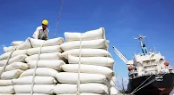
Illustration: Freepik.com
https://ugm.ac.id/en/news/indonesias-rice-production-predicted-to-reach-35-6-million-tons-ugm-expert-cites-need-for-technology-and-adaptive-irrigation/Published Date: July 14, 2025



 READ
READ