Downloads
 Login
 Register


Tags
From Rice Fields to a US$514 Billion Economy: Vietnam’s Remarkable Transformation — and the Investment Opportunity Ahead
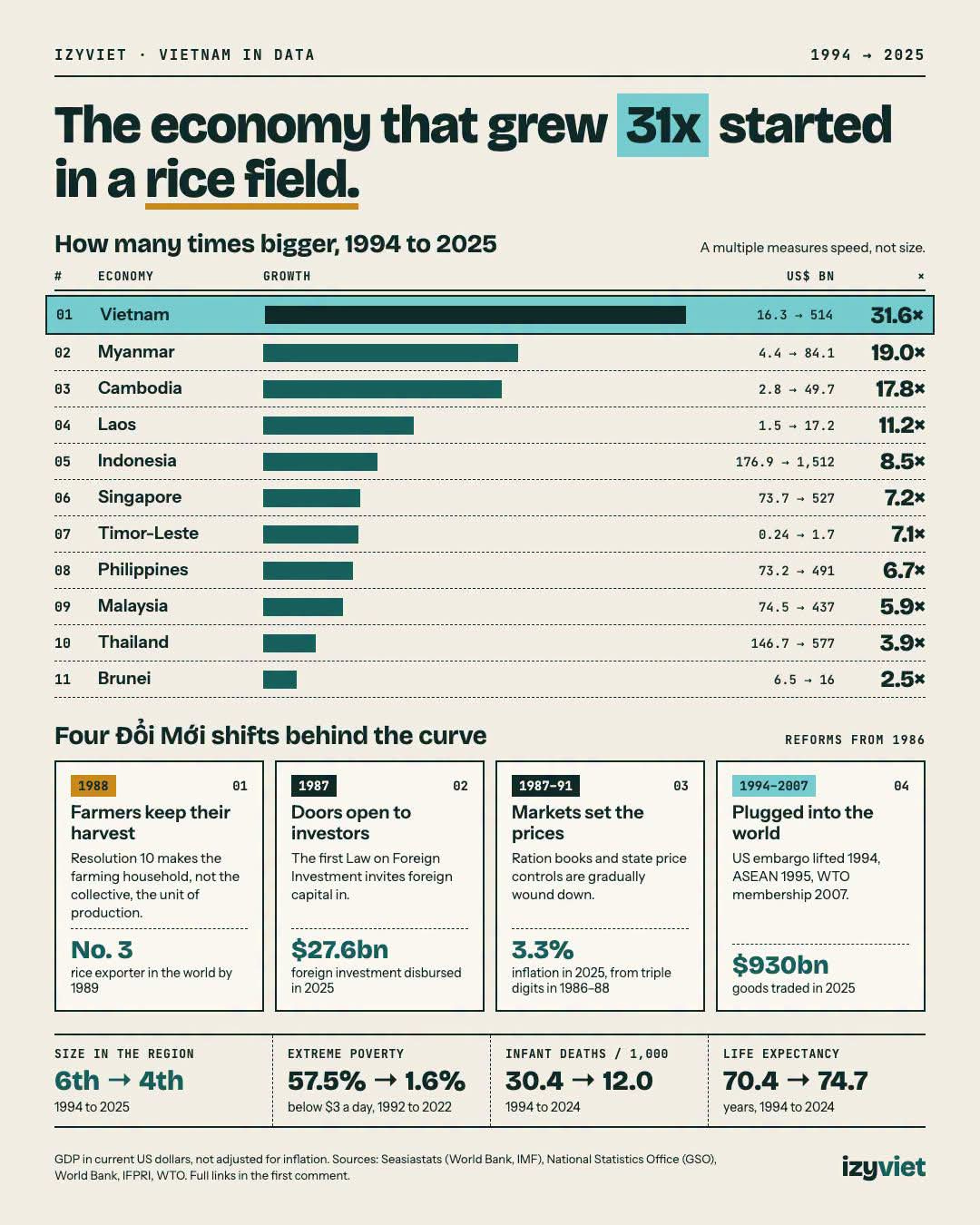
In 1986, Vietnam was battling triple-digit inflation, with prices rising by several hundred percent a year. The country was struggling to feed its people, importing more than 460,000 tonnes of food in 1987 and 1988 to cover domestic shortages.
Then came a remarkable turnaround.
In 1989, Vietnam exported 1.4 million tonnes of rice, becoming the world’s third-largest rice exporter. A country that had struggled to feed itself was beginning to emerge as a major force in global agriculture.
That was only the beginning.
The Đổi Mới reforms, launched in 1986, gradually transformed Vietnam by giving farmers greater control over production, opening the door to foreign investment, allowing markets to play a greater role in setting prices, and connecting the country to the global economy.
The results over the following decades have been extraordinary.
- 31.6× economic growth: Vietnam’s nominal GDP expanded from US$16.3 billion in 1994 to US$514 billion in 2025.
- US$930 billion in goods traded in 2025, reflecting the country’s deep integration into the global economy.
- US$27.6 billion in foreign investment disbursed in 2025.
- Extreme poverty fell from 57.5% to 1.6% between 1992 and 2022, measured against the US$3-a-day poverty line.
- Life expectancy increased from 70.4 years in 1994 to 74.7 years in 2024.
But Vietnam’s story is no longer just about economic development. It is increasingly becoming an investment story.
Corporate earnings are growing rapidly
Data sourced from S&P Global Market Intelligence show that Vietnam’s publicly listed companies have delivered substantial growth over the past decade.
Across 704 listed companies, from November 11, 2016, through October 26, 2026:
- 24.1% annual earnings growth
- 17.1% annual revenue growth
- 19.7% annual growth in total market value
These figures tell an important story. Listed companies have been expanding their businesses and growing their earnings, while aggregate market value has risen alongside that growth.
For long-term investors, corporate earnings matter because they represent the economic engine behind shareholder returns. Over time, companies that sustainably increase their earnings can create substantial value for their owners.
Vietnam leads the region in forecast earnings growth and ROE
The outlook is equally compelling. According to Bloomberg consensus estimates, Vietnam is forecast to deliver 42.3% earnings-per-share (EPS) growth in 2026, the highest in the region.
Vietnam also leads the region in forecast return on equity (ROE), at 15.0%.
These two measures offer complementary insights. EPS growth indicates how quickly earnings attributable to each share are expected to increase, while ROE measures how effectively companies generate profits from shareholders’ equity.
Together, the forecasts point to a market with strong expected earnings momentum and comparatively attractive profitability. Forecasts are not guarantees, of course, but they provide another reason for investors to look more closely at Vietnam.
And the stock market still looks inexpensive
Despite a decade of strong corporate growth, Vietnam’s stock market remains attractively priced by its historical standards.
As of October 26, 2026, the market traded at 12.2 times aggregate earnings, compared with its 10-year average of 15.9 times earnings.
That is approximately 23% below its historical average valuation.
In other words, investors are paying less for each unit of aggregate corporate earnings than they have, on average, over the past decade.
This does not guarantee that share prices will rise, nor does a lower valuation automatically make every listed company a good investment. But the combination of strong historical earnings growth, the region’s highest forecast EPS growth and ROE, and a market valuation below its historical average deserves attention.
The next chapter of Vietnam’s story
Vietnam’s transformation offers a powerful lesson: a country’s economic future can look very different from its past.
The reforms that helped turn food shortages into rice exports laid the groundwork for decades of industrialization, foreign investment, and integration into global trade. Today, the country has a US$514 billion economy and a listed corporate sector that has delivered strong earnings growth.
For investors willing to think like business owners rather than short-term traders, the opportunity is to identify companies capable of turning Vietnam’s continued development into sustained earnings growth.
The journey from rice fields to a global manufacturing and investment destination took decades. With strong corporate earnings growth, leading regional forecasts for 2026 profitability, and a stock market trading below its historical average valuation, Vietnam deserves a closer look from long-term investors.
Sources: IzyViet – Vietnam in Data; World Bank, IMF, and other sources cited in the accompanying infographic; S&P Global Market Intelligence for listed-company earnings, revenue, market value and valuation data; Bloomberg consensus estimates for 2026 EPS growth and ROE. Figures and calculations are based on the periods stated above.
https://theinternationalinvestor.substack.com/p/from-rice-fields-to-a-us514-billionPublished Date: October 28, 2026


 READ