Downloads
 Login
Login
 Register


Tags
Chhattisgarh strengthens the ‘Rice Bowl’, secures farmers’ future
By An Dwivedi
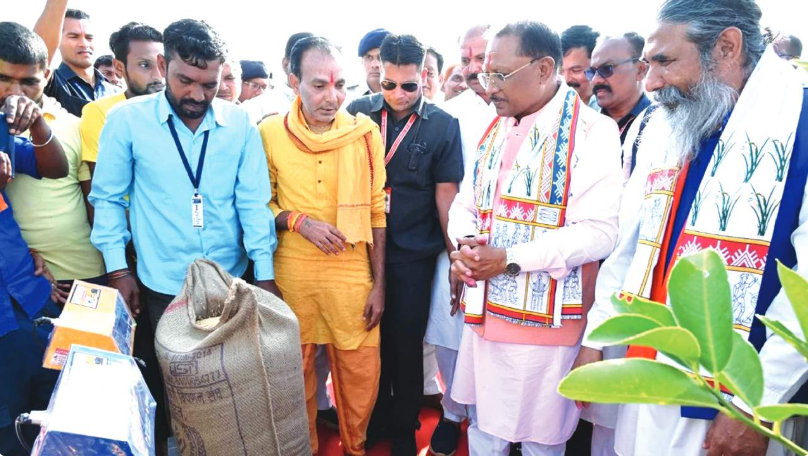
At a time when agrarian distress continues to dominate political debates across India, Chhattisgarh has chosen action over rhetoric. Under Chief Minister Vishnu Deo Sai, the state has demonstrated what it truly means to put farmers first — not through symbolic gestures, but through decisive financial commitments and structural reforms that directly strengthen rural incomes. The announcement of nearly Rs 10,000 crore in direct transfers to about 2.5 million farmers under the Krishak Unnati Yojana is not just another welfare measure. It is a bold reaffirmation that agriculture remains the foundation of Chhattisgarh’s economy.
By ensuring that farmers receive Rs 3,100 per quintal for paddy — one of the highest effective procurement rates in the country — the Government has sent a powerful message: the producer will not be left at the mercy of volatile markets. For a state where nearly 80 percent of farming households are small and marginal, this assurance of income stability is transformative. It shields vulnerable farmers from price shocks, strengthens their bargaining power, and injects unprecedented liquidity into rural markets.
In the latest procurement season alone, more than 14 million metric tonnes of paddy were purchased at support price, with payments exceeding Rs 33,000 crore. In the Kaharif year 2024-25, the state had procured 149 lakh metric tones of paddy and total of Rs 31,089 crore were disbursed to the 25.49 lakh farmers. That scale is not accidental — it reflects a system that is functioning efficiently and with intent. Critics may question the fiscal sustainability of such high procurement prices. But this criticism misses the larger economic logic.
Money placed directly in farmers’ hands does not sit idle — it circulates. It finances consumption, boosts local businesses, creates employment, and stimulates rural demand. In an economy where domestic consumption drives growth, empowering the rural sector is not populism; it is sound macroeconomic strategy. Moreover, the state’s agricultural push is not limited to procurement bonuses. The Government has cleared pending bonus arrears worth over Rs 3,700 crore, provided zero-interest short-term agricultural loans up to Rs 5 lakh, and distributed nearly Rs 7,000 crore in interest-free credit during the 2024 kharif season alone.
These measures reduce dependence on informal lenders and encourage investment in better inputs and modern farming practices. Equally significant is the proposed reform of the Agricultural Produce Market Act. By facilitating easier participation of traders through the national e-NAM platform, Chhattisgarh is not retreating into a protectionist procurement model. Instead, it is expanding market access and strengthening price discovery mechanisms. The state understands that long-term farmer prosperity requires both assured income and competitive markets. The results speak for themselves.
Chhattisgarh is among the leading contributors of rice to the Central Pool and has consistently ranked at the top in procurement numbers. Its agricultural identity — the “Rice Bowl of Central India” — is not a slogan but an economic reality supported by policy choices. Of course, challenges remain. Irrigation coverage still needs expansion, and diversification beyond paddy will be crucial for ecological balance and long-term sustainability. But these are next-stage reforms — and they are far easier to implement when farmers are financially secure. Income stability creates the confidence required to adopt new crops, technologies, and practices.
Too often, agricultural debates in India become trapped in ideological arguments about subsidies versus reforms. Chhattisgarh’s model offers a pragmatic alternative: combine assured price support, timely payments, affordable credit, and market reforms. It is not an either-or approach; it is a comprehensive framework that recognises the realities of rural India. Importantly, this strategy also carries a moral dimension. Farmers are not merely economic actors; they are the backbone of food security.
Ensuring remunerative prices for their produce is not charity — it is justice. When Governments prioritise corporate incentives without equal urgency for primary producers, imbalance grows. Chhattisgarh’s policy direction corrects that imbalance. In political terms, the Government has taken a calculated but confident step. It has aligned itself unapologetically with the agrarian majority. In economic terms, it has invested in the most reliable engine of rural growth. And in social terms, it has reinforced dignity and stability for millions of households.
The true test, of course, will be continuity. Sustained investment in irrigation, storage, agro-processing, and diversification must complement procurement support. But with its current trajectory, Chhattisgarh is not merely responding to immediate pressures — it is shaping a long-term rural growth narrative. In an era where many states hesitate between fiscal caution and farmer welfare, Chhattisgarh has chosen clarity. It has placed its bet squarely on the farmer. If the momentum continues, this model could well become a benchmark for agrarian policy across India — proof that when Governments back their farmers decisively, the entire economy stands taller.
Author is Editor of The Pioneer, Raipur Edition
https://dailypioneer.com/news/chhattisgarh-strengthens-the-rice-bowl-secures-farmers-futurePublished Date: February 13, 2026



 READ
READ