Downloads
 Login
 Register


Tags
CBOT Rough Rice Futures Ease as Asian FOB Prices Hold Firm
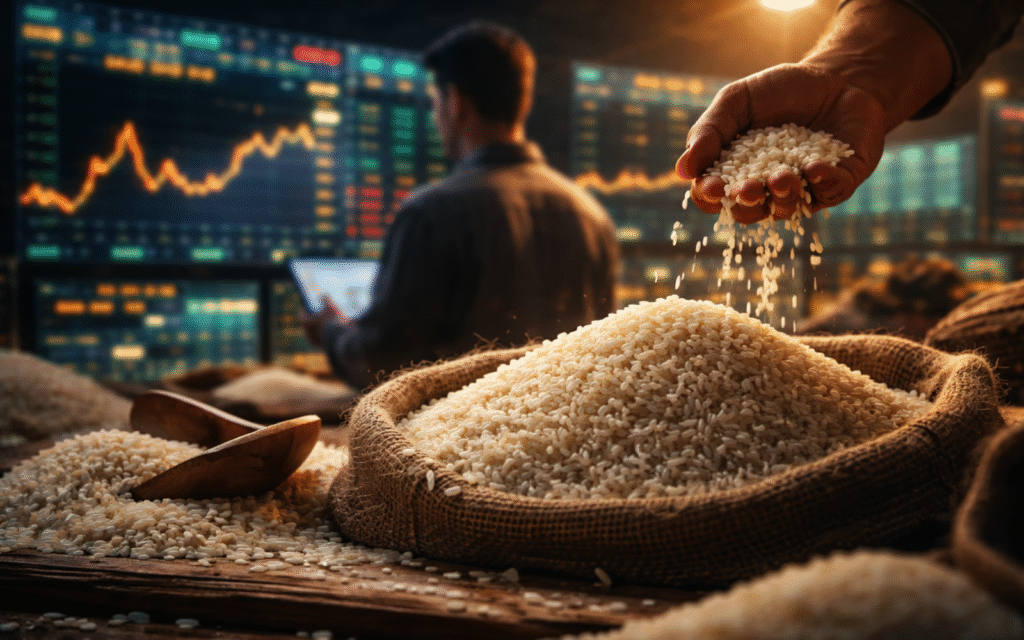
CBOT rough rice futures edged lower this week after recent highs, while FOB export quotations from India and Vietnam stayed broadly steady. Benchmark rough rice futures traded near USD 18.27/cwt on November 19, 2026. The global rice balance remains relatively tight, but no acute new supply shock has emerged in mid-November.
CBOT rough rice futures: modest losses across the 2027 strip
Contracts across the 2027 strip posted small day-on-day declines:
- January 2027: about USD 18.28/cwt, down 0.12, or 0.63%
- March 2027: about USD 18.72/cwt, down 0.10, or 0.56%
- May and July 2027: USD 19.12–19.18/cwt, with marginal gains
- September and November 2027: USD 16.40–16.45/cwt, essentially flat
The curve slopes down from mid-2027 onward, with a clear drop in the late-2027 contracts. Volumes and open interest remain moderate, which suggests large participants have not yet repositioned aggressively.
Commitments of Traders data as of November 10, 2026 show large speculators modestly net long in rough rice, at roughly 4,500 contracts and only slightly higher than the previous week. Commercial participants are net short.
Asian FOB prices unchanged
The latest physical indications, last updated on November 13, 2026, were unchanged from the previous reading for India (New Delhi, FOB) and Vietnam (Hanoi, FOB):
- India, all golden sella: EUR 0.87/kg
- India, 1121 steam: EUR 0.77/kg
- India, PR11 steam: EUR 0.39/kg
- Vietnam, long white 5%: EUR 0.34/kg
- Vietnam, jasmine: EUR 0.36/kg
- Vietnam, Japonica: EUR 0.45/kg
The stable physical quotations suggest the softness in futures so far reflects technical selling and position adjustments rather than a clear downturn in export values.
India’s export policy and Vietnam’s demand
Global balances for 2026/27 remain relatively tight. Recent USDA updates point to reduced Indian exports and slightly softer import requirements in parts of South Asia and West Africa, which tempers but does not remove the tightness.
India adjusted its rice export policy conditions again in early November. The government is monitoring domestic stocks and prices, and traders, millers and large retailers are required to report rice and paddy inventories. The measures aim to keep domestic food inflation in check while allowing selected exports, particularly basmati, under tighter oversight.
In Vietnam, firm demand from the Philippines and other regional buyers is supporting export quotations for broken fragrant and jasmine rice. Domestic trading in the Mekong Delta is described as slow, which suggests the support for export prices is coming from external demand rather than local tightness.
Weather outlook: El Niño remains in focus
A strengthening El Niño and a positive Indian Ocean Dipole are expected to persist through at least November 2026, before gradually weakening into early 2027. So far, no major new crop shock has emerged in the main Asian rice belts. Rainfall deficits and distribution risks for late-planted or off-season crops are still being monitored, and the main market effect for now is on sentiment rather than realised crop loss.
https://commodity-board.com/rice-futures-ease-but-physical-fob-market-holds-firm-in-asiaPublished Date: November 20, 2026


 READ