Downloads
 Login
Login
 Register


Tags
Authorities Race to Save Rice Crops as El Niño Drought Hits Seven Provinces
By: Phoeurng Phearak
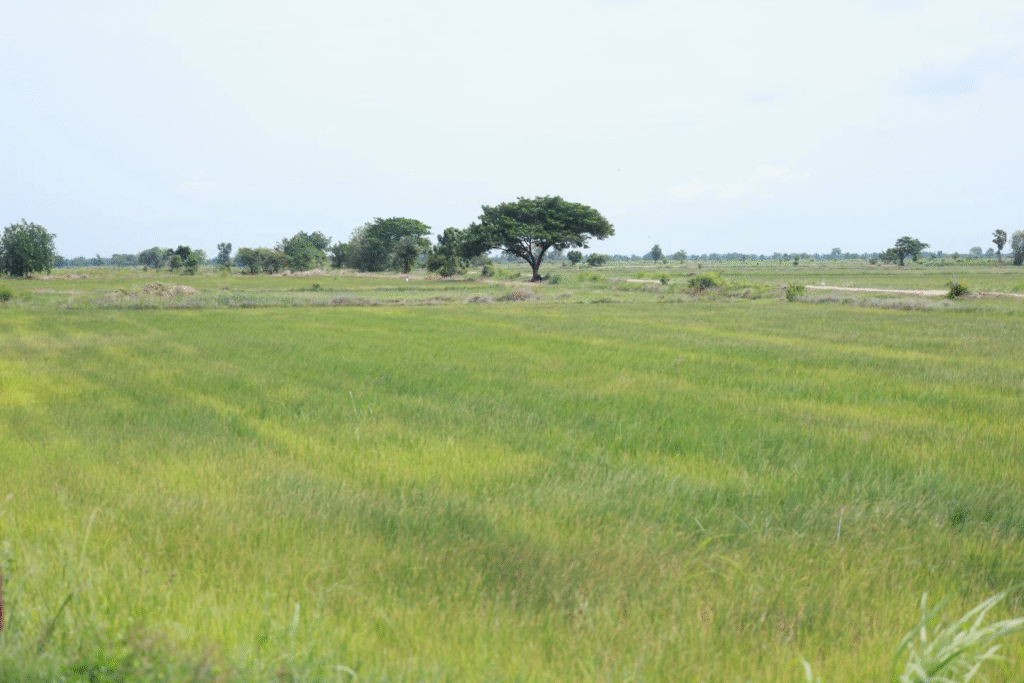
PHNOM PENH – More than 180,000 hectares of rice fields in seven provinces have been hit by drought caused by the El Nino phenomenon. Authorities are ready to respond but efforts are hampered because some farming communities are far from water sources and there is limited irrigation infrastructure.
As of July 20, drought had affected 180,663 hectares of rice fields in Banteay Meanchey, Battambang 62,554 hectares, Kampong Thom 191 hectares, Siem Reap 19,503 hectares, Ratanakiri 4,200 hectares, Kampong Cham 63 hectares and Pursat 19,360 hectares, said Soth Kimkolmony, spokesperson for the National Committee for Disaster Management (NCDM).
Kimkolmony said El Nino has significantly reduced rainfall during the rainy season while water stored in reservoirs from the previous dry season is insufficient.
“Rain has been unevenly distributed. Many farming areas are experiencing water shortages and drought affecting agricultural crops,” he said.
Despite the widespread impact, Kimkolmony said authorities have intervened in many affected areas by pumping water to rice fields, meaning most crops have not yet suffered permanent damage.
He added that the government continues to monitor conditions and provide emergency assistance, although some farming communities are far from water sources.
Farmers Face Financial Pressure
The drought is creating mounting pressure on farmers, many of whom rely almost entirely on rain to grow rice.
Theng Savoeun, president of the Coalition of Cambodian Farmer Community (CCFC), said climate change is making drought more frequent and severe, leaving farming households increasingly vulnerable.
“Most Cambodian farmers depend on rain-fed agriculture. When rainfall is delayed or insufficient, they face serious difficulties because many have borrowed money from banks to buy seeds, fertilizer and fuel,” he said.
If rice crops fail, farmers often have to replant, doubling their production costs while still carrying existing debt, he added.
Savoeun called on authorities to expand emergency irrigation efforts by deploying large-scale water pumps, provide replacement rice seed to farmers whose crops have died, and work with financial institutions to ease loan repayments during the crisis.
He also urged the government to consider fuel subsidies for farmers, saying rising fuel prices have further increased costs.
Beyond immediate assistance, Savoeun said farmers need greater education on climate adaptation so they can better cope with increasingly unpredictable weather.

“Many farmers still lack sufficient knowledge about climate change and adaptation. They are facing pressure from crop losses, debt and changing weather patterns all at once,” he said.
In Battambang province, where some of the country’s largest rice-growing areas are, farmers say conditions have become increasingly desperate.
Dy Pakna, a 57-year-old farmer from Thmei village, cultivates three rice varieties, including phka malis, romduol and srongae sral across 10ha.
“This year is different from previous years. Normally by June there is already enough water for planting, but this season there has been very little rain,” he said.
Pakna said he borrowed money from a bank and spends about $2,000 each year on rice production, while some of his rice has already started to wither.
“If there is no rain within another 10 days, most of the crop could die unless authorities can bring water in time,” he said.
If the crop is lost, he hopes the government will provide replacement rice seed because many farmers cannot afford to buy seed and start over.
He also urged authorities to improve irrigation canals and water storage systems to better prepare for future droughts.
On July 21, Minister of Water Resources and Meteorology Thor Chetha said the ministry has deployed large-capacity water pumps to several provinces to help deliver water to drought-hit farming areas.
In response to this emergency, the ministry has prepared equipment in advance to respond to drought conditions.
This includes about 115 large-capacity water pumps and nearly 400 intervention machines stationed across the provinces, all of which have been repaired and made ready for deployment to drought-prone areas.
The ministry is also working with local authorities and institutions to provide technical support, issue weather and drought warnings, and coordinate emergency responses.
Chetha acknowledged that helping remote communities is challenging because some affected areas are far from reliable water sources.
“We recognize that some provinces still lack sufficient water sources. The ministry will continue developing new reservoirs and water infrastructure so more water can be stored for areas that frequently face shortages,” he said.
The ministry has also urged local authorities and residents to use water efficiently while preparing for the possibility that El Nino conditions could continue affecting parts of Cambodia in the coming weeks.
The seven provincial departments of Water Resources and Meteorology have also issued drought advisories following the continued development of the El Nino phenomenon.
The warnings, which are in effect from July 20 to Aug. 10 2027, show that rainfall in affected provinces is expected to remain below the long-term average, increasing the risk of water shortages and drought ranging from mild to severe.
Rebekah Bell, the UN Food and Agriculture Organization (FAO) representative in Cambodia, acknowledge that the country is among the Southeast Asian nations most vulnerable to El Nino-related agricultural drought because of its heavy reliance on rain-fed farming and limited irrigation.
Bell said Cambodia’s latest agrometeorological outlook forecasts hotter and drier than normal conditions, with below-average rainfall and longer dry spells during the peak rainy season from July to September.
She warned that prolonged dry conditions and uneven rainfall could reduce rice production, affect livestock and fisheries, and threaten the livelihoods of smallholder farmers.
https://cambodianess.com/article/authorities-race-to-save-rice-crops-as-el-nino-drought-hits-seven-provincesPublished Date: July 23, 2026


 READ
READ