Downloads
 Login
 Register


Tags
Telangana Rice Prices Surge 65%, Exposing a Broken Market Link
By Urban Acres
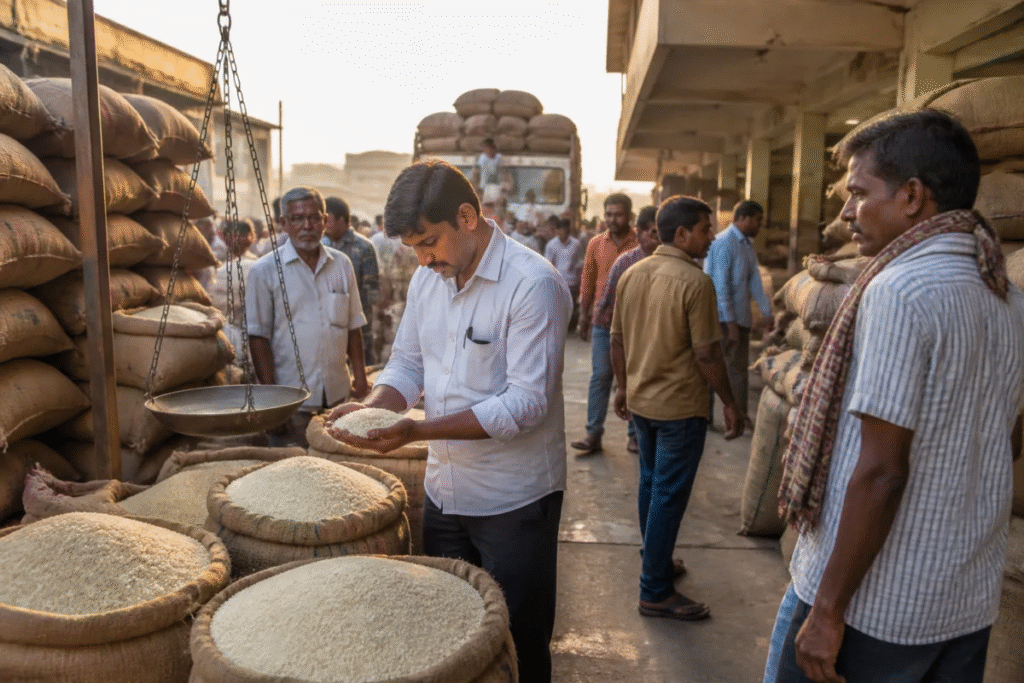
Telangana rice prices have risen sharply even as the state remains one of India’s largest paddy producers, revealing how agricultural surplus does not automatically translate into affordable food for urban households. Wholesale Sona rice prices increased 65.4% year-on-year, from Rs 2,068 per quintal in October 2025 to Rs 3,419 in October 2026, while rice inflation in the state reached 13% in September.
The price rise places Telangana’s food economy at the intersection of production, procurement, storage, transport, trading and household consumption. A state may produce large quantities of paddy and still see consumers pay more if grain does not move through markets efficiently, if stocks are limited at particular points in the supply chain, or if trading practices amplify volatility. The available data does not establish one definitive cause, but it shows that the link between farm output and retail affordability is under strain.
That distinction matters in Telangana because rice is a primary food grain for millions of households. The state is also part of a southern Indian region that includes Andhra Pradesh and Karnataka, all of which are major rice-consuming markets. When wholesale prices rise, the effect is not limited to traders or mills. It reaches household budgets through monthly grocery bills, particularly for families that depend on rice as a staple and have limited flexibility to substitute other foods.
The reported price movement was not a single, uninterrupted increase. Union department of consumer affairs data cited in the report shows that wholesale Sona rice prices were relatively stable through the middle of 2025. The price stood at Rs 1,990 per quintal in June and Rs 1,953 in July, before increasing to Rs 2,063 in September and Rs 2,068 in October.
The increase accelerated towards the end of 2025. Prices rose to Rs 2,475 per quintal in November and Rs 2,677 in December. They then fell to Rs 2,599 in January 2026, Rs 2,325 in February and Rs 1,970 in March. The decline suggested that the market was capable of moving in the opposite direction, but it did not last. Prices rebounded to Rs 2,166 in April, Rs 2,386 in May and Rs 2,724 in June, eventually reaching Rs 3,419 in October. The cited series does not contain data for August and September.
This pattern complicates any simple explanation based only on production. Prices fell during the first quarter of 2026 and then rose steeply over the following months. That makes market arrivals, stock positions and the timing of procurement and trading important areas for examination. The supplied report does not provide a complete account of inventories, arrivals or mill-level transactions, so it cannot determine how much each factor contributed to the escalation.
The gap between production and affordability is a recurring institutional problem in agricultural markets. Paddy is produced at one point, processed into rice elsewhere and then distributed through a network of markets, wholesalers, retailers and public or private channels. Each stage depends on infrastructure, information and bargaining power. If connectivity between markets is weak or price information is delayed, local conditions can create sharp differences between what farmers receive and what consumers pay.
A policy paper from Professor Jayashankar Telangana Agricultural University, titled ‘Price Behaviour, Market Infrastructure and Farmers’ Awareness on APMC Act in Telangana’, identified exploitative trading practices as a major constraint in agricultural marketing. Samarendu Mohanty, a co-author of the paper, said the price trajectory in Telangana differed from that in some other rice-producing states. Odisha, he noted, recorded a good kharif crop, but rice prices there had not increased as sharply as in Telangana.
The comparison does not by itself prove that Telangana’s markets are being manipulated, nor does it establish that Odisha’s market arrangements are directly transferable to the state. It does, however, underline why production figures alone are insufficient to understand food prices. Two regions can have strong harvests and experience different consumer outcomes because their market infrastructure, storage systems, transport links, procurement channels and trading practices function differently.
The policy paper recommended strengthening market infrastructure and improving connectivity among key agricultural markets to reduce price volatility. It also proposed real-time price information through agricultural universities and market intelligence centres. These recommendations address two separate weaknesses. Better infrastructure can reduce delays and transaction costs, while timely information can improve the ability of farmers, traders and administrators to respond to price changes.
The administrative challenge is that these responsibilities are spread across several parts of the agricultural market system. Market yards, procurement agencies, agricultural departments, universities, traders and distribution networks each influence how grain moves. A price surge may therefore require more than a single intervention. Authorities would need to understand where supply is accumulating, where it is constrained and how prices are being transmitted between production centres and consuming markets.
The available evidence also points to uncertainty around weather-related influences. Experts cited in the report said El Niño-linked uncertainty may be affecting production expectations and market sentiment. Its role in the current price rise, however, still needs to be assessed alongside supply trends, stock positions and the functioning of agricultural markets. That qualification is important: expectations about future supply can affect present prices, but the report does not establish the scale of this effect in Telangana.
For households, the distinction between a temporary market movement and a structural failure is less immediate than the monthly cost. Sama Chandrika Reddy, a Hyderabad resident, said her family of six requires at least 25 kg of rice each month and that rising prices were adding considerably to household bills. Her account illustrates how a wholesale change becomes a recurring expenditure for urban consumers.
The data therefore presents two parallel stories. Telangana continues to be associated with substantial paddy production, while the state’s consumers face a steep increase in the price of a basic staple. The first describes agricultural output; the second describes the performance of the food distribution system. Treating the two as equivalent risks overlooking the infrastructure and market institutions that connect farms to kitchens.
The next question for policymakers is not simply whether Telangana has enough paddy, but whether grain is arriving, stored, processed and traded in a way that protects both farm incomes and consumer affordability. The reported recommendations on market connectivity, infrastructure and real-time information provide a framework for that inquiry. What remains unresolved in the supplied evidence is the precise contribution of arrivals, stocks, weather expectations and trading practices to the October price level.
The immediate development to monitor is whether the Rs 3,419-per-quintal price recorded in October represents a continuing trend or another temporary peak. That will depend on subsequent market data, stock information and evidence from the agencies and institutions responsible for agricultural marketing in Telangana.
https://urbanacres.in/telangana-rice-prices-surge-65-exposing-a-broken-market-link/Published Date: October 21, 2026


 READ