Downloads
 Login
Login
 Register

Tags
Rice production falls by 250,000 tonnes
The Rising Nepal
By Ajay Shah, Mahottari, Oct. 12: Nepal’s rice production has declined by more than 250,000 metric tonnes in a year, adding to the challenge of achieving rice self-sufficiency as both the area under cultivation and productivity continue to decline.
Against this backdrop, research efforts have intensified to develop new rice varieties that offer higher yields, mature faster, and can withstand floods, droughts, and changing weather conditions.
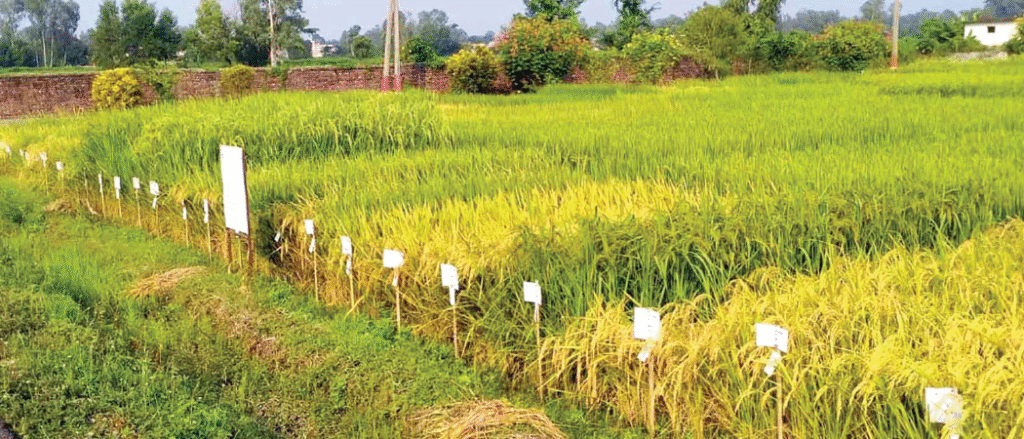
The National Rice Research Programme, Hardinath, based in Sapahi, Dhanusha, under the Nepal Agricultural Research Council (NARC), has been developing, testing and recommending new rice varieties based on farmers’ needs and the climatic conditions of different geographical regions.
However, researchers say the expected results have not been achieved due to inadequate promotion of recommended varieties and limited access to quality seeds.
According to the Ministry of Agriculture and Livestock Development, rice was cultivated on 1,376,872 hectares in Nepal in fiscal year 2025/26, producing 5,705,126 metric tonnes. In the previous fiscal year, rice production stood at 5,955,476 metric tonnes from 1,420,636 hectares.
Within a year, the area under rice cultivation decreased by 43,764 hectares, while production fell by 250,350 metric tonnes. Productivity also declined from 4.19 metric tonnes per hectare to 4.14 metric tonnes. Although Madhes Province is a major rice-producing region, production has been affected by a lack of irrigation, irregular monsoon rainfall, delayed transplantation, inadequate supplies of quality seeds and fertilisers, and limited use of modern technology.
Researchers say climate change has also increased the risks of drought, waterlogging, floods and abnormal temperatures.
Rabindra Prasad Sah, spokesperson and senior technical officer at the National Rice Research Programme, said several varieties had been recommended based on farmers’ needs and production conditions. Major varieties include Hardinath-1, Hardinath-6, Bahuguni-2, Chaite-5, Ramdhan, Samba Mansuli Sub-1 and Hardinath Hybrid-1.
Hardinath-1 matures in around 110 to 115 days and can produce more than four metric tonnes per hectare. According to the research programme, Chaite-5 can yield around 4.6 metric tonnes per hectare, while Hardinath-6 can produce approximately 5.21 metric tonnes.
Similarly, Bahuguni-2, which can tolerate flooding and drought during the reproductive stage, has a yield potential of around 5.8 metric tonnes per hectare. Hardinath Hybrid-1 can produce up to 6.47 metric tonnes per hectare.
Mathura Yadav, chief of the research programme, said the benefits of years of research had yet to reach farmers’ fields because the recommended varieties were not being adopted on a sufficient scale.
“Even a high-yielding variety such as Hardinath-6 has not been adequately promoted. Farmers have been unable to adopt new varieties because seeds are not readily available,” he said.
According to the research programme, around 99 rice varieties have been recommended so far. Sah said farmers should select varieties based on their field conditions, irrigation facilities, weather and market demand.
While high-yielding varieties can increase production, varieties such as Basmati, Lalka Basmati and Kalanamak, which are valued for their distinctive flavour and quality, generally have comparatively lower yields, he said.
Researchers say Gangasagar-1 and Gangasagar-2 may be suitable for areas prone to waterlogging and flooding, while Hardinath-1 and Chaite-5 are suitable options for spring rice cultivation.
They have also recommended that farmers focus on irrigation, balanced fertiliser application, pest and disease management, and mechanisation to increase production even on limited land. The research centre at Hardinath conducts variety trials and research on around 15 bighas of its approximately 65-bigha premises. After evaluating the yield and quality of different varieties at the centre, researchers also conduct trials in farmers’ fields before recommending suitable varieties. Seven scientists are involved in rice-related research and experimental work.
According to researchers, future efforts should focus not only on developing high-yielding varieties but also on varieties that require less water and can withstand climate-related risks.
Producing quality foundation seeds, ensuring timely distribution, strengthening promotion and providing technical advice are equally important to make research outcomes accessible to farmers, they said.
Developing new varieties alone is not enough to increase agricultural production. Research findings can translate into higher yields only when farmers have timely access to quality seeds and can adopt technologies suited to their fields and local weather conditions.
The Rising Nepal
https://risingnepaldaily.com/news/87702Published Date: October 12, 2026


 READ
READ