Downloads
 Login
Login
 Register

Tags
Bringing technology to the fields: Efficiency is the measure of success.
Drones, autonomous vehicles, and data management platforms are opening up new production methods in agriculture. However, technology only truly proves its value when it is suited to farming conditions, helping farmers reduce costs, improve efficiency, and use resources rationally. This is also a key issue raised by experts and businesses when discussing the digital transformation of agriculture in Tay Ninh.
Báo Tây Ninh
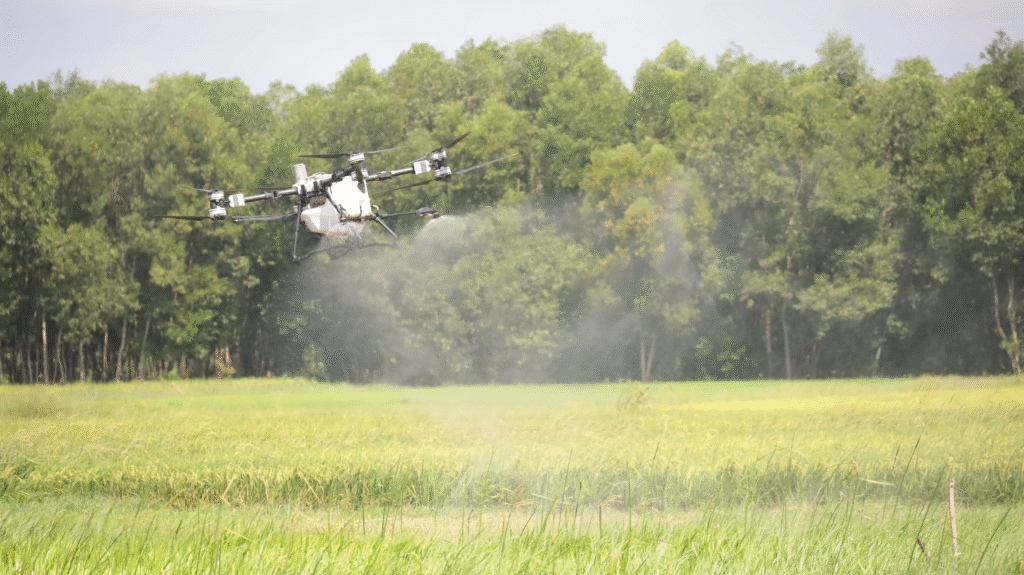
Airplanes spraying pesticides over rice fields.
From modern equipment to practical needs
Digital transformation is creating more opportunities to innovate agricultural production methods. Tasks that previously relied heavily on manual labor, experience, and time can now be supported by machinery, data, and automated control systems.
Within the framework of the 2026 Tay Ninh Province Science, Technology, Innovation and Digital Transformation Festival, many businesses presented solutions for applying drones in pesticide spraying and farming.

Mr. Nguyen Huu Thang, Director of 2TECH Agricultural Drone Company, said that the DJI Agras drones introduced by the company at the event aim to meet the needs of mechanization, especially in the context of increasing agricultural labor shortages. The application of agricultural drones can reduce labor costs, limit direct contact with pesticides, and improve the organization of production processes on large areas.
Besides equipment, the company also focuses on developing its distribution, warranty, and technical support systems. This is essential because agricultural aircraft require users to be instructed on operation, maintenance, and troubleshooting during operation.
Joining in the presentation of technological solutions, Truong Thinh Trading – Technical Co., Ltd. (Truong Thinh Drone) showcased agricultural drones with different payload capacities, suitable for the cultivation needs of various crops.
Mr. Phan Huy Thuy, Deputy Director of Truong Thinh Drone, said that in addition to agricultural drones, the company is also researching and developing autonomous equipment for production, including seed sowing vehicles that can create maps, operational plans, and determine the amount of seeds to use based on the area.
These devices demonstrate a trend towards mechanization that is gradually shifting from replacing manual labor to assisting producers in controlling technical parameters. However, introducing technology into the fields cannot stop at simply equipping with new equipment. It is crucial to correctly identify the needs, investment capabilities, and practical effectiveness for each production region.

According to former Vice Chairman of the National Assembly and former Minister of Agriculture and Rural Development Le Minh Hoan, the application of technology in agriculture should stem from the actual needs of farmers, aiming to reduce costs, save labor, and improve production efficiency.
A sensor device is only truly valuable when it helps water at the right time; electronic logs must support production management and meet buyer requirements; artificial intelligence needs to help detect anomalies, support decision-making, and reduce costly experiments.
Use the right techniques to avoid waste.
One of the key issues when applying agricultural drones is that their effectiveness depends not only on power, capacity, or operating speed, but also on how they are used.
According to Mr. Phan Huy Thuy, Deputy Director of Truong Thinh Drone, since the early years of introducing drones into agriculture, the company has focused on researching operating parameters to reduce water usage, agricultural supplies, time, and labor. However, in practical use, not all operators utilize the equipment according to the appropriate parameters.
Mr. Thuy mentioned that some people still maintain the habit of using large amounts of water for spraying, while the service provider wants to increase the flight speed to cover a larger area. When the parameters are not suitable, the spraying efficiency can decrease, causing material waste and environmental impact.
This is a matter of concern because an aircraft’s high payload capacity does not necessarily mean it must utilize the maximum amount of water or supplies in all situations.

For pesticide spraying operations, the selection of water volume, height, air velocity, and spraying method must be based on the crop type, growth stage, pesticide characteristics, and technical requirements. Saving water during spraying does not mean arbitrarily reducing the dosage of pesticides compared to the instructions. If only service productivity is prioritized while neglecting work quality, the advantages of technology may not be fully realized.
This experience shows that agricultural mechanization needs to be accompanied by workforce training, technology transfer, and the development of appropriate usage procedures. Operators must understand the characteristics of the equipment, farming conditions, safety requirements, and related regulations.

Bringing technology closer to farmers.
Besides technical efficiency, farmers’ accessibility is one of the determining factors in whether technology application can be sustained and scaled up.
Agricultural drones and autonomous vehicles can help reduce labor and increase productivity. However, investment costs, technical requirements, and maintenance also present challenges, especially for small-scale producers.
Not every farming household has the means to invest in expensive equipment. Therefore, in addition to direct ownership, developing mechanization services and applying technology through businesses, cooperatives, or service providers is a direction that needs attention.
Based on practical experience, Mr. Nguyen Huu Thang, Director of 2TECH Agricultural Aircraft Co., Ltd., stated that the company is developing its distribution and technical support network, aiming to expand its service capabilities to users in many areas. Warranty, repair, and operational support are considered crucial factors to ensure people feel confident in using the equipment.
Meanwhile, Mr. Phan Huy Thuy argued that, along with introducing new equipment to the market, businesses need to focus on guiding users in selecting appropriate operating parameters. This is because the effectiveness of technology is not only determined when purchasing the equipment but also depends on how it is utilized throughout the production process.

For cooperatives, organizing shared or interconnected mechanization services can help consolidate needs, reduce the investment pressure on individual households, and facilitate the adoption of standardized technical procedures.
However, for these models to be effective, coordination is needed between technology providers, service organizations, and producers. In this coordination, service quality, usage costs, and technical support capabilities must be prioritized.
Evaluating the effectiveness of technology application should be based on production costs, work quality, material savings, labor time, and benefits for the people. The important thing is not only to bring technology to farmers but also to help them use it correctly, exploit it effectively, and adapt it to their actual production conditions.
https://www.vietnam.vn/en/dua-cong-nghe-vao-dong-ruong-hieu-qua-moi-la-thuoc-doPublished Date: October 12, 2026


 READ
READ